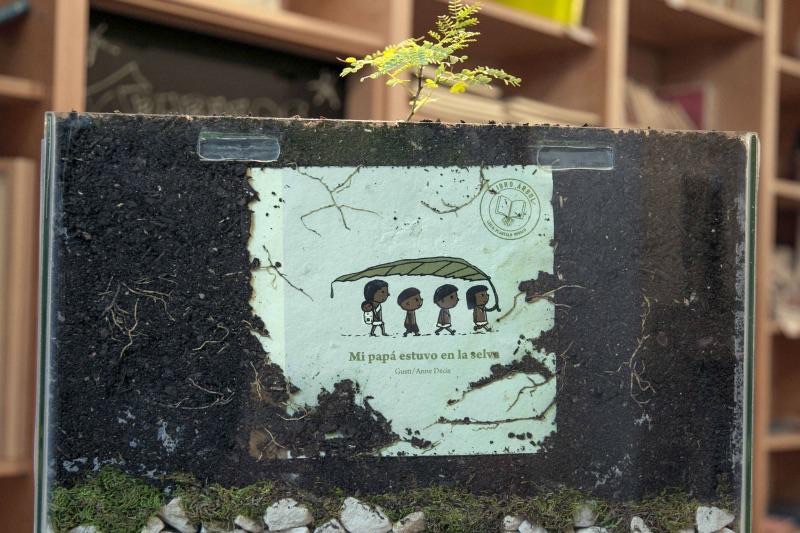
We all know books are special but an Argentinian Children’s Publisher have truly put the magic into one of their books.
In an attempt to teach children the origins of books – trees – they have created a hand-stitched children’s book into which Jacaranda seeds are carefully sewn. Once the book is read, it is buried and within seven to fourteen years the beautiful purpleblue blooms of the Jacaranda tree will flourish. ‘Mi Papa estuvo en al selva’ (‘My Daddy was in the jungle’) is hand made on acid-free paper, uses ecological ink and is finished with silk. The story itself follows a father’s adventures in the South American jungle and is aimed for the 8-12 age group, although it can obviously be read to younger children.
Pequenos, the publishers based in Buenos Aries, believe that ‘trees and children can grow together’ and with this book they have successfully achieved the world’s first truly recyclable book whilst teaching children about ecological responsibility.
The book caused a sensation when launched earlier this year, gaining not only national but also international notoriety. Some bookshelves promoted the books by half-planting them in soil and allowing the seeds to germinate – a spectacular and thought-provoking sight and visualising the novel concept of not only do books come from trees but trees come from books.
It will be interesting to see if their idea of ‘Tree, Book, Tree’ will be picked up by other publishers and grow across the globe. How can it lose? Teaching children the love of reading and ecology. Alas the stunning sub-tropical Jacaranda seeds will not flourish in colder climes and adjustments must be made accordingly. Ahh…
Please do take a look at their promotion video which also shows the book production.
In July I was kindly nominated by Diana at http://mythsofthemirror.com/2015/07/17/the-777-writers-challenge/for the 777 Challenge. A talented writer she has published numerous books as D. Wallace Peach. Do check these out. Furthermore her blog is a joy to read touching on a variety of subjects both inspiring and heart-warming.
The 777 Challenge involves going to page 7 of your WIP, scrolling down to line 7 and from there share the next 7 sentences in a blog post. After that please tag 7 other bloggers to do the same with their WIP.
In midst of work and packing for holiday I had to delay until now to complete the challenge. Here is my offering.
My 777 Challenge is from my current (very rough first draft ) WIP which is a contemporary novel entitled ‘Island Girl’, where a girl’s home island of love and freedom becomes her prison from which she has to flee to save her Self.
This paragraph is one from Anna in her school years.
‘Interrupted in her homework, Anna was sent by her father to search for her wayward sister. What was she up to now? How were her parents still so blind to their mischievous little daughter. That was probably it, Katrina being younger as well as her smile. Anna had to admit it was the cutest in the history of smiles. She’d tried it once when in trouble and her parents had quickly asked her if she was in agony. How embarrassing. Never again.’
I’m tagging the following bloggers for this challenge. If some of you have completed this before, my apologies. No worries if you don’t want to partake, just accept it as my recognition and appreciation of you as members here on wordpress.
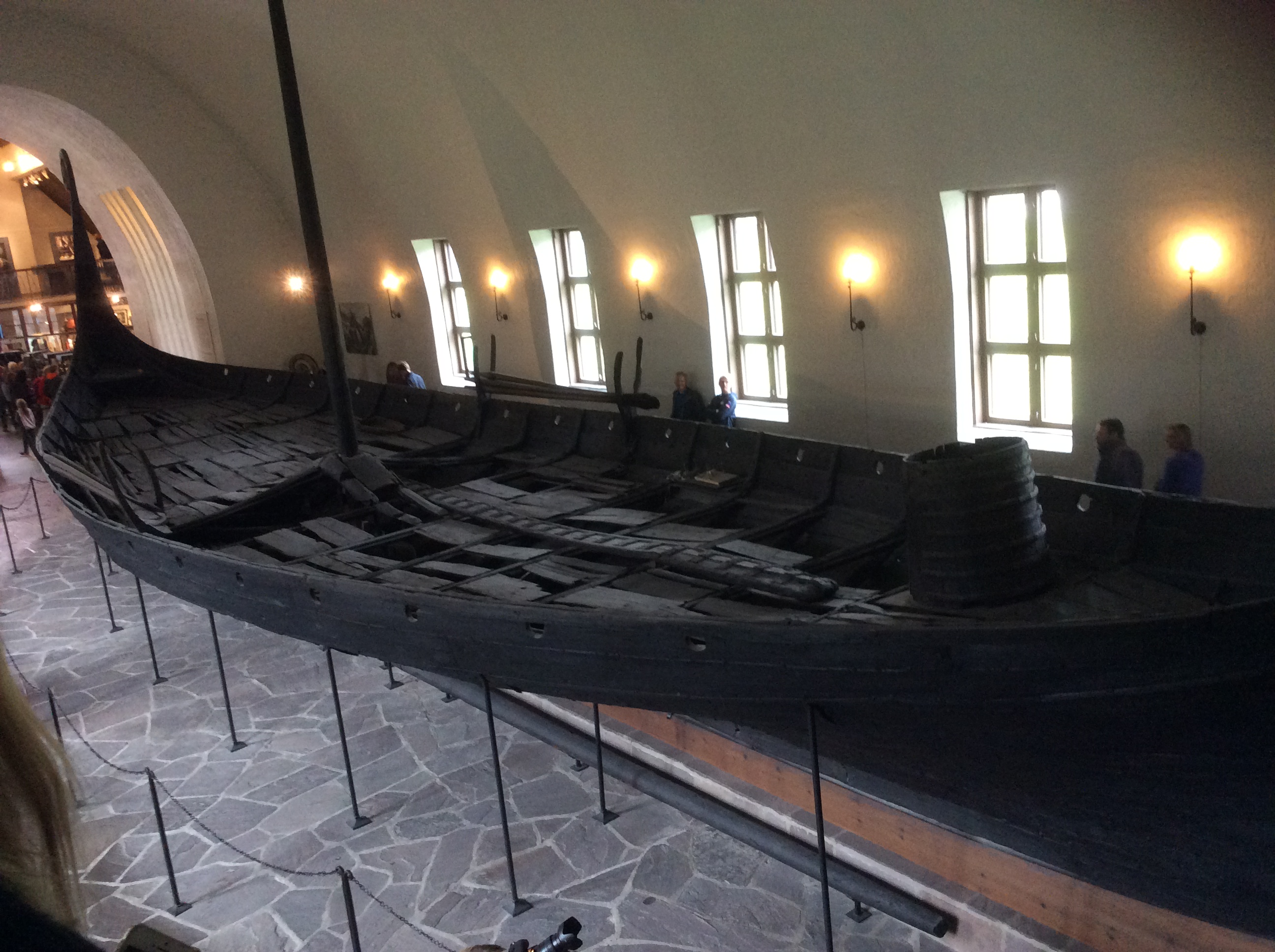
The Oseberg Ship. Photo by Mårten Teigen of Museum of Cultural History, Oslo
Like subterranean explorers we travelled for miles along the network of tunnels approaching Oslo. This was quite unlike any city approach I had experienced.
The occasional car swished past on the cavernous carriageway of Bjørvika Tunnel and soon we made our exit from the urban roads. Within minutes we arrived on Bygdøy, a small rural island which boosts an array of tantalising museums. Among them is the Kon-Tiki Museum. Thor Heyerdahl’s book made a huge impression on me as young and one day I must return for this pilgrimage. For now our destination was The Viking Ship Museum which was easy to find with the aid of the long-suffering SatNav struggling on with the Norwegian pronunciation.
Overhead shot of The Oseberg Ship
On seeing the Oseberg Ship I initially gasped in awe and immediately felt a humbling stirring in my soul. Over a thousand years old and our fore-fathers had not only created a vast sea-worthy craft but had done so with great sense of beauty and elegance. This was no clumsily constructed vessel, rather the wonder of craftsmanship shone from every angle, the soft planed oak boards with the carved keel, the perfect round-headed iron fastenings, then looking up to the bow I spotted the magnificently carved snake head spiral.
This slideshow requires JavaScript.
The ship, the largest intact Viking ship in the world, was built around 820 AD and could be either sailed or rowed with 30 oarsmen. Fourteen years later The Oseberg Ship was used as a burial ship for two women, one in her 70s the other in her 50s.
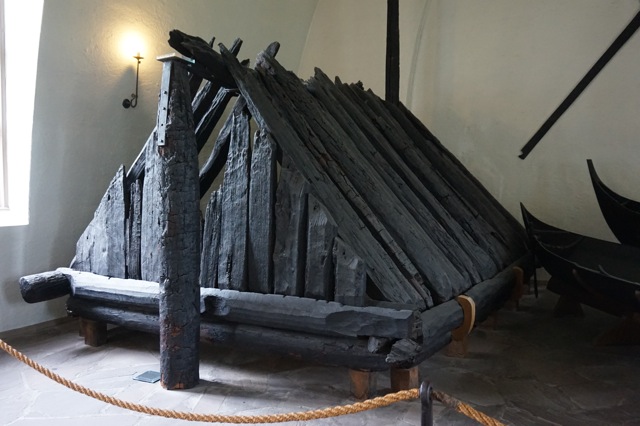
Burial Chamber
They were placed in a specially made burial chamber which resembled a small log cabin and with them were placed various items to help them in the after-life, including kitchenware, sledges, clothes, as well as horses and dogs. The remains of a peacock was one of the more exotic and unusual animals discovered. There would have been jewellery and weapons but these were looted within a hundred years of burial.
This slideshow requires JavaScript.
The artistic wonder continued as we wandered further into the museum. To be so aesthetically delighted was totally unexpected. We looked with awe at the beautifully carved sledges, a wagon, animal-head posts as well as the paraphernalia of the every day. The perfectly formed spades would not be amiss in a local B&Q; I could just imagine the price tag dangling on the top.
My wonder at these explorers of the past shifted to admiration of the early 20th Century archeologists whose care and dedication strove to rescue and persevere the finds which had been buried in the blue clay. Seeing the collapsed nature of the buried boats – oh yes, I forgot to mention the shock and amazement of discovering two further complete Viking Ships at the museum; The Gokstad Ship and The Tune Ship, tucked into opposing sides of the large cross-roads shaped museum.
Buried boats and artefacts were discovered tumbled to the side like giant wooden dominoes. All askew. All topsy-turvy. Looking so fragile in the photographs from the era, now the power and force resonated from the ships, silencing the large crowd mingling around us.
Churns – Repaired
Churns and Artefacts in buried boat
Our experience at the museum was tinged with sadness and poignancy as we learned my son’s generation might be to last to view the artefacts on display. The seemingly perfect objects were preserved with alum and they are slowly corroding from the inside out whilst scientists are working hard to find a solution to the chemical disintegration.
Replete in spirit and mind we left in mutual silence, our musings loud in our own heads, our hearts full of raw emotions from our millennium journey in the previous hours. It was time to leave this island of tranquility and head to our next destination – our hotel in Oslo city centre.
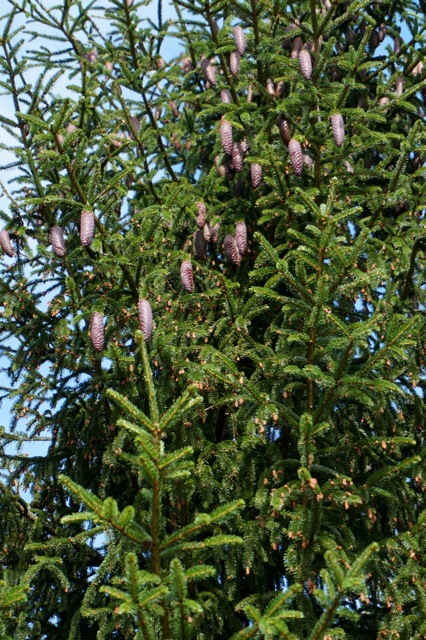
My eyes never tire of staring in awe at the towering trees, examining the clusters of purple pine cones hanging forty metres above my head. My eyes never tire of looking across the landscape, into the far distance. My ears never tire of the songs from the small birds assembled beneath the feeder, never tire of the haunting cries of buzzards and falcons, their calls echoing for miles around.
How could I tire of that which has become an integral part of myself? The nature has enveloped me, cosseted me and its tentacles has spun around my spirit. Now my soul stretches and fills across the landscape, flying and interweaving with the rustle of the leaves; taking its place in this world of serenity.
Thus refreshed and re-energised I return home.
A small gasp at leaving, a tantalising tug at my heart strings – stay – but I long for my home, my husband, friends. I long to return to my writing again. Like a child at the beginning of a new school year, I wait expectantly in the playground, hopping from foot to foot, skipping around eagerly for lessons to start (yes, I was one of those children!).
As a result of much reading (more on this in later blogs) and of much thought and note taking I now feel confident to return to my first draft and complete it this year.
Reading numerous short stories and anthologies has given me a renewed desire to resume short story writing again and to return to competitions.
As my brain pace entered a gentle walk mode rather than frantic gallop I scanned new competitions with fresh vigour and creative ideas blossomed, little seeds of suggestions that I hope to carry to fruition.
It’s good to be back, ready with pen, paper and keyboard. Thank you to the elk that bounded in front of our car along the track. For a heart stopping moment life was majestically sublime. Thank you to the badger I spotted strolling across the land one morning, its giant mass surprising and awe inspiring, its saunter so certain and determined – what, we think we own the land? How mistaken are we. Thank you to the deer leaping with grace across the meadow full of flowers. Thank you to the foxes, giant hares, birds, fishes, flowers, ferns, trees. Thank you to the crisp morning air, to the warming midday sun, to the sparkling blue of the lake and sea. Thank you for this wonderful gift. Of life, renewed creative spirit and inspiration, increased mental and emotional power.
Thank you all for reading and supporting.
I look forward to reconnecting with you, catching up with your posts, writings, making new friends and to sharing thoughts, ideas and experiences in the months ahead.
This poem perfectly encapsulates my next few weeks, as I head off to Sweden with the family to the two houses in the forest.
Here immersion and union with nature and oneself is made possible and after the initial week or so stillness finally settles on my soul.
One afternoon I’ll stop and as if for the first time notice, really notice, the woodpecker high up in the tree as its drumming echoes across the land. One morning the breeze will be whipped into a frenzy and with contentment I’ll sit and watch the entertainment of the wild, erratic dance of the fir trees, the natural monoliths bending to improbable angles before slowly unfurling to stand gracefully upright again.
The midday sun heats the sand on the beach and like a kid I’ll scuttle to the water’s edge, immediately emitting a shocked squeal. As the crystal clear water ebbs at my feet, I’ll study the HD-quality shells and pebbles. Time at last to be awed by nature’s gifts.
One dark night a loud thud against the house wall will wake me and instead of fear I’ll smile to myself. Silly elk. Can’t they see the house? Then I’ll turn over and sleep soundly once more. One evening, sitting outside with a glass of wine in my hand, I’ll glance high up at the swirling birch tops and then spot the first fleck of autumn, the yellow tinged tips of a few leaves. A sigh of disappointment as summers end beckons.
I wish you all a peaceful, relaxing and healing summer.
Death came to his eyes that day. The advert had gone into the paper on Thursday and since then three calls, two visits and now a sale. He’d never expected this to happen. Why couldn’t he see this? Since he was three he’d lived on two wheels. Scooters, bikes, mountain bikes, motorbikes and trial bikes. The one selling today he’d only got last year.
For two long summers he’d worked at the hotel saving up; hospital corner after hospital corner on the beds, scraping his knuckles endlessly on the dark wood frame, loo after loo scrubbed, room after room vacuumed. He’d had a laugh with the other cleaners too – sorry, ‘maintenance crew’ or such nonsense. At lunchtimes they’d gathered in an unoccupied room watching sport on Sky, sometimes they’d sneak a few beers with them.
A couple of times he’d sneak Jessie from reception into a room. Together they’d tried out the double bed. Hmm…Jessie. She’d gone off to uni now. Of course, she’d wanted to do all that ‘long distance relationship’ rubbish. No way. Those never worked out. He’d told her so too. Okay, telling her by text might have been a mistake; his Mum had laughed nervously when he told her how he’d broken up with Jessie. His Dad just scowled audibly with disapproval. What the heck! It was his life.
They were here now. A couple with a Range Rover and a trailer bouncing behind. Adam, their son, scuttled out of the car and dashed up to the bike, his enthusiasm leaving a trail of happiness in his wake. So young. Just wait until life hits you, Adam. There he was, Adam, stroking, actually stroking the handlebars of his motorbike, now ducking down to look at the wheels, his head turning in exclamation to his parents, then an adoring glance at the engine. Joy radiated from his eyes.
Better get this over with, he thought, grabbing the keys from the pristine kitchen counter, reaching for the helmet on the stool. In the hall he looked into the mirror and thought ‘smile’. The corners of his mouth turned up into a grimace; that’ll do he reckoned as he headed out.
Hollow darkness filled his eyes as the car pulled away, his trial bike rattling in the trailer. An unfathomable emptiness cascaded over him as he glimpsed it for the last time.
He’d won three championships on that. Local ones but still. He’d been taught by the top rider in the country for a while. Then the falls! Remember the one on the moors, skidding down the muddy hillside, leg trapped beneath his bike, engine still running. Caked in mud, he’d got up and rejoined the race. Finished last but he’d laughed all the way to the line, celebrated all night with his mates, the most inglorious defeat and the photos of the day shared avidly on Twitter and Facebook.
Photos. He’d better take them off. Him and his bike. Just him now. As if he could ever have made it, been a real success. Stupid dreams. Those days of foolishness. Days of waste.
He took his mobile from his back pocket, scrolled through the photos. Here one on holiday with his friends all on their trial bikes. Who was that stranger staring at him, with a smile shining on his face? Who was that guy, laughing with his friends, his arm draped round his bike, chin resting on the seat? Click. Delete. Click. Delete. Whoever he was, he was gone. Click. Delete. The look of death in his eyes.
Don’t worry, I’m not going to jump on the PR juggernaut surrounding Harper Lee’s latest (earlier) novel. Nor am I going to engage in the endless conspiracy theories regarding its existence, publication etc.
However, it’s difficult to avoid what has been promoted as the biggest book sensation in recent living memory. ‘Go Set A Watchman’ is set to smash sales records. The publishers are prepared for tomorrow’s look release with nearly 3 million books printed as well as being available on digital format.
So, what’s all the fuss about?
Away from the hype I approached the first free chapter with delight and slight trepidation. Delight as I thoroughly enjoyed and respected ‘To Kill a Mockingbird’, even more after reading it again last summer. This time as an adult I found I appreciated the novel much more. However I was anxious the book would disappoint and fall to ridicule. Reading this first chapter I realised my fears were unfounded.
‘Go Set A Watchman’ promises more of the same beautiful prose as ‘Mockingbird’. The deftness of language is retained with its gentle humour, crisp vernacular mingled with deep insightful reflections from the now mature 26-year-old Jean Louise, otherwise famously known as Scout.
The initial striking difference with ‘Mockingbird’ is that this novel is told in the third person. From this first chapter I would say this is not detrimental. I did not find this viewpoint distant or remote, as has been suggested by some critics. Rather it allowed Scout’s maturity and in-depth reasoning to shine forth, whereas ‘Mockingbird’ worked brilliantly written from the first person, capturing her young innocence, confusion and sense of awakening.
The reader joins Scout as she’s travelling by train from New York to her home town Maycomb to visit her ageing father who is suffering from rheumatoid arthritis. Her laconic observations abound, such as in ‘trains changed, conductors never did’ as yet again the conductor forgets her stop and the train halts 440 yards from the station.
Scout has lost none of her home-town mannerisms as is evident in first her change of clothing to ‘her Maycomb clothes: gray slacks, a black sleeveless blouse, white socks and loafers…’ before adding, ‘she could hear her aunt’s sniff of disapproval’.
She does now though manage to tone down her behaviour as ‘she repressed a tendency to boisterousness’. How far this is true the reader will have to find out later in the book however doubts are raised even in the first chapter as she retorts with harsh honesty to Henry’s marriage discussion: ’I’ll have an affair with you but I won’t marry you’. Even Henry has noticed the change in her, recognising that ‘in the years he was away at war and the University, she had turned from an overalled, fractious, gun-slinging creature into a a reasonable facsimile of a human being’. Overall, Scout is still ‘a person, who confronted with an easy way out, always took the hard way’.
Finally, am I the only one confused by the title? Frustrated by my ignorance I researched further and I was soon enlightened! The phrase ‘Got Set a Watchman’ comes from Isaiah 21.6. ‘For this hath the Lord said unto me,/Go, set a watchman, let him/declare what he seethe.’
This supposedly alludes to Scout’s view of her father, Atticus Finch, as the moral compass (ie. watchman) of Maycomb. (Thank you Wikipdeia!)
I hope you have enjoyed this brief summary of the first chapter of Harper Lee’s latest publication. The final verdict on the novel will of course only be known upon reading the book in its entirety. I will buy it, soon but not quite yet. I don’t feel like be railroaded. I’ll wait for a while…for the paperback! I trust I will be as enlightened and satisfied with the rest of the novel as I was with this opening chapter.
I almost stepped upon this intact nest as I walked across the garden this morning. Luckily I glanced down and I was struck by its size, touchingly small with miniature eggs resting inside.
What a cosy warm sanctuary the birds had built for their young. The nest itself of a sturdy intricate design had survived the gusts of wind which had dislodged it from the lilac tree and placed it upright onto the ground beneath. Some eggs were already sadly broken but three remained whole. Did they have a chance?
My heart went out to the parent birds who would return only to desperately search for their home. Then there were the neighbourhood cats to worry about – a few keen hunters among them and many times the garden has been littered with the debris of battle; pigeon feathers scattered across the lawn.
I ducked beneath the tree branches and spied the ‘cup’ of criss-crossing branches where the nest had cradled. Gingerly I returned the nest to its proper place. All we can do is wait. Life is fragile, even the journey to it is fraught with danger, with many obstacles in the way.
I’ll keep my fingers crossed for these three eggs – and hope to spot three small chicks soon enough. Unlikely maybe, but not impossible.
U P D A T E – 17th July 2015
Don’t we all wish for the happy ending?
With regards to the nest I discovered last weekend the final outcome will never be quite known. I so would have loved to say the eggs hatched, all well. What has happened is that the nest remained in the tree a few days and then after a stormy night I checked the tree again.
The nest was gone. Everything. No remains around on the ground, amongst the bushes, underneath the shrubs. Yes, I checked everywhere. No eggs, no nest debris. Nothing. It does not look good but I’m slightly baffled by the absolute vanishing act. The nest and its tiny contents touched me and I was so happy to share it with you all.
Many thanks for reading and for your heartfelt comments.
My brain is ensnared. My eyes dart to the bright sunlight and soon my toes tap the floor restlessly, itching to move. Now my body is begging for the the outside, the fresh air, the sun.
Inwardly I simultaneously groan and cheer. The battle is over – work can wait, it’s time for a walk!
Do you ever suffer from the same turmoil? Do you need a walking break now and then? If so, put down your pens, push your keyboards aside and join me as I stride out on a local walk – I’d love your company.
Luckily this is a walk from my doorstep and after a quick stroll past the pretty gardens of the neighbouring houses, I cross the main road. Soon the peace of the countryside surrounds me.
Deftly (I wish!) climbing over the wooden stile, I avoid a rotten board. My sudden squeal of pain surprises even myself as nettles spike my bare legs and I stamp about in a ridiculous fashion as if this would soothe the stinging.
Golden Shades of Wheat field
(Please click on the photos to enlarge them.)
Ahead stretches a vast wheat field. A lush sea of colour, from burnished bronze to light yellow to green of fresh new growth languidly rustle in the breeze. The myriad of golden shades sway back and forth in great swathes, the soft shimmering ripples creating soft music as the full ears of corn move together.
Runway Streaks
In one place two light green parallel lines of wheat stretch far into the distance, as if lighting a runway for planes above. Where did they come from? The mystery buzzes around my mind as I try to spot the crop circles which usually appear as if by magic amongst the golden mass. No such wonder today. They’re always fascinating. Nature’s art. Or is it a small alien landing craft? I smile to myself at my mind’s musings.
In front of me looms my marker; a lone oak tree perfectly outlined against the golden field and the sheer blue sky. On a warm day as today the fully grown tree offers welcome cooling shade.
Lone Oak Tree
Years ago, when my son was young it was a fun obstacle as we chased each other round and round the thick trunk. At first, when I could easily have caught him, I’d ‘stumble’ and let his tiny hands grab my legs. Then when he was older I ran for all my worth until dizziness overtook me. I’d stumble and after letting me think I’m winning my son would catch me, save me. Life’s full circle.
Dry Earth Cracks
A right turn in the path and as I traverse the bone dry ground, carefully stepping between the deep cracks I glimpse the church ahead. Standing alone in its dignity and history. The Medieval and later Tudor addition creating a beautiful serene building. I approach it through the lych gate, the church to my right, the cemetery to my left. Built in 1435, the church is much as it was, with the original Nave, East Window and main heavy wooden double doors all intact.
The lych gate was built in 1919 and was originally the place where corpses lay before being brought into the church, hence the engraving above of ‘Mors Annua Vitae’ – ‘Death is the gateway to life’.
This slideshow requires JavaScript.
(Please click on photos to enlarge and to see them in a slideshow.)
I wander around the cemetery, deep in thought, seeking solace for my own losses. Stopping I read an inscription or two. There lies William Beck ‘Gamekeeper to Basil Sparrow Esq’, the gravestone put up by the latter in January 1860 to his ‘courageous and faithful servant who died from wounds caused by the accidental discharge of his gun…’
As I stop at a grave here and there I’ll say out the name out aloud, hoping to honour the person, hoping to revive meaning behind the utterance.
Village cemetery
Writing is never far from me and I scan the names for inspiration for stories or perhaps to find a name to fit in a piece of fiction writing. This was the case with my winning short story, where my main female character’s name was discovered at a cemetery. (By the way, that particular story will soon be featured on my blog.)
I pause at one particular grave. For a baby girl who fleetingly visited this earth for a day. She was born healthy and strong but died seventeen hours later from cot death. I knew her mother well as our sons were best friends and the tragedy shook us all.
So I continue my walk, thoughts drifting on life and death, as always the two intermingled, inevitable.
Walks and thoughts. As I stride across another field I lose my conscious self as an internal discussion rages in my head, this is distilled into peaceful reflections and new ideas swirl into being. As if in a transcendental meditation I wander on and in a shock I discover myself far from my last conscious position. The inner concentration of brain storming so powerful the ‘real’ world takes second place to the inner world. With my brain cleansed, with ideas stored safely for my return, I continue feeling clearer, lighter, brighter. My feelings echo Bill Bryson’s words on walking ‘…you exist in a kind of mobile Zen mode, your brain like a balloon tethered with string, accompanying but not actually part of the body below…’
To my left now is the regal Elizabethan hall with its stunning Georgian front. Now a country home hosting grand weddings it formerly saw Elizabeth I and her retinue as its regular visitors. Built in 1544 with major reconstructions in 1691 and 1715 its features include a spectacular central courtyard.
Georgian Front to the HallTudor Back to Hall (formerly the front)
I remember the lovely afternoon one Sunday when it opened for visitors and it felt a wonder to be served scones and tea in such special surroundings. One Christmas the local primary school children walked up to the hall and enjoyed lunch in the ornate wooden banqueting hall. Overawed the pupils were silenced – for a moment. Imagine, eating in the former residence of King Louis VXII and his wife and their 350 courtiers!
Hall Courtyard
By now sweltering from the heat I welcome the shade from the avenue of trees heading back to the village centre. The wind sweeps along the straight and gently caresses my tired legs. Treading on the road I am still astonished at its surface, the one originally laid by American troops during World War Two, as it led to the local airfield. It must have endured so much heavy traffic in those few years alone but is still going strong.
It was many years before the USA Airforce left the area I’m reminded as I halt by the memorial plaque of an American pilot killed as his plane crashed into the village playing field in 1963. As the F100 Super Saber jet developed an engine fault Col Wendell Kelly heroically chose to stay with the plane to ensure it avoided the local school. When certain the plane would crash away from civilians he did eject, but too late to save his own life. Recently a 50th commemoration service in his honour was held in the village and it was lovely that his daughter and other family members from America could attend.
This slideshow requires JavaScript.
The very same playing field in use today by children and adults, for football matches, cricket matches, fetes. For years I watched my son and his friends charge across the sun-scorched grass, heading full pelt towards the playground. More sedately I walk towards the shop, the field quiet and empty as I recall the yelps of joy as the children were let out of class.
I’m here now. At the local shop, which is run by a team of dedicated volunteers. Time for a break. What will you have? Tea? Coffee? Ice-cream? Yes, I’ll take one of those thank you. Let’s sit out on the table. Yes, just that one there, the one with the red geranium precariously standing on it.
Village pavillion with local shop tucked next to it
Now silence, peace. Time to be thankful. Time to reflect. Tired my legs ache for a rest. Refreshed my fingers itch to write. Alert my brain is brimming with new ideas and plans. I’m off home and back to my writing.
The final stretch of the walk takes me through the dappled shade of the Nature Reserve. Once a gravel quarry it has been developed since the 1960s into a local area of beauty with three large lakes and rich woodland. A bench beckons by the water’s edge but determined I go on my way, greeting the ducks who are paddling near by. I’ll be back later with some bread later, I promise them. At last I spy the house located only a few metres from the Nature Reserve and again marvel at the ideal location.
One of the lakes at the Nature ReserveFelled tree in Nature Reserve
Well, the walk is over and I want to thank you for joining me. I hope you’ve enjoyed it as much as I have.
‘Solvitur and ambulando – it is solved by walking.’
It’s not often I reblog but I came across this from Lucile De Godoy’s which profoundly touched me, leaving me in a contemplative mood on a quiet Sunday afternoon. Wishing you all a lovely day.
I had yoga, plus reading and commenting on blogs, for breakfast.
Catching up on blogs I appreciate, brought me coincidently(?) to the same question, which served me well to kick off another week.
The question I like to ask myself and others: have we find our talent, passion, dreams and purpose, and do we let it live? Or are we following another life path?