A writer influenced by her Swedish heritage and Yorkshire upbringing
Author: Annika Perry
I’m a versatile writer whose books span across various genres.
My first venture into publishing is "The Storyteller Speaks" and this a collection of short stories, flash fiction and poetry. Published in January 2018 "The Storyteller Speaks" has received over twenty-five glowing reviews on Amazon.
"Oskar’s Quest", my second book, it is a beautifully illustrated children’s book for younger children (and all young at heart!). "Oskar’s Quest" is an engaging story of adventure and courage.
I have also completed one more story for children which is as yet unpublished.
"Island Girl", my first full-length novel, is in its final edits and I’m looking forward to publishing this in due course.
Writing has been a passion since childhood although it is only in the past few years that I have seriously started to write fiction.
Initially, a writing course gave me encouragement and direction with my writing. Furthermore, the tutor recommended blogging and in January 2015 I set up my blog, Annika Perry’s Writing Blog. I never imagined the friendships I would make and I’ve been overwhelmed with the warmth and incredible support from people around the world.
In spring 2014 I won First Prize in a Writing Magazine’s Short Story Competition which was a fantastic surprise and joy. Furthermore, I was short-listed for an Ink Tears Short Story Competition the same year.
The recognition of my writing ability outside of my family and friends was a huge boost to my self-confidence and as a result, I started the mammoth undertaking of writing my first novel.
Meanwhile, in early 2017 I was greatly encouraged by my friends and writers to publish some of my numerous short stories in a book. It was with great excitement and sense of achievement to launch the publication of my first book, "The Storyteller Speaks", in December 2017 with the paperback released in January 2018.
The latter part of 2018 and throughout 2019 was busy with the realisation of a dream project, to publish a children’s book. Like so many parents, my son when young would request a bedtime story. These I tended to make up and a couple became his and my personal favourites. I revisited one of these stories and after much rewriting, editing and finding a wonderful illustrator, "Oskar’s Quest" was ready!
Overall my road to publication has been circuitous and aided by the support of my family and friends.
After gaining my BA Honours Degree in German Language and Literature from the University of Leeds I started working as a journalist. Following a serious illness, I changed career and gained a position as Administration Manager for a busy timber import company. I worked here for many years before leaving to pursue my passion for writing.
I am now a full-time writer, blogger and book reviewer.
I was born in Gothenburg, Sweden and at the age of six, moved to the UK with my family where we settled near Ilkley, West Yorkshire. Since then I have moved many times but now live in a small village in North Essex, England with my husband and occasionally my son, when he returns during university holidays.
I am on the following social media sites and look forward to seeing you there. If you have a specific enquiry please use the form below.
Twitter: https://twitter.com/AnnikaPerry68
Author Website: https://annika-perry-author.com/
Amazon Page: https://www.amazon.co.uk/Annika-Perry/e/B0789NNWFX/
Goodreads: https://www.goodreads.com/user/show/55576285-annika-perry
Linkedin:https://www.linkedin.com/in/annika-perry-5a9ab8a6/
Welcome to the final day of my 3 Day Quote Challenge which I’m thrilled to take part in following the kind nomination by Laura at laurabrunolilly.com .
To the challenge…The rules are as follows:
Thank the person who nominated you.
Post a quote on 3 consecutive days.
Share why this quote appeals so much to you.
Nominate 3 different bloggers for each day
As a writer, I wanted to finish this challenge with a quotation about the craft. The elegant and eloquent truth of the following quote struck me like an epiphany when I came across it a couple of years ago and I am sure it will resonate with most poets and writers. Having read her words I instantly noted it down in my journal and it is one I often come back.
The writer of the quotation is fellow writer and blogger Adrienne Rich who blogs at middlemaybooks.com. Adrienne is a writer of historical family sagas about the Weldon and Crenshaw families of Gilded Age Englewood, New Jersey and she ‘first fell in love with family sagas watching family drama at the many funerals’ of her youth. Her blog is ‘to celebrate who we all are, past and present, flawed and sublime.’
Welcome to the 2nd day of my 3 Day Quote Challenge which I’m thrilled to take part in following the kind nomination by Laura at laurabrunolilly.com .
To the challenge…The rules are as follows:
Thank the person who nominated you.
Post a quote on 3 consecutive days.
Share why this quote appeals so much to you.
Nominate 3 different bloggers for each day.
A week ago a star in the music world passed away at the far too young age of 28 and upon learning the news of Avicii’s passing a wave of sorrow was felt around the world. Tributes poured in from the famous to the young, all touched by his music and lyrics; poetic lyrics which became part of so many people’s lives, my son’s (and mine) included.
Below is a quote from ‘Wake Me Up’ as well as a video of the entire song with all the lyrics.
My son wanted to honour Avicii’s memory in his own personal way and put together a piano medley covering some of the songs. I”m proud to include Sammy Perry’s video; first his introduction to the music.
‘This is a piano tribute to one of my favourite electronic artists, Avicii, who unfortunately passed away a few days ago. He has inspired me and countless others to make music and he will be missed by millions. This is a piano mix of some of my favourite songs by him and I hope you enjoy listening to it.’ Sammy Perry
Sometimes a challenge arrives at the perfect time and this one – The 3 Day Quote Challenge – caught me when I find myself surrounded by quotes, absorbed in collecting them, reading through old ones, finding new ones.
For the next three days, I will be posting a quote and explaining why it’s made an impression on me.
Rules and I don’t always mix well; so my quotes may be a bit longer and my first foray into the challenge begins with a ‘Blessing of Solitude’.
The above is an authentic Celtic blessing found in a book written by John O’Donohue called ‘anam cara’ (soul-friend) and sub-titled ‘Spiritual Wisdom from the Celtic World’.
This book resides on my bedside table and one I dip into now and again. Its pearls of wisdom, gems of inner-understanding ensures it’s a book that not only has meant a lot to me but continues to do so. In recent weeks some of my friends are going through hardships and I found myself seeking solace and clarity within the pages.
I’m stunned and very honoured to have been nominated in the Best Pal category of the Bloggers Bash Awards! There are only a few more days to vote until the virtual box closes at midnight on April 30th (BST) so head over to the ballot – there will be lots of familiar names there in a whole host of categories … and towards the end is the Best Pal nominations. PressHEREto vote.
BEST PAL: Which blogger do you want to go to the pub with? Or maybe have dinner with? Who never fails to reply to comments, and has thoughtful things to say? Maybe they encourage the community through weekly challenges or blog parties. A blogger who makes the blog-o-sphere a better place is what makes the Best Pal. (This description courtesy of Bloggers Bash Awards)
Two weeks ago only the daffodils braved the grey chill that clung all around. Trees barely seemed to be in bud and the occasional bulb peeked above the sodden ground, seeming to retreat as soon as they appeared.
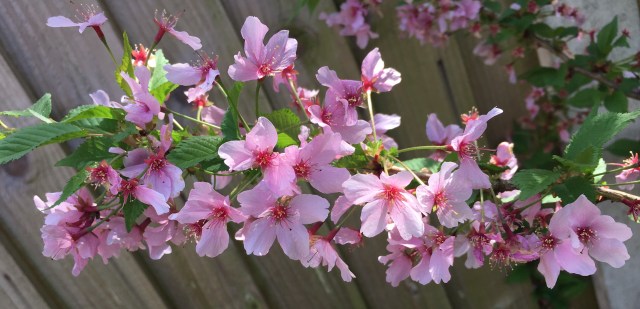
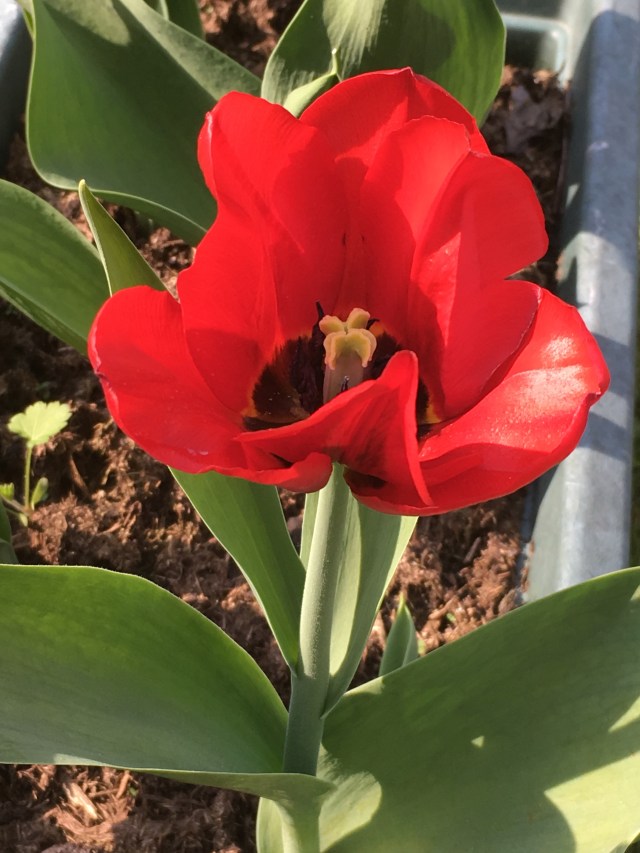
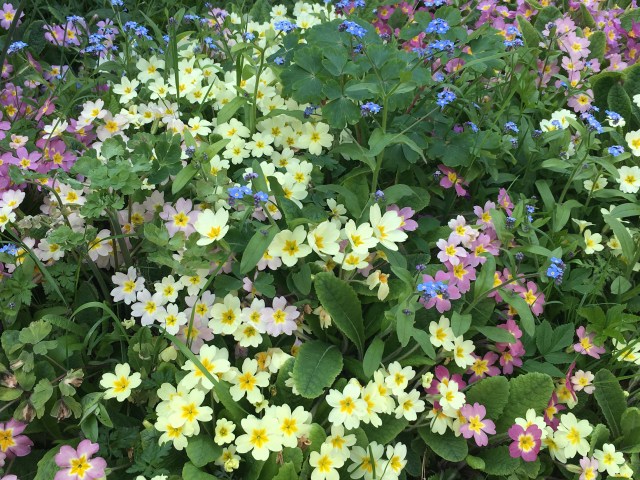
What a difference a week makes with the welcome arrival of glorious Spring weather! As we basked under exceptional warm temperatures, the flowers in the garden woke with a blaze of colour. I cannot help but study them in awe and wonder, often whilst swinging on the wooden seat with hushed joy.
Some of you I know still have a little (or a lot) of the ‘white stuff’, some are in Autumn, so I want to share just a few photos of the Spring flowers in my garden. As it is National Poetry Month, I’ve included part of a Spring poem to accompany the images.
‘A sensitive plant in a garden grew, And the young winds fed it with silver dew, And it opened its fan-like leaves to the light, And closed them beneath the kisses of night.
‘And the spring arose on the garden fair, Like the spirit of love felt everywhere; And each flower and herb on earth’s dark breast Rose from the dreams of its wintry rest.
‘The snowdrop, and then the violet, Arose from the ground with warm rain wet, And their breath was mixed with fresh odor, sent From the turf, like the voice and the instrument.’
The above are a few stanzas from Percy Bysshe Shelley’s poem entitled ‘The Sensitive Plant’ (published 1820).
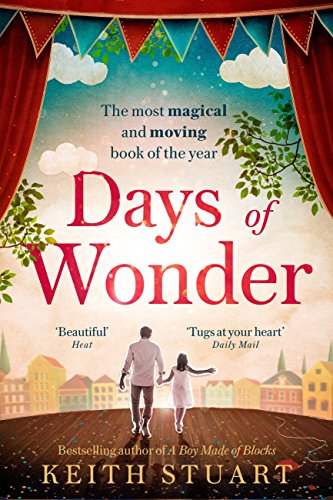
As a huge fan of Keith Stuart’s debut book ‘A Boy made of Blocks’ I was thrilled to be offered the opportunity by the publisher to read and review a pre-release copy of his latest novel. As always on such occasions when I eagerly look forward to a new publication, I hesitated for a fraction before plunging in to read … I just hoped the book would not disappoint. I need never have feared – it is truly a gem!
From the first couple of paragraphs into ‘Days of Wonder’ I knew I was in for a treat and settled back to enjoy, savouring the story, becoming engrossed with the characters and their lives. By the end my emotions had been on a rollercoaster ride, ending in tears, at times laughing out loud, all the time moved and touched to the core.
Keith Stuart’s first book was based on his own life experience as a father with an autistic son, ‘Days of Wonder’, his first fiction novel, also centers on the relationship between a father and his child; in this case a 15-year-old daughter, Hannah and her father Tom. Not only is Hannah seeking her natural independence, experiencing first-love, fretting about A-level options, she also has to contend with an uncertain future – and perhaps none at all. Since being diagnosed with a life-threatening heart-condition cardiomyopathy, her whole life has been under its shadow.
The disease has brought father and daughter wonderfully close together, their bond inseparable since her mother left whilst Hannah was still young. Tom has raised Hannah on his own, with the support of his eclectic theatre group which he manages. The members are close-knit and effectively a second, albeit quirky, surrogate family to Hannah, caring and understanding.
Since the initial diagnosis at the age of five, Tom has sought to bring magic into her life and a professionally produced birthday play at the theatre has been key to this … a tradition Tom is desperate to continue, one that Hannah feels less keen on in the cusp of adulthood… an adulthood that may never exist for her.
Starting the book my one fear was that the disease would dominate the book, that it could become mawkish and moribund. Not at all! The disease is a backdrop to so many stories within the book; the uncertain future of the theatre, how it has saved so many people. It’s about lives, relationships, friendships, love. Of living and dying. I became totally absorbed into not only Tom and Hannah’s lives but that of Ted, Angela, Margaret, Callum, Sally to name a few. Their fears, frustrations, courage and perseverance were uplifting and soulful.
Throughout feisty gutsy Hannah is insightful and wise beyond her years, whilst loving and worrying about her father as she desperately seeks to find him a date. Furthermore, she finds and becomes supportive of her first boyfriend; a young man equally crippled with a very different illness.
The book is effectively and skilfully told through the two-viewpoints of Tom and Hannah. With the latter, it is as if overhearing a private conversation, immediate, at times raw, at times swinging perfectly into modern jargon. As with Tom and the other characters, the sense of humour is impeccably narrated, the put-downs perfectly timed. Through Hannah’s words we learn about her best friends, including a very special 81-year-old lady, the dramas of school, relationships.
Tom’s narrative is personal, emotional, realistic … comically sardonic at times, other moments relating such humorous dating escapades I cried with laughter! As a reader, I couldn’t help but warm to him and feel for his predicament- caring and being over-protective and struggling to let go of his daughter. All the time, unaware his daughter is trying hard to protect her father from the future and for the future. His gentle, confessional tones mingled with the comic and drama persona whilst the ghost of his ex-wife lingered in the background, the possibility that they might yet be a family.
For both of them, there will never be a normal life … and as the novel develops they learn to embrace their predicament; their love and bond growing stronger as a result.
An interesting additional narrative format is the occasional letters in the book … deeply revealing about past events in Hannah’s life and written by her, it is only towards the end the reader becomes aware for whom they were written. This is yet one more poignant and emotional revelation in a novel which has heart-wrenching moments cascading throughout.
The descriptive detail by the author is superb, he is wonderfully visual in creating settings, presenting plays, and I became engrossed in them all and felt as if I’d been watching a film.
‘Days of Wonder’ is ultimately, and perhaps unexpectedly, a powerful, life-affirming and inspirational book. I was hooked from the very beginning and did not want to put it down for any breaks. It’s one of those books that I just had to read one more chapter until I sadly had to say goodbye to my new friends!
I received a free copy of this book from the publishers via Netgalley in exchange for an honest and impartial review.
“The emotions are sometimes so strong that I work without knowing it. The strokes come like speech.” Vincent Van Gogh
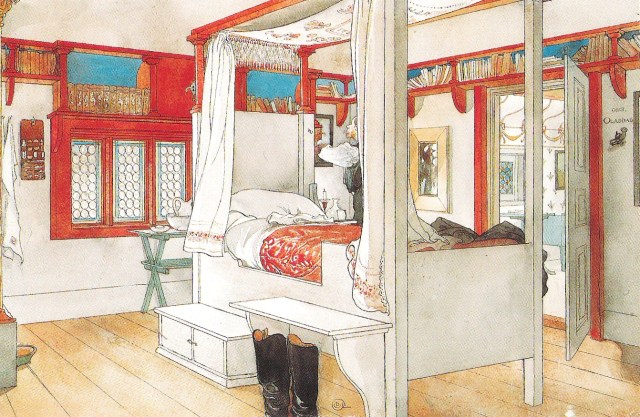
Welcome to my third and final instalment about Carl Larsson and his watercolours of the beloved family home; a place where he ‘experienced an indescribable delightful feeling of seclusions from the hustle and bustle of the world’.
Carl Larsson (1853-1919) was heavily influenced by William Morris and the Arts and Crafts movement in the UK and over the years Karin and Carl transformed their humble abode and in the process created a lasting legacy for interior design in Scandinavia and beyond. Their charming, evocative and distinctive style in furnishings is still highly influential and inspiring homemakers today.
“If light is in your heart you will always find your way home.” Rumi
Whilst Carl, with some help from carpenters, made the furniture, carved the doors and cupboards, Karin was responsible for the textiles and tapestries at ‘Little Hyttnäs’ as well as the rugs.
The idea to paint pictures of the home was first suggested to Carl by Karin during a rainy summer in 1894 when she feared her husband would fall into depression. Inspired, he continued to paint all aspects of their house and lives within and outside it.
“A picture is a poem without words.” Horace
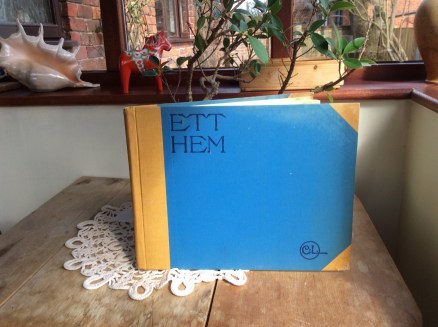
Following Carl’s acceptance of an invitation from the publisher Bonnier to print some of his watercolours, twenty-four of the paintings were reproduced in the now famous ‘Ett Hem’ book. Initially sales were slow in Sweden until a German version became an instant bestseller in Germany, selling 40,000 copies in three months.
Carl and Karin Larsson were said to have been overwhelmed by its success however Carl always felt that the pictures of his family and home ‘became the most immediate and lasting part of my life’s work. For these pictures are of course, a very genuine expression of my personality, of my deepest feelings, of all my limitless love for my wife and children.’
‘Ett Hem’ has never been out of print and has had over 40 print runs. Today the family home is owned by their descendants and open to tourists during the summer.
We shape our buildings; thereafter they shape us.” Winston Churchill
NB. I look forward to reading your thoughts about the posts in this series and I will respond upon my return to the UK later in the month.
Before marriage and settling down, Carl Larsson started his artistic career when a teacher spotted his talent early on and encouraged him to apply for the Royal Swedish Academy of Arts. Although he had difficulty settling in, within a few years he was able to earn enough money to support his parents through drawings and cartoons sold to various papers.
A move to Paris in 1877 was equally challenging although he finally found peace and inspiration in Grez-sur-Loing … and here he met Karin Bergöö, his future wife. At last, he moved away from oils and painted some of his prominent paintings with watercolours.
Breakfast under the big birch 1896
Nameday at the storage house 1898
“No one is able to enjoy such feast than the one who throws a party in his own mind.” Selma Lagerlöf
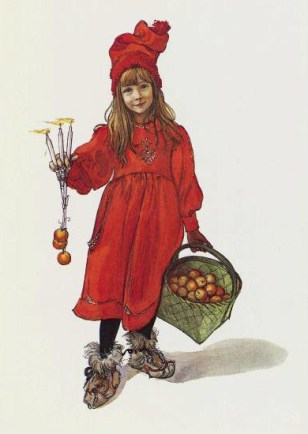
Brita as Iduna
“If I have managed to brighten up even one gloomy childhood – then I’m satisfied.” Astrid Lindgren
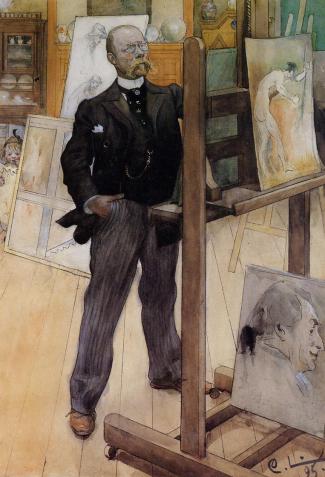
Self-portrait 1906
“I want someone to remember I existed. I want someone to know I was here.” Frederik Backman
NB. This is the second in a series of three posts based around the famous Swedish artist Carl Larsson and his successful book of watercolours called ‘Ett Hem’/’A Home’ centred on his family home. As I’m still on an Easter break in Sweden and disconnected from most technology, comments are turned off for this post but will be on for the next and final one in the series.
Once again, I am flitting away for my usual Easter break in the peace of the Swedish landscape; savouring the calm of forest, the beauty of the lakes and seas! I’ll embrace the opportunity to unwind, relax … as nature soothes my soul.
Ett Hem. Carl Larson 1969 edition
Meanwhile, I’ll leave you with a series of posts to peruse. With no more calendars to hand, I’ve drawn inspiration from a book I found at my mother’s house. Called ‘Ett Hem’, here Carl Larsson documents the family home, its gardens and his family. I will feature paintings from the book, along with self-portraits of the artist, and these will be accompanied by, hopefully, uplifting and inspiring quotations.
One of Sweden’s iconic artists, famous for the paintings of his home, Carl Larsson sadly and ironically was raised in extreme poverty. As young his father threw him, his brother and mother out into the street and thereafter he was raised in a squalid building with three families per room. This wretched start to life ensured he sought to build a loving, colourful home for his family and with the help of his wife, Karin, also an artist and designer, they redecorated the house – Lilla Hyttnäs in Sundborn, Dalarna – given to them by her father. Carl Larsson captured in watercolours the life here with his eight children and wife in the famous book ‘Ett Hem’ (‘A Home’) – a book which ensured he never needed to fear poverty again.
Windowsill with Flowers 1894-1898
“A childhood without books – that would be no childhood. That would be like being shut out from the enchanted place where you can go and find the rarest kind of joy.” Astrid Lindgren
The Kitchen
“Drink your tea slowly, and reverently, as if it is the axis on which the world, earth, revolves – slowly, evenly, without rushing towards the future. Live the actual moment. Only this moment is life.” Thich Nhat Hanh
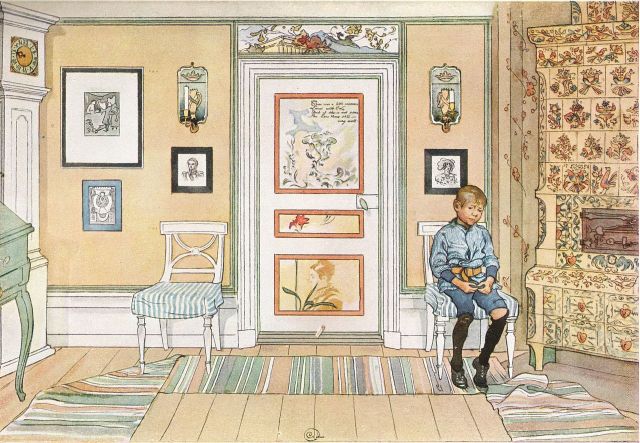
Cosy Corner 1894
“For, so long as there are interesting books to read, it seems to me that neither I nor anyone else, for that matter, need be unhappy.” Selma Lagerlöf
Self-portrait 1895
“Where the spirit does not work with the hand there is no art.” Leonardo da Vinci
NB. Comments have been turned off for this and the next post but will be on for the final third post in the series.
Note: This is a post that was published earlier in 2018 and which I recently has somehow ended up in my draft box!! I have no idea how this is possible but wanted to return it to my blog along with its 80 likes and 160 wonderful comments! Thank you everyone again!
Sammy, I know you have studied music for a long time, since you were ten I believe. I have even had the great joy to listen to your performances both at your home, at school and in Covent Garden in London.
To me your music always express so much vitality, joy and sensitivity and I often wondered where it would take you as you grew up and took your own place in life.
Would it become your hobby and the sciences your priority? Would it become your hobby and the sciences your priority? I guess you still wonder yourself.
So Sammy, you have surprised us all by creating your first single, “MY FRIEND” whilst still 16. I am enthralled with it, its advanced musicality, its depth and also the sad but yet comforting lyrics.
I feel honoured to do this first interview with you and without further ado, we dive straight into our chat.
When did you first think about writing your own music? Was there a moment that stands out?
Sammy: I got serious about writing my own music whilst in Sweden last summer. I was walking through the forest up to a viewpoint; standing at the top, listening to “Without You” by Avicii and felt a strong inspiration to start creating my own music in a way that would make people feel the same way as I did at that moment.
When did you start creating “MyFriend”?
Sammy: I believe I started composing that in November 2017. The first thing I messed around with was the piano chords and melodies which I recorded on my phone. Whilst trying to figure this out I also was working on the lyrics which was by far the hardest part of the process for me.
Would you mind giving us an idea of what inspired this song?
Sammy: The main inspiration for this song came from both my own experiences and those that my friends had and told me about. This song was also inspired by helping friends through hard times in their lives and wanting to help in any way possible
You are a pianist so I wonder how you created all the harmonies and layers to orchestrate the song in production?
Sammy: There was a lot of trial and error with choosing the instruments and percussion sounds. Most of the chord progression and melodies the instruments are doing; such as bells and violins, echo what the piano is doing so these were quite easy to produce. I had more creative freedom with the drums because, although there was trial and error, I had a lot of fun composing the drums in a way that made the piano and vocals stand out and sound more interesting.
Are you working on any new song and if so would you mind telling us about your plan?
Sammy: I am already half way through composing my next song which I plan to release some time in May or June this year. I don’t have much more to share at this point.
Sammy, is there anything else you can add about your music and how it makes you feel?
Sammy: The response from people listening to and hearing their opinion and reaction to it has been overwhelming and makes me more confident and excited about releasing more in the future. I am very happy with the way this song has turned out and my hope is that people will continue to enjoy the song in the future.
Thank you, Sammy, for letting me do this for me unique interview. It is a first for you and for me so it is pretty special.
Sammy: Thank you for having me and I have enjoyed answering all your questions.
Wow! I felt like a movie star as I left the school, a large bouquet of flowers nestled in the crook of my arm. My mind was spinning, my heart was light with joy. I’d just had a most wonderful afternoon with a group of creative writers at a local school. Aged from eleven to fifteen, the eighteen students were brimming with questions, ideas and originality. Their enthusiasm knows no bounds (a soaring and liberating sensation). From my talk below the top tip that remained with the students afterwards was to ‘Write from your Heart’ – one couldn’t ask or hope for more.
Here is my talk to them in full for your perusal and if new (or not so new) to writing I hope it can inspire you and your work.
♦♦♦
A heartfelt thank you for the invitation to meet you all today. I’m thrilled to be here and can’t wait to learn more about all of you and listen to some of your work.
First of all, how did I become an author?
Writing has been my lifelong passion. Just as I cannot imagine a life without books, nor can I imagine a day without writing. An inspirational teacher at primary school instilled in me the joy of creative writing and I haven’t stopped since. Writing became a way for me to paint with words, layering them for texture, using bold dramatic language on occasions, other times capturing the gentle nuances of a moment with subtle word play. It is an art form, that can be crafted, shaped, moulded to an endless variety of formats.
Three years ago I had the opportunity to start writing seriously and a well-established writing course gave me guidance on developing my writing as well as advising me on how to become published.
There are countless short story competitions available and entering some of these was my first port of call. I bought the magazines, studied their stories, and also, this is critical, read the rules to competitions. It baffles me how many fail to do this!
Very soon I won first prize in a Writing Magazine short story competition and the success of ‘Biding Her Time’ proved to be the confidence booster I needed.
I quickly developed a love for short stories and I delight in crafting them. They require clarity, conciseness whilst not being abrupt or missing out on the artistry of language and they can often be a form of character study. Every word has to count!
I draw inspiration from all around me — conversations, everyday experiences, and even news items. If an idea strikes me I make a note of it as soon as possible; after all it’s proven that ideas can float in and out of our consciousness within three seconds. If a notebook is to hand, I’ll scribble in that, otherwise I’ll tap away on the ‘note’ app on my mobile.
I’ve kept journals since young and they are a quiet meeting place for me to jot down my thoughts, ideas, concerns and story possibilities in private; never to be shared or scrutinised. I return to some of these at a later date and sometimes find a gem of an idea for a story, poem or even article.
A small memento of my visit for the students. May many new stories be written with these.
The first line of a story is critical to me. Once that is in place the rest of the writing flows. It is as if someone is ‘dictating’ the story, it becomes organic and takes on a life form of its own. Subconsciously I will be writing away, the first draft always on paper, and many times I will be wonderfully surprised by a twist in a story or the strength of a minor character forcing their way to centre stage. It is a magical surreal experience and one that can last for hours.
The voice of the piece is a major factor in writing. I feel there are always two voices.
Your voice as the writer must be just that — YOURS. Be true to yourself when you write; this is what makes your writing original and enables it to shine out.
The voice or point of view of a story can vary. Will the point of view be first person, which is often more immediate and direct? Or will it be in the third person, which allows you more scope to examine events beyond just one person? There is also the option of the second person – you – format which I experimented with in one of my short stories. Of course, many books feature multiple points of views and it is important to make each distinct and at all times clear whose head you’re in!
Although I have printed a one-off edition of my earlier childhood work and also been featured as part of my writing group’s anthology, ‘The Storyteller Speaks’, is my first published book. I was encouraged to publish some of my short stories in a book by the readers of my blog.
My blog was set up following the recommendation by my tutor for the need of an online presence! As a result, I have made wonderful friends across the globe and also connected with people within all aspects of the publishing industry. Through this networking, I ‘met’ the cover artist for my book who lives in Australia and a company in Ireland provided extensive formatting support.
Furthermore, I increasingly use Twitter to interact with readers, writers and publishers.
Planning a novel is not something I’d considered before I started writing mine a couple of years ago. ‘Island Girl’ is now in its final editing stages and I recollect its early days with fondness. Then, as with much of my writing, I set out to write it with just the backbones of a few ideas, themes and setting.
However, my time-line was slightly array, details of my characters and places were forgotten from one chapter to the next. It was a lot tougher keeping control of all the elements of a full-length novel. Quickly I developed various techniques to avoid future faults.
One way to spot both grammatical errors and glaring mistakes is always to read your work aloud! Since it is a lot to expect to read a whole novel aloud I started using ‘Natural Reader’ app.
Various writing programs are a huge benefit.The free online thesaurus is always open on my tab as I’m working. Similarly, a grammar program such as ‘Grammarly’ helps me to fine tune work, but I never automatically adopt its suggestions. I write on a software program called ‘Scrivener’. This acts as a virtual binder and allows me to plan chapters, look at my ideas on a virtual corkboard, include research documents, as well as writing the novel chapter by chapter.
Not content with writing short stories and a novel, I have also completed two children’s books.
What other advice can I give?
Throw yourself into writing and relish the experience! Find the magic within you and share it! Write from your heart! This may be easier said than done, if like me, your head tends to rule. Don’t disregard your mind but just don’t overthink.
Once you’ve finished a piece, and this can be tough, put it aside for a while. Returning to it with fresh eyes will be key to the next stage; editing. Here engage that brain, tap into your creativity, look out for ways to improve your writing. Perhaps you’re ‘telling’ too much instead of ‘showing’? Not only is it more enjoyable for the writer to show through their writing, it will lift your story.
Never underestimate the effectiveness of dialogue to carry a story forward, to show emotions, even description. It’s striking when you can have a sequence of speech without the ‘he said’/‘she said’. Try to avoid always using adverbs with these; the anger etc should come out in the language where possible.
Never be afraid of feedback of your work; after all we learn through constructive criticism. Also start to read your own written work with a critical eye when necessary.
Play around with your writing. Writing outside one’s comfort zone is a great way to bring new life into your work. Try another unusual genre. Shift your work around — explore new vocabulary and if writing fantasy, maybe even make up a few new words of your own! Use different tenses, viewpoints. I felt a sense of liberation writing from a male viewpoint in some of my stories and using the present tense brought a welcome sense of rush and urgency to them.
When not writing, read lots! Not just in one genre but across the board. It’s a wonderful way to learn. See what works well, and also look out for writing that falters, flatlines … learn from other’s mistakes.
When you start a new piece of writing, remember that this is your first and rough draft. If you wait to write down the most I and absolute best version of your work you may never start at all as you will feel inhibited before even writing a word.
Write with your Ideal Reader in mind — recall your own emotions and feelings when you are swept away by a story. There is nothing quite like escaping into another world; when the present real-world fades to that of the fiction. My dream has been to recreate that experience for all my readers — and hopefully I have. Make your characters three-dimensional, so real that neither you nor the reader wants to leave them!
Through the nitty-gritty of writing, the joy and power of creating worlds, characters, stories should never be underestimated.
As one famous writer said of short stories: ‘(they) are tiny windows into other worlds and other minds and other dreams. They are journeys you can make to the far side of the universe and still be back in time for dinner.’