

An unassuming man writes unassuming songs with such power and poetry that he’s single-handedly dominating the UK music charts with 14 of his songs in the UK top 15.
 Ed Sheeran, a Yorkshire lad, grew up in a village not far away and it was his ‘Castle on the Hill’ that first grabbed my attention with his signature style of telling a story of his youth, simple and straight forward but beneath the surface a soulful and profound message.
Quickly other songs on the album grew on me but ‘Castle on the Hill’ stayed with me and when I learned it was only an hour’s drive away a visit was planned. I just hoped it wouldn’t disappoint.
The predicted hour became a long meandering two-hour journey through quaint villages, thatched houses centuries old hugging the roadside. Soon other houses took on bold and vibrant hues, painted in ochre, startling orange, scarlet, dazzling blue. Small hamlets with the extraordinary names such as ‘Nedging with Naughton’ passed quickly whilst pedestrian style hunchback bridges spanned the brooks. Once again we spurned the Satnav and trusted to instinct, good luck and ultimately the good-old fashioned road until finally, we arrived at Framingham (and it only took three circuits of the town to locate a parking space!).
Framingham Castle dates back to the 12th Century and it was built by a local Norman family and was their home for over 400 years. Later it was briefly owned by Mary Tudor as she gathered her supporters to fight for the throne.
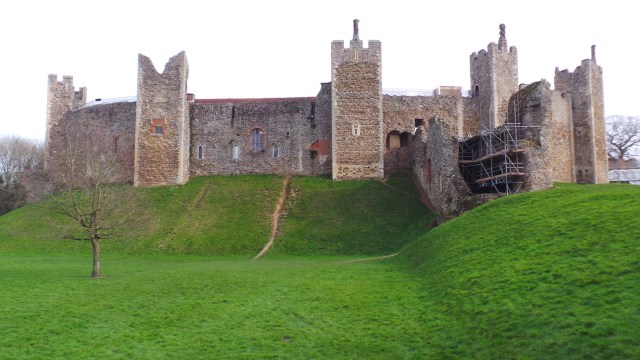
The castle is built on the natural highpoint in the village and it stands magnificently on the mound; a landmark visible across the county to the North Sea.

Its imposing facade strikes me as I walk towards the main gate which would have had a drawbridge across the dry moat. Towers reach for the sky and now number twelve out of the original thirteen and on top of some beautiful brick Elizabethan chimneys have been added by later occupants.


These were for both decorative and practical purposes and seeing their corkscrew design it is easy to understand why!

Having read about the wall-walk this was our first destination. It is unusual to find a complete curtain wall in a castle in England – let alone be able to walk around it.

The climb up the 10.5 m (30 feet) high walls was well worth the effort with spectacular views, particularly looking down at the mere below. When originally built the mere was three times larger and the castle would have been reflected in the still water and provide a striking and stately effect.
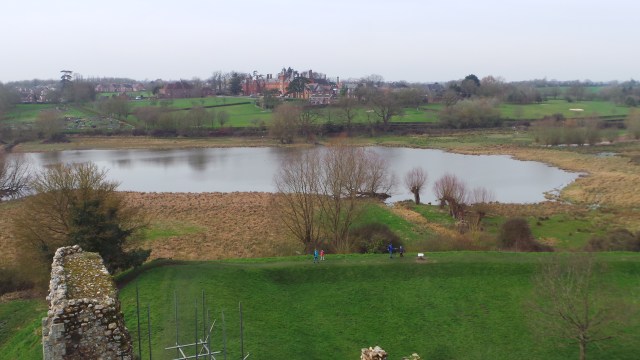
Walking around the moat, past the mere the sense of peace is palpable, the sense of history all around. Where Normans and Tudors walked, fought, lived, sightseers of the 21st-century swarm. People from the village gather, talk, chat…discuss music, compose songs. It is not hard to feel the inspiration which has become a top hit for Ed Sheeran.
As the album ‘Divide’ popularity grows and yes, I have become one of over 672,000 to have fallen in love with the album and bought it and quickly another song stood out to me. Its quiet, peaceful lyrical beauty is a tribute to his grandmother – it is wonderfully moving, touching the hearts of all who listen to it. I’m sure ‘Supermarket Flowers’ will have many in tears.
*From ‘Castle on the Hill’




 This is Flora’s life until one day something amazing occurs – she kisses a boy on the beach and remembers it! The boy is called Drake and also Paige’s boyfriend. This pivotal event transforms Flora’s life and she will do anything to chase her memory of Drake – even to the extent of travelling to the Artic alone in search of him. Her one and only memory in seven years. She’s sure he holds the key to her future self.
 Unlike Flora, the reader has one major advantage – memory! With this ability, the brave, tenacious and surprisingly whimsical nature of Flora shines through and the remote location in the frozen depths of the Artic takes prominence, the bleak white landscape a metaphor of Flora’s blank spaces where her memories should reside. Gradually a more complete picture of her life is created, how her parents dealt with her illness, how her brother wanted her to have a more free, less protected life. His belief in her strength and ability to do anything is the driving force that carries her closer to Drake. But will she ever find him? Will it help her recover her memory?
 I received a free copy of this book from NetGalley in exchange for an honest and impartial review.






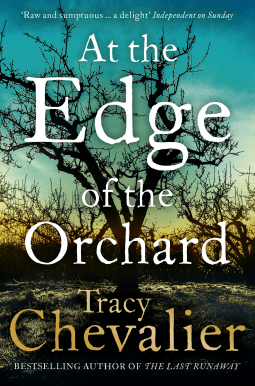
 As a huge fan of her earlier books, particularly Girl with a Blue Earring and The Last Runaway, I was positively giddy to be approved by HarperCollins to review her latest creation, At the Edge of the Orchard. I started reading with a great sense of anticipation.
 Constant war reigns between James and Sadie Goodenough in Ohio in 1838 and onwards as they struggle to turn the inhospitable and aptly named Black Swamp into a successful apple orchard. To James, son of an eminent apple farmer in Connecticut, apples and their trees are an obsession and are treated with reverential care and none more so than his beloved Golden Pippen, a sweet-tasting ‘eater’.
  Meanwhile, his wife Sadie seeks solace from the misery of her life, her losses, in the applejack cider which is made from fresh ‘spitters’ apples.
  Whilst the first section of the book deals deftly with details of apple grafting, growth, picking, the second section centres around the grand sequoia of California and of Robert’s life with them. The description of the sequoia that Robert first encounters is awe-inspiring and I can visualise the whole scene exactly.
 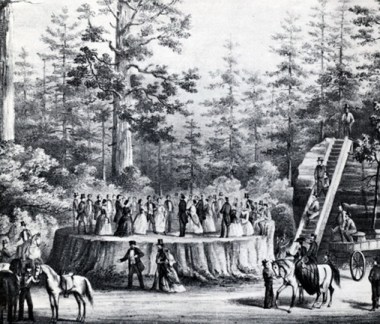 Throughout the book, Tracy Chevalier expertly weaves fact with fiction, including the then recently discovered Calaveras Grove in California. Billie Latham built the infamous stage on the stump of first giant sequoia, named The Discovery Tree, to be cut down at the Grove. As a tree agent, Robert becomes responsible under William Lobb to collect seeds and saplings to send to James Veitch, an English nurseryman for the stately homes in the UK.



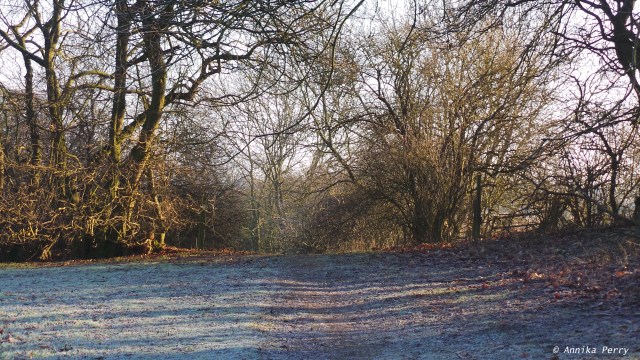

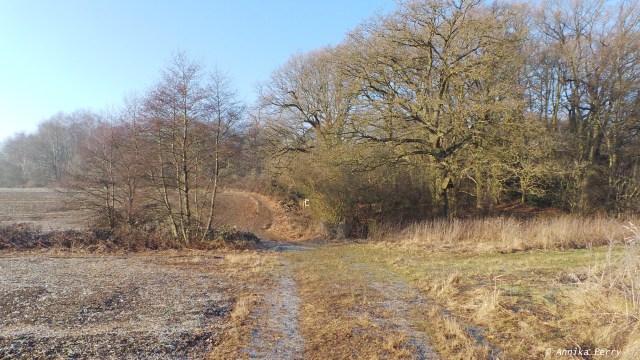


 Imogen popped one more Malteser in her mouth, cracking the honeycomb between her teeth. One of her front teeth wobbled precariously before slotting back into place.
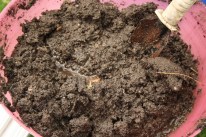 Layla rolled back in shock, knocking against the tool table which sent a trowel flying into the air, the slimy sloppy brown mud on it trailing messily on the floor and landing by her side.
 Layla followed Imogen down the path to the house, shaking her head in wonder. How did her mother’s mask from Gambia end up outside?
 Layla woke with a start and reached for her phone. 00.00. Midnight. Scrambling out of bed she ran to the door when she suddenly heard an ear-piercing screech. Her mother. Then silence followed by a cough becoming louder and she edged away from the door as the footsteps came closer. Stumbling, she reached the wardrobe and lunged inside, tapping at her phone screen.
 The Five Year Journal is a unique form of the diary requiring only one or two sentences a day – over five years. The layout is one day listed five times on each page, each entry to be filled in one year at a time. The concept had me intrigued from the start and was a perfectly thought out present for me.

 I can well imagine that with time my journal will become a source of support and thoughtful reflection of where I have been and where I am going, already it is focusing my attention on ever-present and I’m gaining a new perspective on my life!


 Annika Perry