Small, Smaller, Smallest

article-2663097-1EF3198F00000578-440_634x393

What do you think is the world’s smallest book?

I wondered this myself after my son quoted from one of his factual books that the world’s smallest book could fit into a nutshell.

Intrigued I set out to gather information. article-2663097-1EF31A8800000578-451_306x300Indeed there is a book which could easily fit in a nutshell.

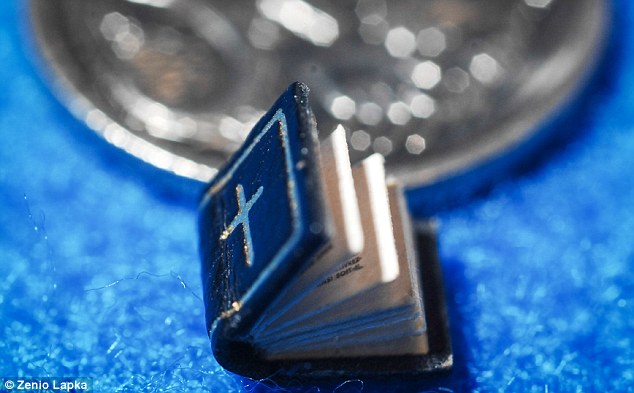
Created in 1952 by the Gutenberg Shop to raise funds for its museum in Mainz, Germany the book measures only 3.5 mm by 3.5 mm. It contains the Lord’s Prayer in seven languages and the pages can only be turned with a pair of tweezers and requires a magnifying glass to be read. article-2663097-1EF3389B00000578-3_634x466

The book is made in the traditional manner, with letter printing, bound in leather, hand stitched and completed with gold cross on cover and gold blocking. nano2

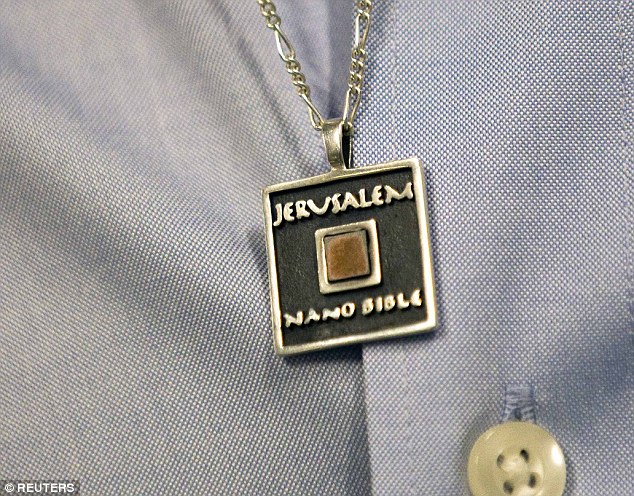
However, even smaller in depth is the smallest bible in the world, the nano bible. Forget paper, printing and leather binding, this bible is a silicon wafer chip measuring 4.76 mm – as large as a finger-nail.

It nano1contains all the 27 books of the New Testament.  Although you can have the book with you at all times – now offered as part of jewellery, there is one serious snag. You better not forget to bring a microscope along!
According to Guinness World Record however, the smallest book is the minute hair-width ‘Teeny Ted from Turnip Town’. teenyCreated in a nano laboratory in Canada, this 30 page tale is only visible through the use of an electron microscope as it is printed on a microchip tablet made from pure crystalline silicon.

This labour of love cost nearly £10,000. The book, which has its own ISB number, was made by the Robert Chaplin at the Simon Fraser University, in British Columbia, Canada. The story was written by his brother Malcolm as a distraction from his economics studies in 2007. teeny3

To the left the is the  small book chip set next to a thin scratch in a piece of glass.

After all that I’m off to read a book – one that can be held in my hand,  legible to the naked eye and not worn as a piece of jewellery!

“Never put off till tomorrow what may be done day after tomorrow just as well.”

by  Mark Twain Photos: From DailyMaill online or otherwise where stated.

DON’T PANIC

lone runner

The Wall. 

Everyone has heard about The Wall faced by marathon runners during competitions and with family members who have run the 26.4 miles, I have listened aghast to their descriptions of pain and fatigue. In quiet awe I have seen them overcome this obstacle and continue to the finish. I  just never imagined I too would one day face the wall, not through running but through my writing. 

Although a ferocious reader since young, I honestly never considered the effort and work required to produce a book. I hold up my hands in surrender, ‘mea culpa, mea culpa’, I was one of those, taking books for granted, their magic appearance on the shelves almost a matter of routine.

Now I know better and since there is a long way until any book of mine might be produced I am fully aware that my learning curve is long and steep. I am only on the start of the  climb and have reached my first base camp.

At just under 50,000 words on my first draft I hit The Wall. Friday afternoon at ten to one. With a marathon writing session completed, I stopped typing. For the first time in a couple of hours I lifted my head from the screen and saw the white doves circling the rooftops and garden. My heart tried a bounce of joy. To no avail. Confused I headed to the kitchen, my legs heavy and my body surprisingly fatigued. A cup of tea and some biscuits, that would help. Wouldn’t it? Picking up the newspaper on the table, tea in my other hand, letters swam around in a swarm on the paper. Finally they settled into a mishmash of words, all individually comprehensible but my mind refused to stay with them and instead floated away, blitzing its way through the morning’s writings, its ideas, plots, characters, twists.  Resigned I put down my cup.

This must be my wall. My creative meltdown.

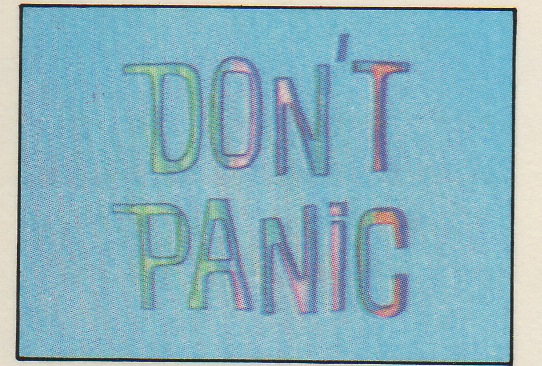
‘DON’T PANIC’. Don't Panic

The famous words written on the cover of ‘The Hitch-Hikers Guide to the Galaxy’ sprung to mind that afternoon and I found them oddly comforting.  When I thought about returning to the writing my mind froze.

Don’t Panic.

What could I manage to do? Some gardening and with secateurs in hand I turned into the demon bush pruner – with glee attacking dead twigs in the garden, cutting bushes to within a few inches of their lives. My mind did not think, it just was. Pure bliss. Afterwards housework tasks were no longer a chore, but completed with satisfaction. I knew this couldn’t hold out for too long.

Don’t Panic. 

Relaxed that the wall was being chipped away, that I would soon return to the first draft, I decided not to push too hard, to force myself against such a obstruction. By Monday afternoon ironing had lost its glow and I resumed my other writing tasks. A short story for a competition and then preparing my next blog post.

I had named this blog a journey – hoping to capture reader’s interest and imagination and bring them along on a journey as I wrote the first draft of a book. What I had not anticipated was the emotional journey within myself. 

Having read countless ‘how-to’ articles in writing magazines as well as a few books on how to write a novel I am now struck that none mentioned the emotional impact of such an undertaking.

Not until I hit the wall.  Now, with a good rest, the house gleaming and garden ready for some new plants, I am ready. With my mind exercised with alternative writing, I am ready. Refreshed both body and mind, I sit down and feverishly start typing. After all, there is another 50,000 words or so to go!

“I like the cover,’ he said. ‘Don’t Panic. It’s the first helpful or intelligent thing anybody’s said to me all day.’

Douglas Adams in ‘The Hitch-Hikers Guide to the Galaxy’.

Beak of Life

100_1448

A dull thud against the glass kitchen door broke my morning reverie.
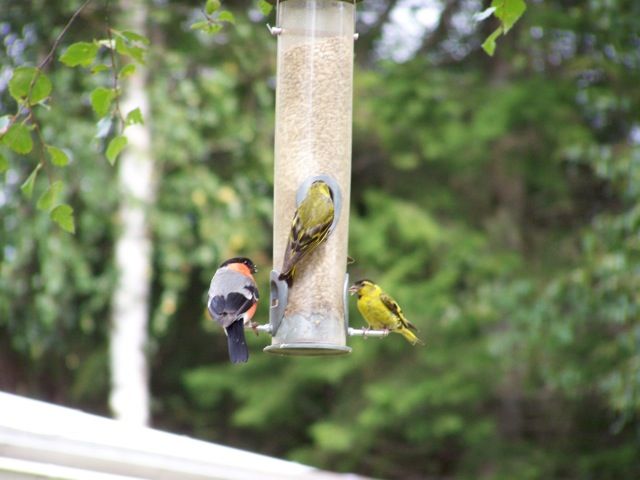
Blissfully I had been admiring the daffodils dancing in the breeze.For a second I muttered at the four bull-finches, vexed at their monopolisation of the bird-feeder.
‘Let the others on, you bullies,’ my mind signalled to them. Did they listen?
Three BirdsNot a chance. I espied an eager robin fluttering below the feeder, then with sudden decisiveness he darted to the fence post. My patient gardening buddy, who alas has a long wait until I weed the borders and he can scour for worms left behind.
Then thwack.
Standing by the door I looked down and spotted a little grey-blue bird lying still on its side.
‘A nuthatch,’ my husband told me confidently. ‘Made a bit of a hatchet job there,’ he added, chuckling at his own witticism. I glared at him before examining the bird again.
He moved, ever so slightly, still alive!  His head and body twitched and his beady black eyes stared accusingly at me.  ‘It’s a door, to our house,’ I retorted telepathically, ‘we need those things, doors!’
Another nuthatch flew down to join his friend and nervously he hopped in circles around him.
Braving my silhouette he approached the stricken nuthatch before abruptly leaping upon him. Swiftly he gave his friend the ‘beak of life’. A couple of pecks on his head, then some around the beak of the injured bird.
It was humbling to witness this love of the avian variety.
However soon I became alarmed as the first signs of affection turned to violence. The pecking intensified to vicious jabs at the now seemingly lifeless bird.
I knocked forcefully on the glass and reluctantly the fit nuthatch skittered away to the lawn. There he  stopped and looked at his friend. I too glanced down.
100_4002
A wonder! The dazed bird wobbled uncertainly on it’s two feet. Would it soon be strong enough to hop around? Was there a chance he could fly away?  I remained hopeful and giving him peace to recover I moved away – after all there was breakfast to prepare.
With the three assorted cereals tipped into their bowls, toast ready, orange juices poured, tea pot overflowing, I cautiously edged towards the door.
Outside on the bird feeder there was the normal feeding frenzy – but on the patio or lawn there was no sign of our two special visitors who caused the morning’s excitement.
Robust and fit enough to fly away; they had departed. A little nuthatch rescued by his fellow friend.
What love, courage and devotion. My heart stilled for moment. Maybe here was a lesson for us all.
————————————————
To finish a quick message on this special Sunday here in the UK to all Mums out there –  a Happy Mother’s Day to you all and have a thoroughly enjoyable day being spoilt! I am!
images.jpg

A Midwife’s Revolt: A Book Review

sleeping women

Painting: Courtesy of B.Haynie

Recently I had the opportunity to join NetGalley, an online book reviewing organisation.  Publishers send in their books months prior to release and ‘professional readers’ are then asked to review the book. The feedback and recommendations are considered highly valuable to the publishers and future readers alike.

badge_proreaderI will be reviewing one new book here on my blog on a monthly basis – do look out for them and hope you enjoy the reviews.

The Midwife’s Revolt  by  Jodi Daynard

cover60583-mediumWithin the first few sentences, this book immediately and powerfully transported me to the life of women left behind home during the American Revolution.

The story follows newly-wed Lizzie Bolyston as she sets up home on a farm on the outskirts of a new town South of Boston.

Related in Lizzie’s voice the reader quickly enters the head and heart of this strong young lady as she faces increasingly tougher struggles.

Firstly grief blindsides her but with help of friends she slowly overcomes both this and then the prejudice to what is regarded as her ‘witch’ like skills of healing and midwifery. She is exceptional in both and gradually, the ‘medical arts’ taught to her by her mother, help provide a living for Lizzie whilst saving dozens of lives.

As the war deepens Lizzie finds herself embroiled in political intrigue centred around her close friend Abigail Adams, the wife of the future Second President of America. For a while Lizzie even finds herself attempting to disguise herself as a man during her espionage escapades. After all, the book starts with the sentence: ‘My father once told me I had the mind of a man.’

However this is not a traditional thriller as parallel to the assassinations and treachery runs various strands of the romantic nature.

Lizzie finds herself courted by a man, Mr Cleverly- but can she trust him? Equally she is attracted to another, Thomas Miller – yet again she is faced with the same dilemma of those unstable times – is he trustworthy?

The actions of her servant and close friend Martha also raises further doubts as to faithfulness and friendship. This suspicion causes great heart-ache for both women. Life for them all is never simple nor straight forward and nothing is quite what it seems.

I must make a quick mention to another powerful being in the book, whose existence is still etched on my brain – the wonderful and faithful horse, ‘Star’, her husband’s beloved animal. Life is never fair, Star!

Jodi Daynard’s writing is fluid throughout and its authentic contemporary feel never wavers. At times I have to remind myself this was actually a work of fiction and not a factual story.

The harsh and bleak life is brilliantly rendered, so raw I suffered with the women through their troubles and the winters of hunger. How I celebrated with them as they ate their far too rare servings of warm apple pie!

Their struggles with the farm are graphically related and whilst celebrating feminism and its strength, I rejoiced when they received the occasional help from a man with some of the hard graft.

The book climaxes with a dramatic battle on their very doorstep where the battles of the heart are reconciled and the future of America is more secured.

Although I approached this book with trepidation – the time period alone of the American Revolution  filled me with fear – I can honestly say there is never a boring moment in the book.

It has a  strong pace throughout, the characters, whether good or evil,  are vividly portrayed and the true grit and courage of the women shine through.

This is truly a gem of a book. Do read it now and escape into the past!

Publishers: Lake Union Publishing

Release date: 7th April 2015

N E W S F L A S H      N E W S F L A S H    N E W S F L A S H

I just found out that I am now on the short list on the Ink Tears Short Story Competition 2014.

Yes, I am thrilled to have reached this far.

Winners will be announced end of this month.

“From the eyes to the river
From the river to the sea
From the sea to darkening clouds
From the sky back down to me
Follow my tears…”
by Eddie Reader, singer/songwriter

Love Poem

The Peripheral A Sunny Sunday morning greeting to you all.

I told you before that I have been writing since I was a girl and as a present to my patient mother I made a big collection, had it bound and gave it as a Christmas present.

I called the book  ‘The Peripheral’, which was the name of a magazine I used to produce when young for my friends and family.

Whilst visiting my mother yesterday we skimmed through the book and I saw this poem. I wrote this when I was 12-years old.  Poetry is not my forte and I was surprised to find this but wanted to share it with you as it is equally relevant today.

LOVE

Love

A thing to be cherished

Treasured forever

Love

A thing between all

From the ‘superior’ humans

To the ‘humble’ hedgehogs.

Love

A thing needy to all

Always there, ready to delight

The eager youngsters

The ageing parents.

Love

Never ask for its presence

Love, real love

Unquestioningly comes

It never falters

Or flickers away.

Love

Its strong pulse is ever near

Never closing its doors

Where happiness flows in.

Love.

“Joy is a net of love by which you can catch souls.”

Mother Theresa

Update: Current word count on first draft of novel: 40,531 words

Netflix for Books

PastedGraphic-1

You’ve heard of subscription television; now prepare yourselves for subscription books – the ‘netflix for books’ is here to stay. 

What does this really mean though? 

How much brighter does this make the world for the reader and the writer ?

Is it effectively a modern day virtual library? Hardly.

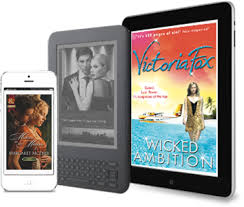
Although Amazon were not the first to introduce subscription books, their release of Kindle Unlimited (KU) five months ago brought subscription books to a world wide market. At first glance the deal is enticing for readers. To be able to borrow ten books per month for £ 7.99/month sounds tempting.newcorn partII

However unless you are a exuberant bibliophile you will never read the ten books allowed and if one or two books per month is the norm, then you could find yourself paying more than you would if buying books themselves. With so many books available for exceptionally low prices the monthly direct debit could easily become more expensive.

It is not only readers who should beware and approach with caution; writers too are beginning to struggle under the Kindle Unlimited contract. 

Writers are paid a percentage amount according to the number of reads of their book. This comes from a monthly pool of money set aside by Amazon.  Already some writers have noticed a 40%-75% drop in their revenue.

Income has fallen further for writers as customers have started reading KU books instead of buying new ones. There is a real risk that buyers will read the more established authors, which might have cost more previously, instead of taking the chance on an unknown new author whose books were previously much cheaper but still cost on normal kindle or paperback.

imagesThis catastrophic decline in income has resulted in some writers withdrawing from the Kindle Unlimited programme and instead selling their books under the much more generous ebook terms. 

The extremely restrictive demand by Amazon for exclusivity on books on KU has further cut sales for authors as they have been unable to release their books on other platforms.

The top five big publishers are so far withholding most of their titles from Kindle Unlimited and therefore the choice on KU is rather limited for the reader as the top selling authors (which many people want to read) are not represented. 

Subscription books are still a force to be reckoned with as other platforms, such as scribd* or oyster, do exist and their terms are far more generous towards the writer and do not demand exclusivity. 

Finally let us not forget that faithful ‘old’ paperback and hardback books. Will their new found stability following the introduction of ebooks flounder under the onslaught of subscription ebooks? Will this become the next substantial obstacle for the publishers of hardcopy books?

Will KU see a fall in their subscription as writers flee from their terms and conditions? 

Will readers demand a better and bigger selection of books for their monthly fee? 

Will Amazon cave in to writers’ demands for similar contract terms as other subscription services and thereby tempt in the bigger-hitting authors to join them?

Do you have any experience of Kindle Unlimited? Either as a writer or as a reader? I would love to hear your comments and share your experiences. Only by doing so can we empower ourselves to make the best decisions as writers and readers.

“I find television very educating. Every time somebody turns on the set, I go into the other room and read a book.” 

Groucho Marx

THE POWER OF THE CREATIVE SPIRIT

100_7552

Welcome to you all and to the first of a new month. Spring floats on the breeze and sitting out on a weather-worn bench in the garden I rise my face to the dazzling sunlight. As the daffodils tilt and twist to capture its warmth, so do I.

On such a morning I find myself pondering the nature of the creative spirit and at times its unimaginable strength in the face of insurmountable agonies.

These musings follow in the wake of reading about Frida Kahlo. She was not an artist for which I hold any particular affection although I know of her work. What I did not know was of the life of pain she endured until her untimely passing aged only 47.

Firstly as a child she suffered from polio but made a recovery to normal life. Then aged 18 she was severely injured when the bus she was travelling on collided with a trolley car.

As a result of these injuries she was never free from pain again. In the following years she had over 35 operations and many episodes of agonising pain that resulted in her being bed-ridden for many months at a time.  Among other sorrows the physical damages rendered her unable to have children.

Where this life would fell many, Frida instead discovered, with her parents help, her love of painting and throughout her life she painted over 150 paintings. Furthermore she travelled in Central America, the USA and Europe. On a personal level she married the famous painter Diego Rivera – twice!  Throughout their tempestuous mutually adulterous relationship she never stopped painting.

The indomitable spirit of the creative being within us is alive and waiting to be tapped. It takes courage, persistence and passion to continue to work through pain and illness of any sorts. Its rewards are unquantifiable.

Reading about Frida’s life and knowing so many who continue their creative work in spite of (or perhaps as a result of) their hardships is a true inspiration – to myself and  hopefully to you all.

‘Our existence is not an accident but a mystery…We can entrust ourselves to this mystery, for we are part of it. Indeed we are it.’

By  Jean-Pierre Weil, ‘The Well of Being’

A Break and Biographies.

100_5458

It’s amazing what wonders a break can make.

Last week was half term and I had therefore decided to give my first draft a welcome rest – we needed to give each other some breathing space. Instead I had a restful and fun time with the family. On Monday out came my iPad, my Keyboard and once clipped into place I was set to go.

I found I was writing with renewed vigour and energy as well as a greater sense of enjoyment and satisfaction. My fingers struggled to keep up with my thoughts, stumbling over each other on the keys. One downside of this extra vitality is that my poor brain never seems to stop buzzing and even half asleep I will find myself trying to recall sentences to write down in the morning. The world of my characters are becoming such a large part of my real world that even in my sub-conscious the border between real and imagined is blurring.

When I started this project I knew many of the ‘rules’ of writing a novel and realised from the beginning that I had committed a cardinal sin in my approach. My error – never starting,  no matter keeping up to date, a biography of my characters. Week after week I have winged it, just writing away, everything held in my head. It seemed to work well enough although I was forgetting names of smaller character. After the weeks holiday my memory had lapsed even further so yesterday I finally started my biographies.

First there is the obligatory visit to a good stationary shop for  a new notebook. As all writers know, you can never own too many of these. After throwing away a small fortune on a blue striped ‘Pukka Pad Project Book’ I returned home and set to work.

On a separate page I wrote the name of a character featured in the story and then added detail.  As I need to reinforce my time-line I have given birth dates to everyone as well as surnames, siblings, school names, type of work. I finally got round to writing a clear description of each character, including any particular features, eg. a lop-sided walk, nervous habit of fidgeting, their speech manner. etc. Furthermore I have added their likes and dislikes as well as their fears. Also I like to describe the characters’  clothing, the feel of the material, the look.

Below are a couple of character biographies I completed last year for another book idea which as yet has not been developed further. They should  give you an idea of what is involved.

My Fictional Biographies Examples.

Christine Brazier.

Christine was born on 12th May 1978 in North Yorkshire and lived in a small village called Bellingham. She later attended the highly prestigious Harrogate Ladies College and later studied medicine and in 2002 graduated from Durham University.  She is currently a paediatrician at Leeds General Infirmary. Christine did not have an easy childhood, losing her mother to cancer aged ten and thereafter, although her father cared for her, she lacked love and warmth in a normal family setting. Her older brother was largely disinterested in her. As a result Christine has become a very uptight and controlling person, almost a perfectionist. Although she will listen to others she has often already made up her own mind. This flawed character trait is crucial to the story. She is a keen health fanatic and enjoys spinning at the local gym, road running and races and is addicted to tweeting.  Her guilty pleasure for relaxation is on-line bingo – but always within limits. To start with she has no sense of humour. As the story progresses and she loses control of her life we see her change to a more easy-going, relaxed person, willing to accept help from others as well as learning to laugh in adversity. Christine is divorced with two children who mean the world to her. Christine is very skinny, tall and has green eyes and dark red hair cut short and  straight. She has a habit of tilting her head to one side when listening to others. When talking she tends to talk in short clipped sentences at work and her frustration with people she considers working too slowly is palpable.

Owen Boyd. Journalist, later Christine’s friend.

Owen was born on 23rd March 1968 in a poor suburb of Bradford. He is a disillusioned reporter on the Yorkshire Post, which is based in Leeds, and he has become bitter over the years about his lack of career advancement. His dreams of working for the nationals has never materialised. He left school at 16 to work at the local paper and attended college part time to gain his national certificate in journalism. Boyd, as he is referred to at work and outside, has scruffy blond hair with blue eyes and does not have a keen sense of style. This shows up more than usually as he is tall and has a solid build.  His comfortable style of clothes for work does not sit well with the modern sleek expectations of the office.He never walks or saunters, rather strides purposefully forth as if on a mission.  Following his years of experience in the print press he feels this gives him unique knowledge of how to work and he resents taking orders from younger more senior but inexperienced managers. This often leads to confrontation. However he is often right and his dogged obsession with the smallest detail and meticulous research skills have stood him in good stead.  Following a bitter divorce and estrangement from his teenage daughter Boyd has  became addicted to prescription drugs and started smoking again. His love for the outdoors hasn’t dulled with time and he is still a keen cyclist and gardener. In his childhood he had a passion of keeping tropical fish and this interest has been revived since living on his own and he now has one room at home filled with fish tanks.

“The spirit of man is nomad, his blood bedouin, and love is the aboriginal tracker on the faded dessert spoor of his lost self; and so I came to live my life not by conscious plan or prearranged design but as someone following the flight of a bird.”

Laurens Van Der Post

Word count of first draft:35,108 words

Colourful Collective Nouns

ow.jpeg

I love the colourful collective nouns I discovered recently and feel ashamed they’d passed me by all my life until now. There are so many to choose from but below are a few I want to share with you. Hope you enjoy them: whether collective noun pro or a novice. Enjoy.

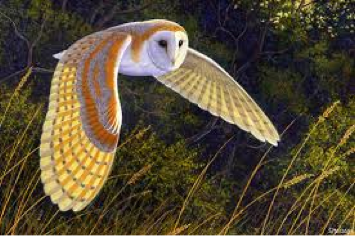
Whilst trekking through the jungle (or sailing in a small boat across the ocean) there is the  risk of being assaulted by an ambush of tigers.  Creches around the world entertain the young children by a storytelling of ravens The floral display of flowers will never seem the same again after witnessing a bloom of jellyfish and continuing on the herbaceous theme, those poor Jellyfishplucked game birds; not bad enough being shot, now they risk becoming a bouquet of pheasants. Maybe the sight of them caused the gaze of racoons or resulted in a bellowing of bullfinches. What about those majestic circus performing African mammals, clambering precariously on top of one another until you have a tower of giraffes. After witnessing all their strenuous effort the sleepiest of animals slowly dash for their pillows and duvets and as their eyelids battle with drowsiness there is soon a bed of sloths. Not all animals are so lethargic bullfinchesas the magnificent nocturnal birds of prey swoop to create a parliament of owls. Imagine them holding court over the country, power of the land in their stately talons – and who knows, perhaps much wiser lawmakers than their human counterparts. The most appropriately collective noun must surely be a flamboyance of flamingos as they gather in their thousands (or at times over a million) on the African lakes. One of our busiest rodents are a scurry of squirrels as they dart about the land, collecting nuts and seeds, stopping occasionally for a swift glance around before leaping away, up the tree, over the fence, down the alleyway.  Finally, let the past be safely stowed away within a memory of elephants.

 “in every landscape the point of astonishment is the meeting of the sky and the earth.”

by Ralph Waldo Emerson

In Print

Kindle3

I want to share some good news with you all.

This morning I sat in bed having a leisurely breakfast. How decadent I know, but since it’s half term at the moment, I happily grab a few moments of relaxation whenever possible.

Having read the back few pages first of Writers’ Forum (March 2015) I turned to the front pages. A few seconds later I squealed with delight as I found my piece on The 17th Century Kindle printed in the ‘NewsFront’ section of the magazine.

I had sent this to Writers’ Forum a couple of weeks ago and since I hadn’t heard anything from the magazine I had forgotten about my submission.  Again, a real boost and I am happy to share this interesting story to a much wider audience. The piece submitted to Writers’ Forum was much briefer than my blog post on The 17th Century Kindle as the guidelines clearly stated that items should not be more than 200 words.

We are awakened through poetry;
we are affirmed through ritual,
we are fulfilled through music.

by Confucius