THE 4,000 YEAR-OLD STORY

100_7898

Hasn’t mankind always had a desire to tell a story? To tell their story?

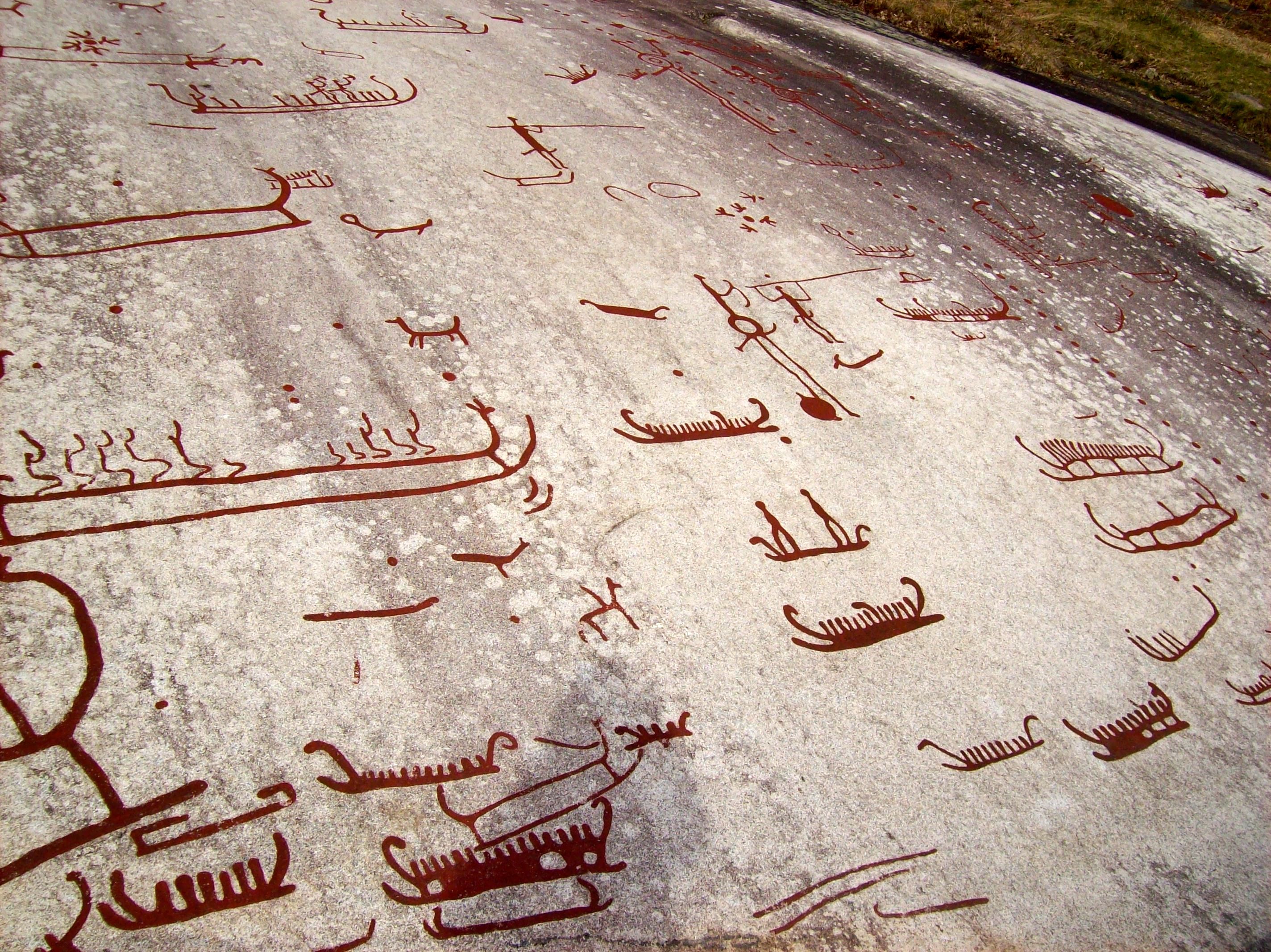
The thought struck me as early one Friday morning during Easter as my son and I visited Vitlycke Rock Carvings in Sweden. It’s not often you have a World Heritage Site all to yourselves and in quiet reverence we strolled amongst the 4,000-year-old rock carvings.

100_7892As if bleary from sleep, the sun hung low in the sky, its light dancing between the trees, the dew on the grass shimmering in sparkles of delight. Slowly we approached the biggest rock panel which alone bears over 500 images.

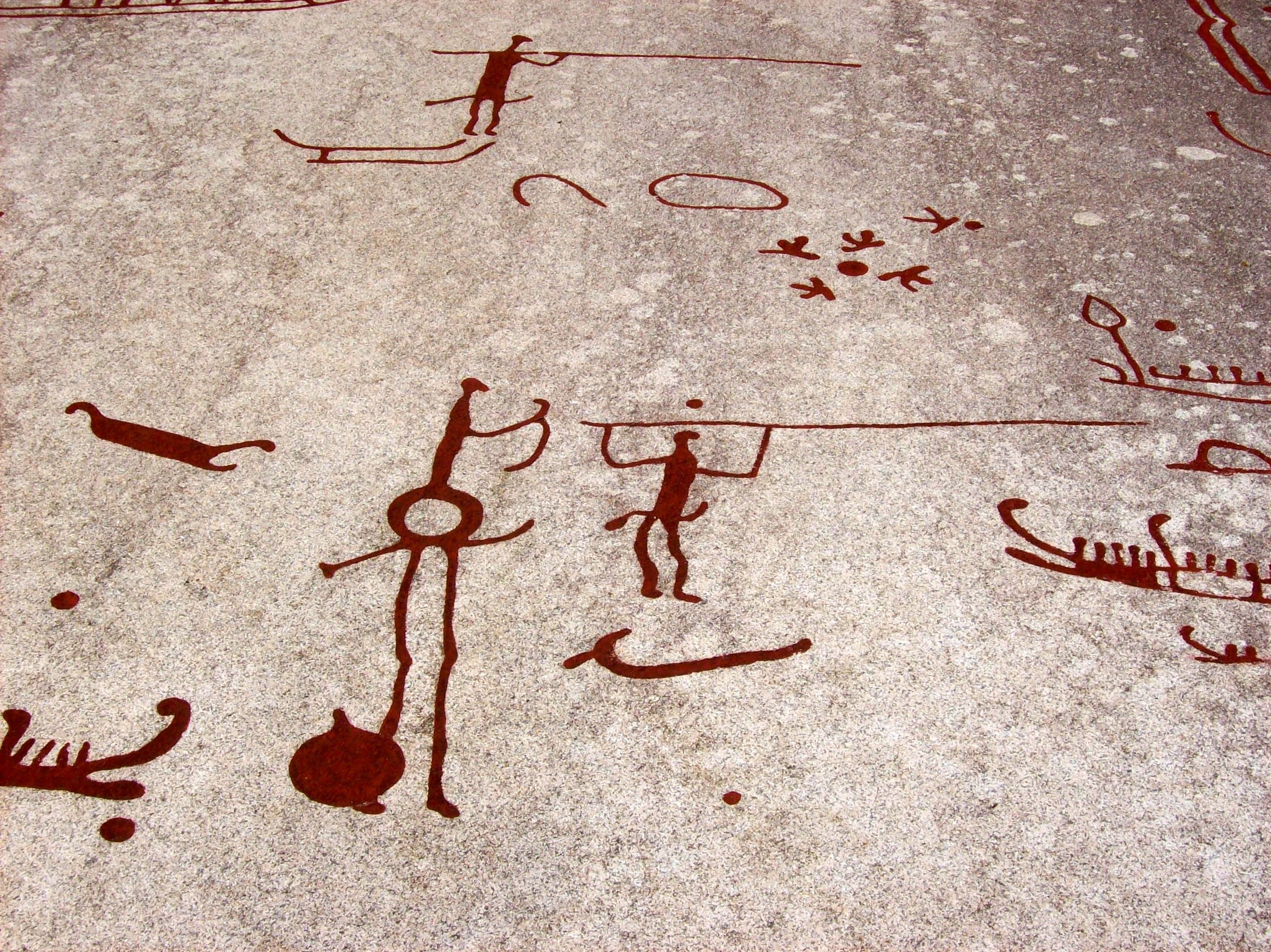
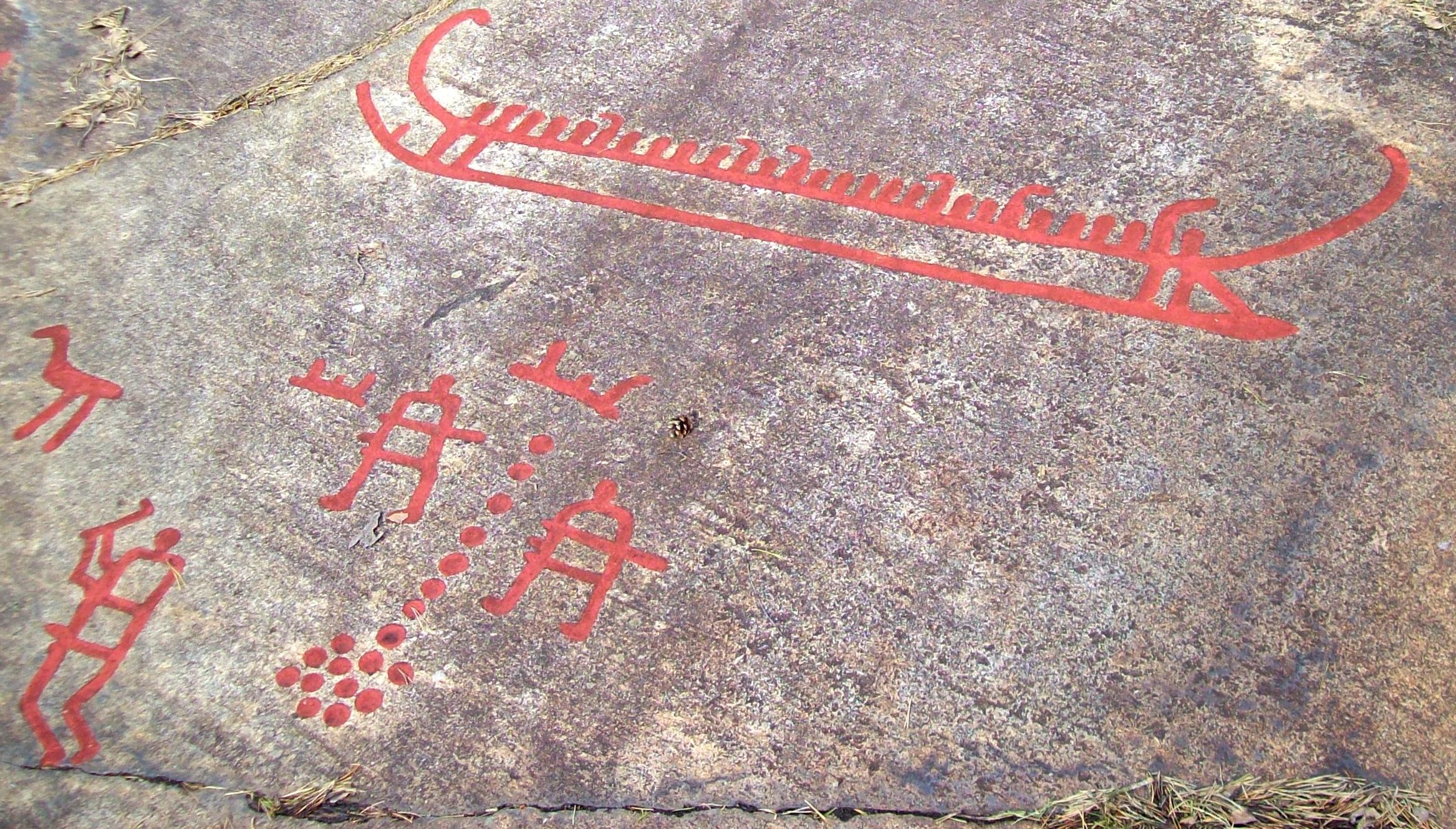
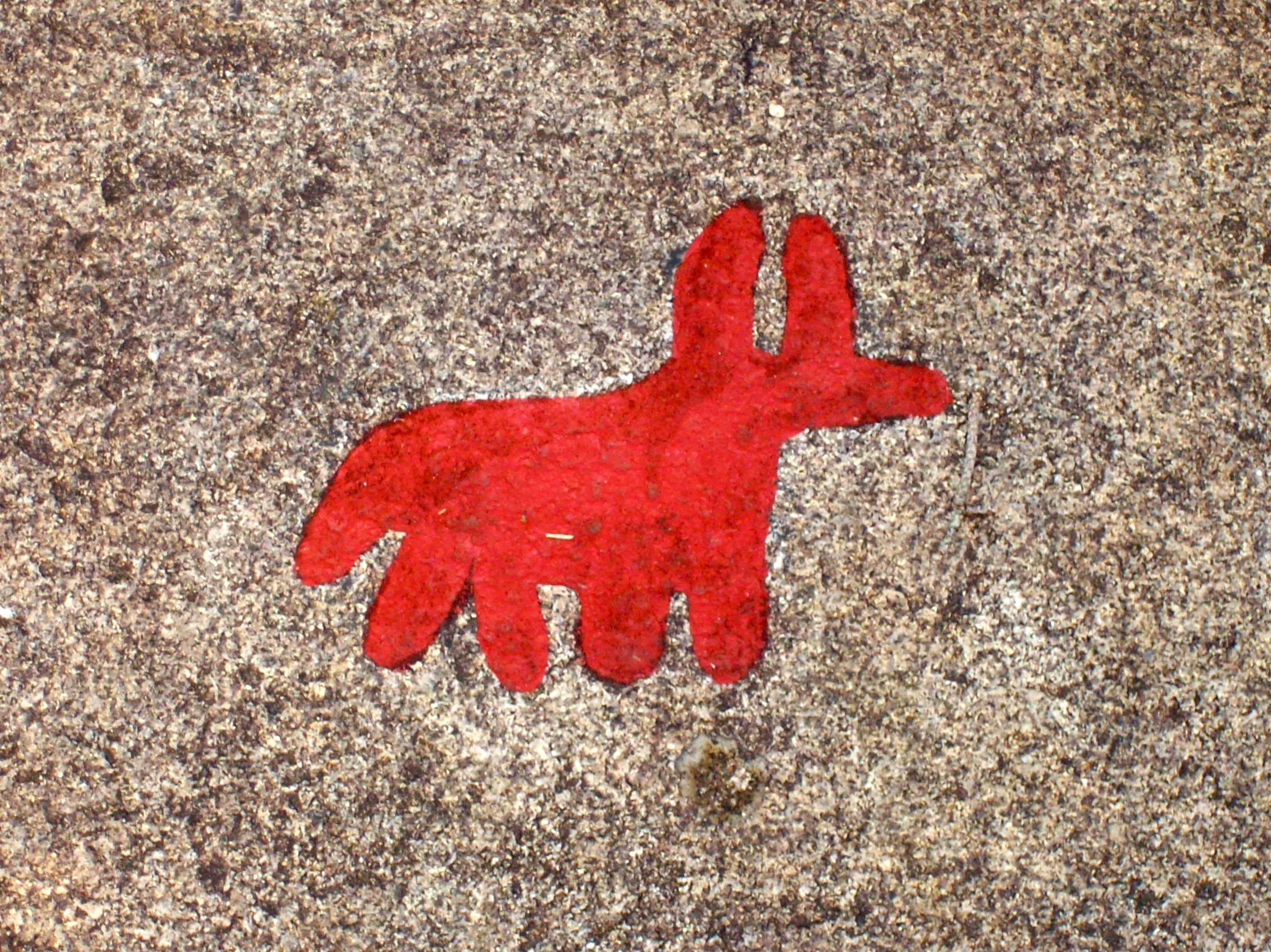
The creative force of the images struck me first. They were full of passion; with brute strength telling the story of their lives. Of gods, hunting, fishing, ships. Of people and animals. Of men and women. Of war and battle. The artistic images rendered vibrant and more visible by the red coloured paint.

In the silence, we felt we had stumbled upon a sacred site, the atmosphere spiritually ladened. The vivacious animated figures were ready for action and seemingly about to leave their two-dimensional existence and enter the realm of 3-D.  I imagined a flotilla of boats sailing away across the seas.

On my first visit many years ago the ship images had bemused me as from the hill the sea was not visible, being miles away. However, a plaque quickly explained that in the Bronze Age the water level was 15 m higher. Below us, where the car was parked, where the visitors centre was built, would all have been under water.

100_7894One particular image of a man is over 2 m long and is the largest petroglyph in the area. Is it a portrait of a local chieftain I wondered? I read the plaque which states this is an image of the god Odin.

With determination and care the people of the Bronze Age wanted to leave their mark – literally! They wanted to leave us their story for future generations. These petroglyphs are a testament to their success, to the power of their story.
100_7905Certain images are still enigmas, argued over by university scholars and school pupils. That is the joy of them as well. What is the meaning of the 30,000 or so ‘cup’ marks visible across the county? One set here has a line of them, reaching down and then ceasing in a circle of ‘cup’ marks. Is it fertility symbols, as declared by scholars? Or at times I like to imagine a group of children, not yet capable of drawing the more detailed images, ‘doodling’ on the rocks.

The magical mystical morning ends with a quiet picnic of contemplation overlooking some of the rock carvings. The people from the Bronze Age beat their story into solid granite, stories which survived four millenniums. Will our forms of story telling live on into eternity?

Wishing you all a lovely day; may the sun shine brightly and breeze blow gently.

“After nourishment, shelter and companionship, stories are the thing we need most in the world.”

Philip Pullman

100_7903

BACK TWO WEEKS & BACK IN THE GROOVE

Play in Blues

How does a holiday break affect your writing?

That was one of my concerns when I left for Sweden in Easter. There I faced two weeks without writing on my novel. Two weeks with my thoughts drifting further away from my fictional friends.

On my return I approached my desk that first Monday morning with trepidation. A sprawling mess of papers lay scattered across its surface and on these were our passports, tickets,my jewellery. With a nudge I cleared a space for my Ipad and keyboard.

stone in seaI felt unprepared to start; my memory hazy and mentally timings were out of kilter. Baby steps, I told myself. Baby steps. I therefore picked up my tablet and started to read the last chapters of my first draft, familiarising myself with the story and its characters.

Until now I’ve tried not to reread too often what I’ve written, concerned that I  would become excessively critical and too keen to do a major rewrite early on. I feared my flow would be be halted.

My fears were groundless.

After happily reacquainting myself with the story, I studied my notes on Scrivener’s Corkboard and noted which section I intended to tackle next. I was  glad for the side notes I’d made previously, they proved very helpful.

To revisit my friends in the book I read through the character notes I have made in my notebook, once again thankful that they were so complete and detailed.

By now my mind was once again buzzing with the book, the characters started to whisper their words, the story painted in my mind.

benchStill, I was not quite ready. I decided to wait until the following day. Tuesday morning, with all travel paraphernalia cleared away, I read the notations I had made during my holiday. Yes, I know, I lied! Strictly speaking I wrote a few pages of notes now and then.

Finally with the tablet and keyboard up, I was set. I had to laugh at my own ridiculous state. My nerves jingled as I faced the blank screen. I flexed my fingers, relaxed my neck back and forth. Then I took the plunge. And typed.

A few sentences in I was thoroughly enjoying revisiting my book and letting my creative spirit flow.

Often you read about writers being worried about taking a break.

Does it really cause such difficulties?

Don’t writers, as people in every profession, need a holiday?

An opportunity to recharge their creative energies?

I really would like to read your opinions about this; whatever your profession.

Until then, hope you enjoy the video – writing the title of the post brought it to mind. This song and many other ‘80s pop songs got me through all my school exams:-)

“If I were a medical man, I should prescribe a holiday to any patient who considered his work important.”

Bertrand Russell

Current Word Count on first draft of my novel: 62,358

COLOUR YOUR WAY TO STILLNESS

IMG_0886

Writers! Down your pens. Push aside the keyboards. Remove the laptops. Now, pick up your colouring pencils and set to join the latest craze sweeping across our nations – colouring books for adults.

The intricate exquisite illustrations of these books are truly magical and delighting millions of adults as with care and affection they set to colouring.

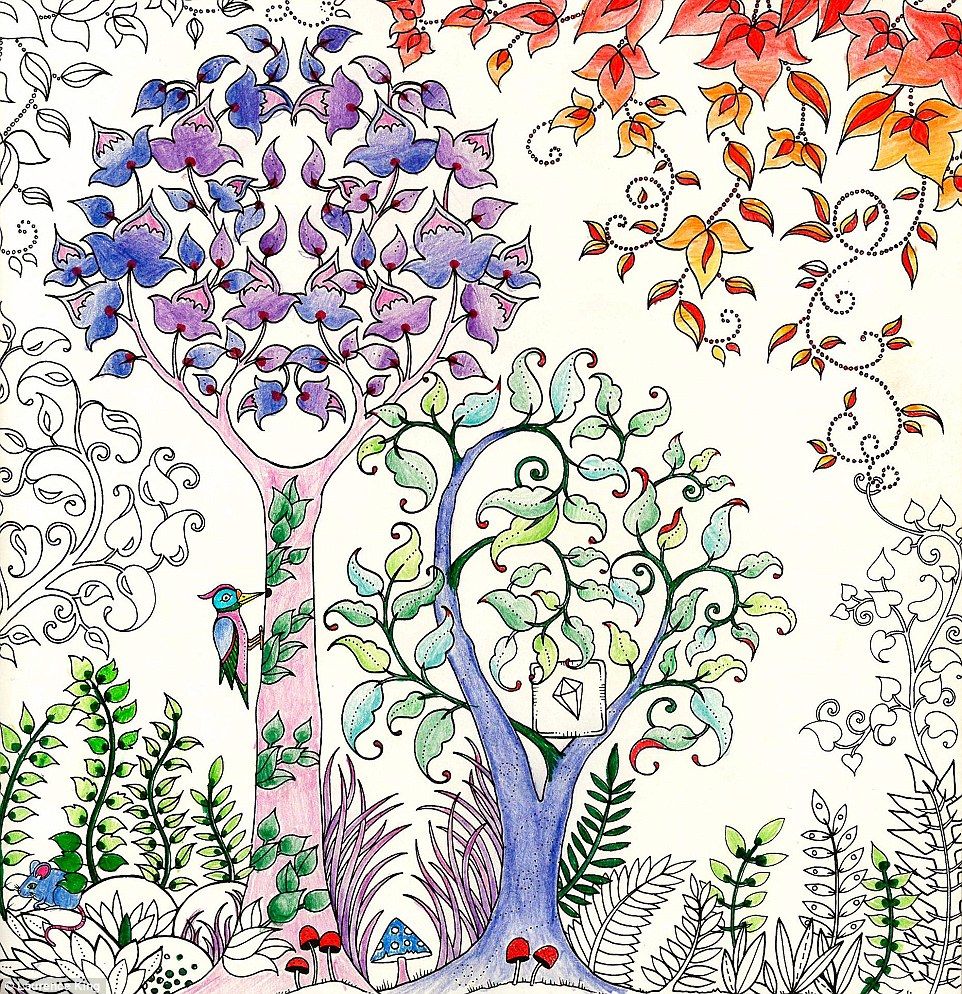
IMG_0888Some books, like Scottish Johanna Basford’s million blockbuster ‘Secret Garden’ and latest offering ‘Enchanted Forest’ offer not only beautiful inky drawings set around forests, taking you on a journey through them; they also replicate the sense of childhood adventure as you discover hidden objects and unveil nine secret symbols to unlock the castle at the end of the quest.

Basford, who had a hard time selling her initial idea to her sceptical publishers, says she was keen to create something she herself would enjoy. Whilst she stresses the fun and relaxing element of the colouring, the books are not only about nostalgia and reliving childhood as there is certainly a deeper meditative aspect to the books.

IMG_0891In our non-stop 24/7 culture, ‘Enchanted Forest’ and many other colouring books like it allow us a few moments of quiet and solitude, time to be at utter peace within oneselves. The calm achieved, away from the bombardment of the outer world and tuning out one’s inner ‘chatterings’, is increasingly recognised as a form of therapy. Indeed other colouring books for adults are being sold as Art Therapy and Mindfulness. The market is huge with these books alone accounting for half of Amazon’s top ten non-fiction hardback book sales.

IMG_0889Has anyone caught the colouring bug already? Is it a hit abroad? I would love to hear from you and if possible share some of your colourings.

So, as I take a break, join me in this adventure. In a few minutes of vital mindful downtime. Relax, enjoy, get colouring.

Below is a time-lapse video of Basford creating an illustration for one of her books click on the link below. As you can see, it’s all done by hand.

“I am certain of nothing but the holiness of the Heart’s affections and the truth of the imagination.”

John Keats

LEIPZIG REMEMBERED – PART TWO

Reblogging this in the hope that WordPress can get the correct date and it comes to the top of my posts. Very frustrated with WordPress today.

Annika Perry's avatarAnnika Perry

View of GDR

This is the continuation of Thursday’s post, writing about the first days upon our arrival in Leipzig, in the former East Germany, with my suitcase stranded in England and waking up in a very foreign country.

LEIPZIG REMEMBERED – PART TWO

That first morning my three friends and I gathered in my room to draw up a plan of action. First some breakfast, then we had an orientation meeting at the university with our mentor. Bread rolls and water was our breakfast and then we looked at the map.

The communist GDR did not believe in maps per se. This was more a map a seven-year-old would produce, with pretty pictures for where buildings etc were located, hardly accurate. Only a couple of street names were provided and furthermore no sense of scale as we soon discovered since most of the buildings were drawn in the wrong place and large…

View original post 1,492 more words

LEIPZIG REMEMBERED – PART ONE

Leipzig

Leipzig Railways Station

Picking up on the topic of the GDR following Monday’s blog, I’m happy to to post a piece I wrote about my three months in Leipzig as a student.

LEIPZIG REMEMBERED – PART ONE

This was a scene out of a film.

Feeling lost and lonely I stared ever more desolately at the baggage conveyor belt. Most of the other passengers’ bags had long since been picked, just one rather large black suitcase lumped its way round. However I was not alone, being surrounded by twelve  other students from my German department. Most of them increasingly frustrated and angry as I refused to accept the inevitable. My suitcase – my lifeline for the next three months – did not make it to Berlin! Furthermore I would be going to a place where there would barely be anything to buy as replacement, as we soon had to cross Berlin for the train to Leipzig, then in East Germany. My friend led, no, dragged, me to report the missing bag. Many forms later detailing descriptions, address of where we were staying – ie. no idea as yet and only had contact name via Karl-Marx University in Leipzig, we were ready to leave. At least my German was getting a lot of early practice!

Hardly able to contain my tears I left the arrivals hall clutching a paper with Leipzig airport’s telephone number to where my suitcase would be forwarded. This delay turned out to be a lucky for me as the next two hours my fellow students completed the equivalent of the Berlin weightlifting championship en route to the Zoogarten train station in central West Berlin.

Up and down the underground, carrying bags up long flights of stairs, then down again. Lifting them onto tube trains. Groans, moans all around and definitely a few pulled shoulders. The Leipzig student who met us and took us into the town had obviously had not been to Berlin before as we later discovered. Returning home three months later we simply got off the train at Zoogarten station and onto the airport bus outside the station. Easy.

Aching, fed-up we were finally about to enter our first Communist country. We were noisily excited, as only those confident of freedom can be. We queued in long thin barricaded maze rows and at the passport control there were at least two East German officers in each booth plus the guards, as well as the mirror behind you. Now a small sense of intimidation set in , but only so briefly. We were in East Berlin! In East Germany! The wall had been breached a few months earlier but it was still very much a separate state, in a state of limbo, except for the increased freedom to travel, many restrictions and limitations still applied.

It was a while before our train so we took turns to guard the bags as we popped outside to explore Alexanderplatz. We tried hard not to be disappointed but the word grim sprung to mind. Grim and bitter. A huge grey square with stark grey buildings set back and lit up by dirty yellow light. Very bleak, very cold-war era.
BerlinBy now we were getting hungry and having finished our meagre supplies we were shown the way to a ‘restaurant’. I use the word loosely. No seating area, standing tables only. I ordered the least offensive sounding dish – soup and bread. Green mush arrived with big fatty sausage dumped on top. The bread was stale, the mush barely edible. The sausage bears no mention. This was as good as the food got whilst eating out, except at the few West German stall traders who came across the border and served delicious pizza slices with chips. We soon learnt to stock up on food when travelling and often went to West Berlin to buy ‘luxury’ items.

watchtowerThe train rattled in and with more heaving all the bags were carried on board, stowed away and we flopped thankfully into the seats. Old-fashioned, friendly train, seats facing each other. By now so tired we barely exchanged words as we stared out in to the darkness. We showed our tickets to man in long black leather coat – was this really a ticket inspector? Was paranoia already settling in? We saw many of these men on our travels and they were an excellent deterrent to fare-dodging.

Just before our arrival  in Leipzig we went through an area called Bitterfeld. It was a scene of utter devastation. All the trees were dead and only a metre of trunk remained visible. It was completely lacking in vegetation, animal life or light. No houses. Just miles of desolation. Later we found out that Bitterfeld had been labelled the most polluted area in Europe – what an honour! Industry had killed off all plant and animal life and the average life-expectancy was far lower for the workers in the factories nearby. On future trips as we travelled through we tried to hold our breath and avoid contamination. Silly, I know!

At last at our destination – Leipzig! The station was grand with up to sixteen platforms, a most beautiful lofty glass vaulted ceiling stretching the length of the station. It was as if we had been transported to the 1950s with long large trains pulling out to exotic-named places, Prague, Budapest, Warsaw but a few. Dutifully awed we met the man who was to be our mentor  – Herr M.

It is not often I take an utter dislike and distrust of someone on first meeting, but Herr M. was an exception. Looking around I could see I was not the only one so affected, eleven of us felt the same and the impression on subsequent meetings only reinforced this opinion. One student was innately innocent and couldn’t see bad in anyone or anything and she spent the next few months in contented delusion. The only time her sense of justice was riled occurred during a visit to the local zoo which she fled  in tears, crying over its barbaric treatment of the animals.

Before departing the UK our Head of Department had hinted, albeit never stated directly, that there were rumours, very possibly true, that Herr M. had worked/was working for the Stasi. We were told to watch what we said. (A while after reunification it turned out Herr M. was arrested as a spy, but I never did find out what happened after that. )

At last we were nearing the end of our journey,. More dragging, carrying of bags to a block of flats, conveniently located near the station. A creaky lift carried us up to the fourth floor and a room. We crammed into the room which had two bunk beds, a wardrobe, two desks and a shower room. My despair returned as I faced a night without any clothes, toiletries. Nothing. Quickly everyone was allocated into different rooms. My name by the end had not been mentioned. Herr M. looked triumphantly at me and said I was staying in this room, so far by myself! My friends rallied round me with spare toothbrush, knickers, socks, nightie, top and I quickly made note of their room numbers as they disappeared.

The place was covered in black dirt. The beds, unmade, exposed a mattress in three parts. It was so hot I opened the window, only to close them again against the cacophony of rattling crashing trams. Of course with time the noise became a source of comfort to me and I would wake up when they stopped for the hour between two and three in the morning. But that night I covered my ears with the minuscule pillow, then stuffed my ears with cotton wool, then sang to myself. All to no avail.  Nothing, absolutely nothing could obliterate the noise.

They say things always look brighter in the morning. Try coming to Leipzig. Borrowed clothes, no food or drink, no sleep, no contact with the outer world. One of my first priorities was to discover where the phones were. The main telephone exchange was located at the station where we learned to bring our books and work as often we waited one to two hours for a phone to be made available. You had to book the phone, wait to be called into the booth and afterwards pay for the call. Patience was learnt early on. Not then the world of mobiles and tablets.

TO BE CONTINUED IN MY NEXT POST…

LEIPZIG REMEMBERED – PART TWO

View of GDR

This is the continuation of Thursday’s post, writing about the first days upon our arrival in Leipzig, in the former East Germany, with my suitcase stranded in England and waking up in a very foreign country.

LEIPZIG REMEMBERED – PART TWO

That first morning my three friends and I gathered in my room to draw up a plan of action. First some breakfast, then we had an orientation meeting at the university with our mentor. Bread rolls and water was our breakfast and then we looked at the map.

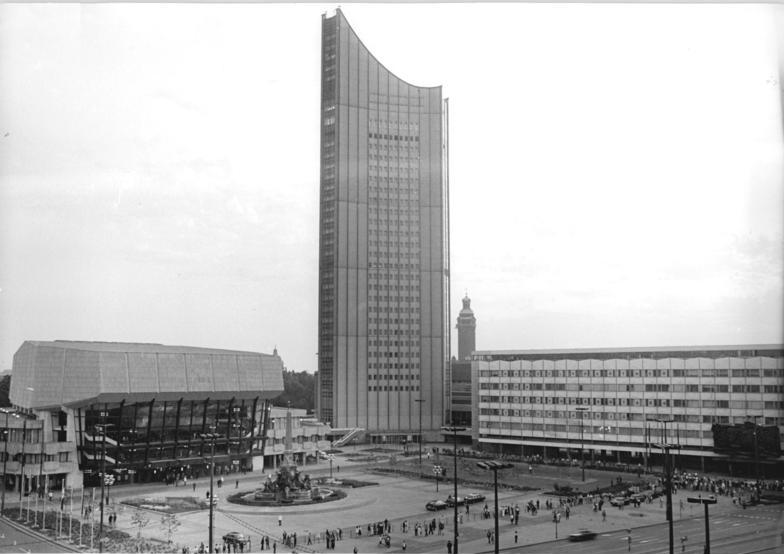
The communist GDR did not believe in maps per se. This was more a map a seven-year-old would produce, with pretty pictures for where buildings etc were located, hardly accurate. Only a couple of street names were provided and furthermore no sense of scale as we soon discovered since most of the buildings were drawn in the wrong place and large boulevards were left out.We made our way to the north of the city, getting hopelessly lost but we had out goal in sight. A large tower building some Finnish students had told us to look out for.
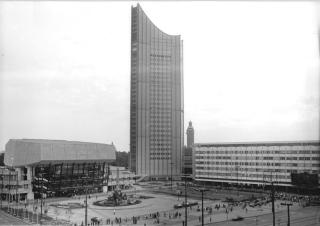
Leipzig, Karl-Marx-Platz, Universitätshochhaus, "Neues Gewandhaus"

After many mistakes we finally made it to the front doors and were told which floor we needed for Herr M.’s office. Let us say floor 12. Four lifts, two on either side of the foyer beckoned us. We carefully read the instructions and found the elevator for floor 12. Confidently we stepped in and pressed the button.

The lifts of the Karl-Marx University have single-handedly resulted in my terror of elevators. Floor 12 rushed past. We panicked, first  stabbing at the button, then at any button and at last the lift stopped on floor 19. Just one from the top. The doors opened. Absolute silence. Brown carpet and walls. Doors closed again and off we went again. We fell down. We were sure the cable had broken as our feet started to lift from the floor. At 2 we jarred to a halt. One of my friends dashed out as the door opened and said she would try the another  lift.

We persevered and soon were quite expert at riding up and down at terrifying speeds. At last the closest we got to stop was floor 14 and we got out and found the steps to walk down. Never in three months did we actually manage to get the lift to stop on 12. By now the whole building seemed to be leaning slightly – or was that just a reaction to the ‘roller coaster’ ride?

Herr M.’s office was not unpleasant and after receiving all sorts of useless information I asked for help with tracking down my suitcase. He seemed to find it mildly funny and lent me a phone – not until later did I realise how exulted I was to borrow a normal working phone. No news of the bag, call tomorrow. I felt sick to the pit of my stomach. We left, walked down a few floors before finding a lift to carry us the rest of the way.

On our own in Leipzig. Shall we call that first day – survival?  Once again we were hungry and as we had just been told about the university canteen nearby off we went – at least it was easy enough to find. When would we learn! Food was piled on our plate, regardless if we wanted it. All inedible. Hunger we learnt was to become a permanent state of affair, only truly staved off in West Berlin where we ate sumptuously. With no lunch we headed to the supermarket. This was to become a daily battleground. Daily as no bread or milk would keep for more than one night.

There were two supermarkets to choose from, equally chaotic. At least there wasn’t all those annoying queues around fruit and vegetables – there were hardly any to have. We picked some potatoes and spent another thirty minutes finding out how to pay for them. First to a lady  had to weigh them. On the opposite side of the shop another lady then had to price them up. Finally we had to pay for them at the cashier. Morrisons seemed like  heaven once home again.

Of course, there was full employment here. We quickly learnt to look at people around us and learn from them.  Milk came in small plastic bags. Most drinks were pop with bottles tops so after food shop we sett off in search of  bottle openers. We found a department store – mostly empty but with one ginormous basket of bottle openers. Brilliant. We were all set.

After one more night of borrowed clothes I woke up with severe backache. Well, not really but a rumour was going round from the Finnish students (our survival expert helpers) that if you complained about backache to housekeeping you would be given one complete mattress.

Three of us took our bits of mattresses down and bravely knocked on the door of the housekeeper. Very scary, as the ‘witch’ herself opened it. She was probably a very pleasant serene lady with sparkling personality. To us she barked out questions in guttural German. We guessed her queries, replied meeker by the minute, all ready to flee with our old mattresses never to return.

Surprise, surprise, no argument. We were told new mattresses would be delivered to our room and old ones were taken away. We glowed with triumph and had a celebratory drink sitting on bed-slats. For two nights I had been in the room alone. A most unusual situation as many students were five or seven to two bedrooms and one bathroom. I awaited my roommate with trepidation, having been informed that I was the only English student to actually be sharing with an East German.

The next morning as I was getting dressed E. turned up. She had arrived late in the term as she had been at her parents house in the country. She seemed very friendly, my own age, just chatty enough.

Suddenly, mid-conversation her face clouded over. What had I done? Had I said  something insulting without even realising it?

‘Do you believe what you read about me in the paper?’ she asked.

‘What?!’ I replied, totally flummoxed. She then explained that her former roommate from England had written an article for ‘The Independent’ about E.

My first reaction was to be impressed that someone so young had  an article published in the paper. My second thought was  that ‘The Independent’  was  usually a reliable paper. I answered that I had not seen the article and did she have a copy. The article accused E. of working for the Stasi, of spying on the English student, going through her possessions, writings, being very unpleasant and rude throughout. I gave a noncommittal answer and for the next hour or so silence.

Then normal conversation resumed and a sense of détente achieved. I do not know if the article had any truth in it. I do know that  E. was friendly to me when she was there, which was not often. Once she very kindly invited me to her parents house where I spent a weekend of pure bliss. Fresh food, good chocolate and a big bathroom with a bath.

I am sure they still remember this strange visitor who locked herself in the bathroom for over an hour. Washing my hair squeaky clean. No black incipient grime anywhere. Lovely bubbles, beautiful fragrances. Countryside, animals, walks in unpolluted air. No trabbies. As I said, pure bliss and for that I was very grateful to E.

Day three arrived and by now I was resigned to never seeing my suitcase again. I decided one final call was in order before I tried to find some clothes to buy. For quick phone access I resorted to Herr M.’s office, visiting under some other pretext and finally asking for his help. I was astounded to learn that my suitcase was safely in Leipzig airport and that I must now only turn up to collect it! Trabbies

The airport was not far from town, but it might as well have been half a day away as this was how long it took to retrieve it. With no direct links to the airport I needed to hire a taxi. For this risky operation I enrolled the help of my friend and we approached a trabbie cab.

The trabbies were just as tiny inside as they looked from the outside. We squashed in the back and arrived safely at the small airport. The suitcase was waiting for me and I was filled with such joy it was ridiculous. Only a bag after all but I was now ready to face whatever East Germany had to offer. The one bag filled the boot and we saw the car sink. Would it manage with us in the back as well?

We clambered in via the driver’s seat and snuggled together yet again. Our joy was short-lived as on the motorway the driver suddenly stopped and got out. We had heard bad things about the taxis here, hence my initial concern.

We had supposedly ran out of petrol and it was indicated that some Deutsch Mark would help. We said we had nothing else beside the original fare and stuck to our ground. Time passed. Our driver left to talk to others. Should we stay trapped in the car or get out? If we got out might he abandon us and  drive away with my bag? I felt ever more attached to my bag and didn’t want to let it out of my sight again.

We stayed and after half an hour a police car stopped by our driver. Loud angry words were exchanged and meekly our driver returned and drove us back to town. Hurrah! At last I had arrived.


Things that make me happy: Japanese string gardens, Dylan Thomas & a song for Spring.

This magical garden on Katy Kelleher’s blog caught my eye and I wanted to share with you on what is a most glorious Spring day. Maybe we should all try some of the ‘forest-bathing’.

Katy Kelleher's avatarKaty Kelleher

hanging string gardens japan1. In Tokyo, the “experience designers” at teamLab have created a beautiful, kinetic hanging garden made with a form of bonsai called Kokedama. Tied with string and bound with moss, the plants are able to grow mid-air, roots burrowing into little contained bundles of dirt. And because art and science are just natural bedfellows: This floating field is also mechanized to move with your body, parting the way for views to walk amongst the blossoms unhindered. What a lovely, happy thing to create. It reminds me of another untranslatable word I’ve been digging: Shinrin-yokuTranslated literally it means forest-bathing, but it’s often used to refer to a short, rejuvenating walk in the woods. Nice, right?

2. One of my all-time favorite poems is “Fern Hill” by Dylan Thomas. Just go read it to see why. This is one of those poems where all the parts are the best part, but here is…

View original post 86 more words

MOTHERLAND: A BOOK REVIEW

babs2

Painting: Courtesy of B. Haynie

MOTHERLAND BY JO MCMILLAN

Welcome to my second book review.badge_proreader

MotherlandCoverToday’s book is of special interest to me as it is partly set in former East Germany during the late 1970s. Having spent three months at the Karl Marx Univeristy in Leipzing before reunification I was keen to see how well  the author captured the GDR’s unique and complicated spirit? How well and accurately she portrayed the places and its people?

The answer to both these questions is resounding very well indeed.

Written in the first person of 13-year-old Jess, Motherland follows three years of her life as a communist believer whilst living in Tamworth. Her mother, Eleanor, is a staunch socialist  (communism is in the blood) and she works ceaselessly for the cause whilst at the same time being employed as a teacher.

To start with the writing style is comic in places, wonderfully fluid and light.  Of her mother, Jess says “…her communist beliefs. Card-carrying. Chronic. As if it were a medical condition”.

As a child at Grammar School Jess suffers for her beliefs; facing both scorn and physical punishment from both the pupils and members of staff.  Miss Downing, the headmistress, regards Jess “with a dead father and a communist other, … as good as orphaned”. As it was Jess’s father died before she was born. “Each just the other side of life.”

Tamworth is unreceptive, and at times violent, to Eleanor’s zealous campaigning and Jess herself  describes it as “…that’s what you did with Time in this town, filled it. Because you weren’t born with a life, but a giant hole”.

No wonder therefore that Eleanor and Jess are overjoyed to receive the opportunity to travel to East Germany for a summer whilst Eleanor takes on teaching classes. Finally they are being offered the chance to experience the socialist dream.

Their first visit fails to dampen their innocent and naive trust in the system. For Eleanor she views GDR not so much through rose-coloured spectacles, rather through technicoloured rainbow glasses. During their first visit and subsequent visits and events her indefatigable belief in the GDR never falters.

Her unsuspecting beliefs never waver whereas Jess becomes increasingly aware of the discrepancies of the promised words and reality. Whilst Jess changes during these pivotal years she continues to love and protect her mother – realising that her mother is as happy as she can be in the sharing community of the East German society.

The tension in the book mounts as Jess’s innocence is shattered and she  gradually awakens to the murkier nature of the GDR, where friend becomes foe, where one’s every move is monitored, reported. Where paranoia is the norm.The first cracks in Jess’s beliefs are created through her friendship with an East German girl, Martina.  Her mother befriends and later falls for Martina’s father, Peter.  The friendship between the four will have devastating repercussions for them all.

As the book develops so does the language, mimicking Jess’s own internal development. From her comic language at such events as her childhood attempt to defect to the GDR, the language becomes more serious and sophisticated as Jess becomes unwittingly deeper involved in the intelligence world. It’s a most successful transition in writing style.

The author creates not only the sense of 1970s East Germany, with its Berlin Wall, grey cities, idyllic countryside, Bitterfeld, Buchenwald, Zwickau, endless monument visits and of course the trabbies;  she also captures the spirit of the UK with its CND, National Front, Thatcher – and not forgetting the Angel Delight!

This book is not what I expected – more complex, multi-layered. Funny and sad with great characters who succeeded in getting under my skin and living with me long after I had finished the book. It’s most surprising and well-worth a read.

Book Rating: Smiley-face-emoticon-575-2

Publisher:  John Murray Press

Release Date: 2 Jul 2015

“Sacred space is an absolute necessity for anybody today…This is the place of creative incubation. At first you may find that nothing happens there. But if you have a sacred place and use it, something eventually will happen.”

Joseph John Campbell

ESCAPE TO AN EASTER OASIS

100_7486

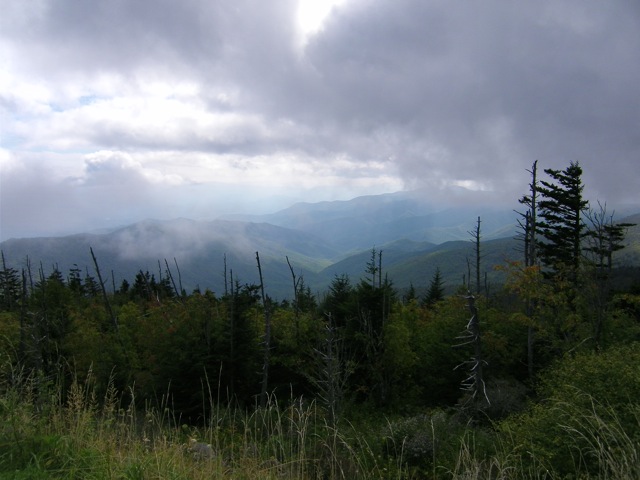
Imagine a place far out in the Swedish forest.  It’s half a mile to the nearest neighbour whilst other houses are scattered miles apart. The road is a dirt track with deep ditches on either side. Just there, to the right is the property, two houses set upon a land twice the size of a football pitch. This is my haven for the next two weeks over Easter.

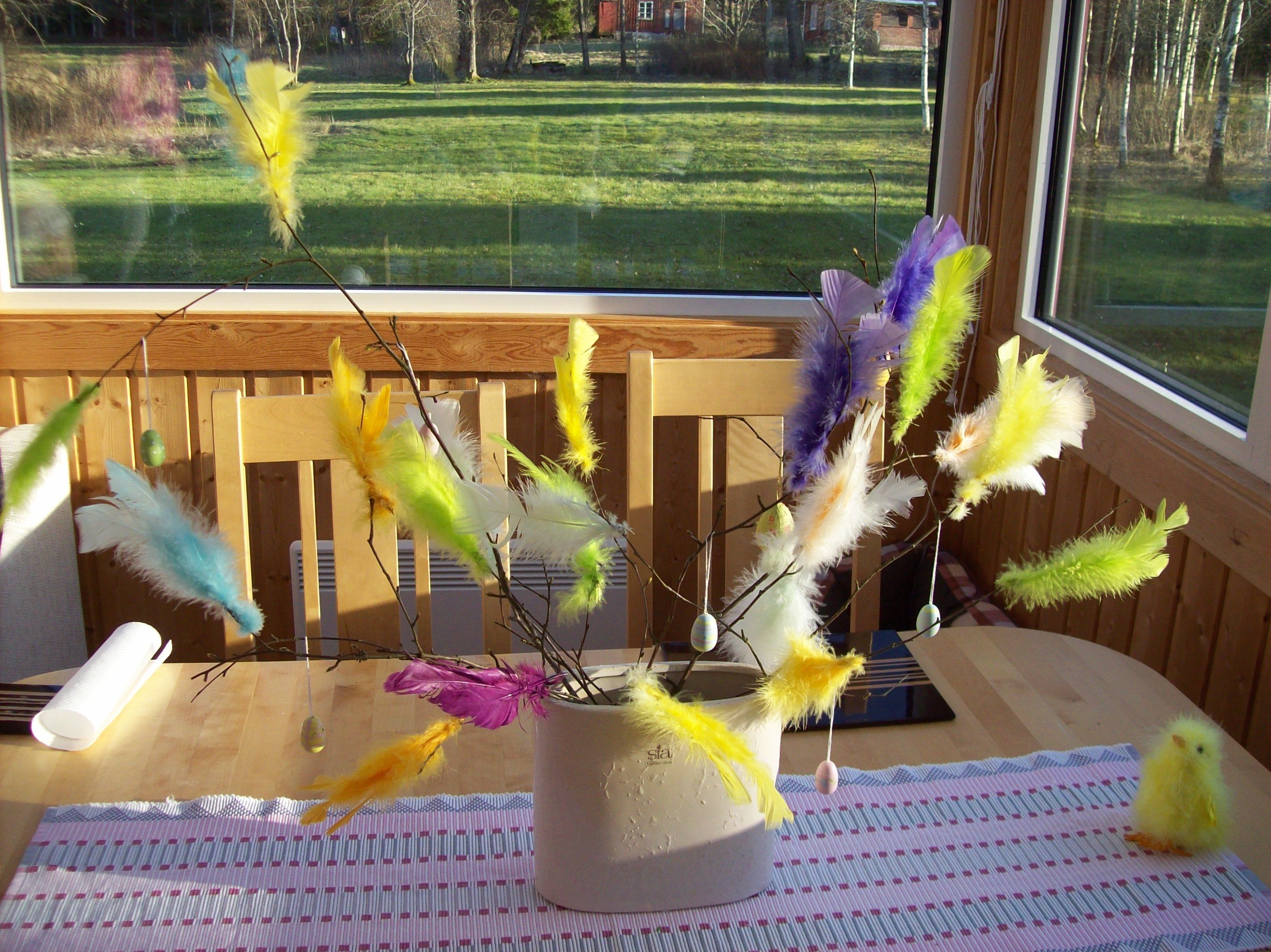
100_6333Pure tranquility – as pure as the air from the hundred, nay, thousands of trees around.  Pure tranquility – as pure as the water which pumps from 80 m below the ground. No television, telephone or wifi. Peace and quiet. Don’t worry though, there is electricity and all the mod cons, so we’re living in warmth and comfort.

It takes a while to tune into the silence, to hear the individual birds, to become aware of the different tones of the breeze. The tempo of our days slow until time itself seems to slacken and the days stretch appealingly in front of us. No rushing. No staring at screens.

In lieu of television an afternoon is happily spent sitting inside with a cup of tea watching the thunderstorm wreak havoc upon the land as puddles are turned into mini-lakes and the fir trees enter into a ferocious frenzied dance. We take time to listen to the hail crashing outside. The force of nature overwhelming and once again I am reminded about my small place on this planet.

In the morning I wander the land, clutching my orange juice in frigid fingers, negotiating the uneven ground in my clumsy wellies, my dressing gown flapping round my legs. I stop and raise my face to the dappled morning sunlight falling through the birch trees, whilst in the distance I spy the mist hovering above a field, drifting, floating wistfully away as the sun’s rays strike them.

In the shade I study the intricate cobwebs which lay frozen stiff, their delicate threads an intriguing puzzle of designs. Glistening in the morning frost they are small sample last night’s wondrous creations. Nature’s own art gallery, free to browse. I just have to make sure I am up early enough!

Silence. Quiet. Did I mention that? No cars. No machinery. Just the peace.

This is where I will be this Easter, relaxing, being with my family and I look forward to coming home refreshed and with renewed energy.

Although I might not be able to post until my return I do have access to my neighbours’ iPad and hope to pop across now and then and see what you’ve all been up to.

IMG_0538I look forward to sharing more with you upon my return after the Easter holiday.

Have a very happy Easter break everyone.


“Some old-fashioned things like fresh air and sunshine are hard to beat.”

Laura Ingalls Wilder

My Desk – A Reflection of My Life

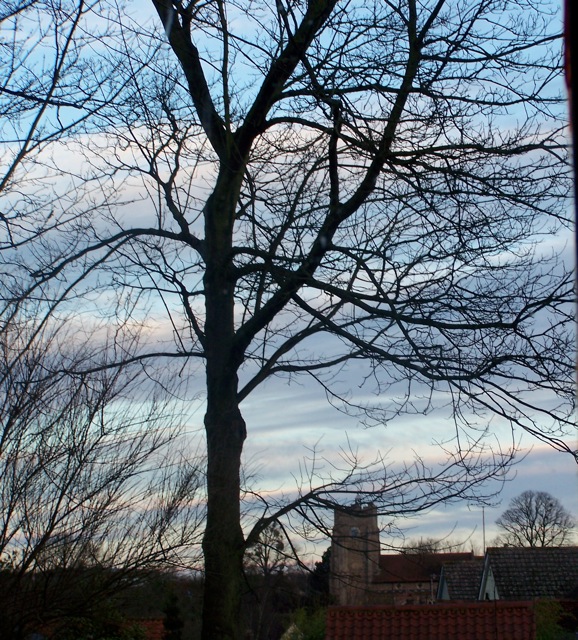
Tree Against Sunset

As I approach my desk for round two of my writing session this morning I smile at the disarray of objects upon its surface.

A white feather quill pen is in the furtherest corner, a birthday present from my son a few years ago ‘to help with your writing Mamma’. Five pencils are lined up, ready to be sharpened. They have lain there for three weeks, dull and useless, with pens and a fountain pen tipped over them. In this heap are my ubiquitous Hals throat lozenges; these are littered wherever I sit down to work or read and if none are in the house I feel bereft and unable to concentrate.

Near the quill pen is a 16 inch tall cardboard cut-out of Heisenberg from ‘Breaking Bad’ complete with yellow suit and gas mask. I am a total fan of the series and am currently going through cold turkey after viewing the final episode.

Next to him are two postcards; one from Vietnam showing a typical floating market in the Mekong Delta. This is from a friend travelling there as I write. The other card is one I bought at The Fitzwilliam Museum, Cambridge after seeing  the Claude Monet’s  ‘Springtime’ (1886) there. Next to them stands a thank you card from another friend. Its brightly coloured flowers in equally decorative pots brighten this grey March day and shows how well she knows pot-mad me.

Bored yet? I hope not. Luckily this is a rather large wooden desk, with lots of room for knickknacks and every morning my iPad and I fight the same battle to make space for my keyboard and cup of tea. Yes, this was the reason for my break and with the fiercest of ginger tea – the one in the red packaging – I am sipping it from the mug bought for me by my son for my last birthday. On it are the words ‘Go away I’m writing’. I love it so. My only regret, I wish I was bothered by more visitors so I could swing the cup and its message at them.

For some quick music I lean over and switch on my pink iPod and to tell the time I look at my pink Beetle car ornament with clock in its door. There is more as a cuddly bear (from my son) cradles the sign 40 – so you know my age or so now! Then a sweet ornament of a boy lays on his side, engrossed in a book (from my mother).

A giant black Helix lamp is adorned with my costume jewellery, dangling down in shades of white, grey and gold. On either side of my iPad are various notebooks, A4 writing pads and files. Upon some are doodles I draw whilst thinking or talking on the phone. My reading glasses lay unused to one side as my eyes are still undecided if with or without is better for working on the computer.

To my right the beginning of my packing pile for the Easter holiday is growing with a shower cap perched precariously on my pink Blott writing pad and a turquoise nail varnish balanced on the edge of the desk. By my side rests my iPhone, an item, which for better or worse, has become an extension of my arm. Last but not least, my two coasters, a tile one made by son as young in primary school, the other one a heart shape bead one made many years ago by my niece.

I never realised how my family and friends surround me on a typical writing day, that one glance up is rewarded with a a sparkle  of love and warmth. And yes, fun too.

I would love to hear about your working space / desks. What surrounds you? Or do you prefer a clean tidy area in which to work? What precious items are there for you to look up at?

“To bring your attention to a stone, a tree or an animal does not mean to think about it, but simply to perceive it, to hold it in your awareness.”

By Eckhart Tolle