IDEAS

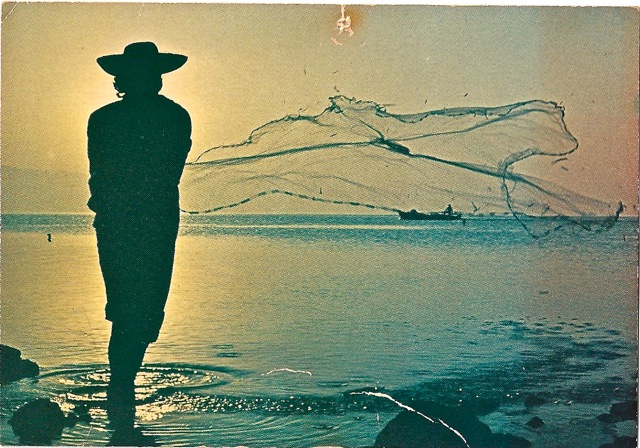
Tropical fisherman

IDEAS

Scientists say you have three seconds to cement an idea or puff, there it goes, evaporating into the ether. This has happened so often to me recently that I’m beginning to think the three seconds is generous.

A most perfect thought pops into my sub-consciousness and I grasp at its tendrils, reigning it in with the power of my conscious brain. I rise from the sofa and head towards my notebook. Once present in the real world, it will be safe, cosseted and nurtured; when suddenly another idea ignites and detonates in my head.

The  original thought explodes quietly into smithereens. Deep within my head I flail around for the slightest hint or image of my idea. It’s there, hidden behind the dust cloud of destruction. If only I can reach that bit further. The debris is clearing, I’m sure of it, think and think again. My eyes are closed tight, head is bowed in concentration.

No, it’s gone. Irretrievable. At least, I have the new thought to hand though. Haven’t I? What? What was it again?…Nooo…

Luckily many of my ideas do make it to fruition although I seem to have rather a scattergun effect of ideas. Various words or images will create a series of ideas which I hastily jot down. An old man’s lop-sided gait, witnessed in town, became central to a short story. A pair of hand-repaired spectacles, recalled from childhood, featured in a chapter, highlighting the character’s despair and worry. Like many writers most of my ideas will remain known only to myself, until they have been moulded into a short story or such. Only then will I show the first draft to friends.

Ideas are fragile things and can easily be killed off by the slightest shrug of the shoulders, the questioning bemused look of a friend. That poor idea that could be so vital to the writing and lead onto new paths decimated by well-meaning.

So, catch your ideas, nurse them, mould them. Once they turn into a piece of writing, then happily share. Not before though.

Happy Fishing and May Your Thoughts Bite Aplenty.

 A new idea is delicate. It can be killed by a sneer or a yawn; it can be stabbed to death by a quip and worried to death by a frown on the right man’s brow.

By Ovid

Battle of Views

Black Tulip

In the past week the Battle of Viewpoints has been fought within the pages of my novel.

Automatically I started writing in the the third person, feeling comfortable and at ease.

Then one of the main characters clamoured to be heard and as an experiment I switched to her first person voice.

The result was not the triumphant powerful success which I had imagined.

Although I enjoyed being in my character’s head and travelling with her thoughts and observations on paper (or screen), my writing suddenly became simplified. This could be as the character at this stage is a young girl aged 10 and my language in her voice couldn’t help but reflect her youth.

Furthermore the passages of description which I feel are critical to the story became lost as the need to describe the settings became superfluous since they are familiar to the character. Any such description became false and forced.

Often writers use first person as this allows the reader to quickly engage and identify with the character, thereby drawing them into the story. I have often written from this viewpoint in my short stories and found it ideal. There is one danger though and that is the reader is limited to that one character’s perception of the story, through their eyes only. It is virtually impossible to introduce any events away from the character. One way to add further dimensions in the first person perspective is to use two or more characters.

Having just read ‘The Invention of Wings’ by Sue Monk Kidd I did consider this approach. In her wonderful book there are two narrators: the slave girl, Handful and the slave owner’s daughter, Sarah Grimké, who alternatively swap the story telling and thereby relate two very diverse and diametrically opposing worlds and experiences.

As I could not imagine two characters alone carrying the my story I knew more would be needed and was concerned this could be become cumbersome.

At one stage whilst discussing my dilemma with a friend she questioned if I could use both first and third person? I hesitated and gave the notion a thought. I cannot remember reading any books written thus, but perhaps they do exist. The mental and emotional logistics of such a narration though seemed fraught with difficulties and pitfalls, so I decided to avoid that route and instead reverted to the third person.

On the whole it was a relief to return to the third person viewpoint. The floaty descriptions returned but now enhanced with a third person perspective. The distant narrator is replaced with a more personal viewpoints of the characters.

Although the chapters are not headed by the which character is leading the story, there do exist ‘signposts’ very early on showing which character’s viewpoint will dominate the chapter.  I now retain the freedom to write about events well outside the characters if required whilst ensuring characters are personable and well-rounded. To avoid confusion I am sticking to four character viewpoints in the third person, this gives me the breadth to explore their emotional and inner feelings and thoughts of each one. The plot will still be pacey whilst other characters and subplots can be easily introduced.

In her book, ‘Sunrise’, Victoria Hislop writes beautifully and in the third person, so effectively at times I didn’t realise it wasn’t in the first person. The pain, anguish, deceit and love of the characters  are depicted with startling vitality.

The battle is over, calm reigns and now I just have to rewrite a couple of chapters. No problem.

I told myself reading was a kind of freedom, the only one I could give.

Sarah Grimké in ‘The Invention of Wings’ by Sue Monk Kidd

Current word count of first draft of my novel:  14,940 words