
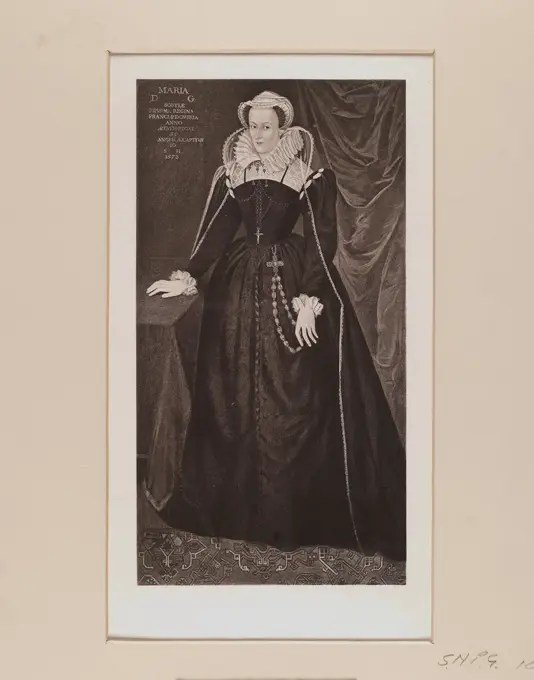
The eighth day of Februari 1587. My Majesty, Cousin Elizabeth, They will say that my last letter is the one to Henri, my dearest brother-in-law, King of France. We are close, but not the way we were at times, Elizabeth. The letter to him will be about the final housekeeping for my staff, it will become my last political act, ultimately my testament to the future. The inner truth resides within me, my dear cousin. I know, how can I think of you as dear after your cruelty these past decades? Years that are inherently bent and twisted, distorted beyond any recognition. Every year became a lifetime yet fleeting and gruelling. I wake on the four-poster bed, the heavy drapes a cocoon from my life, my fate, my death. The majestic red material in tired folds, the red blood of martyrs. Do you want to make one of me, cousin? Cousin, what a sweet word of family. The familiar, a close relation and we know each other well. Don’t we? As I open my eyes in the morning, the dreams of our childish giggles echo into the bedchamber. Do you recall the games of tag, darting between the roses in the gardens, around the lakes? Of course, being older, I often let you win. Maybe I should have overruled you already then? My kindness has perhaps become my downfall. Those were the times of joy, before the tragedies in our lives, when our chortles bubbled up to life-affirming laughter. ‘Most unladylike,’ our guardians reprimanded us, as once again we ran away to play on the manicured lawns. The day you sequestered me in castle after castle, year after year, you banished the laughter out of us, out of our people, our country. As a sovereign, I thought I would one day visit these illustrious habitations, just never as a regal prisoner, wanting for nothing, wanting for everything. We never stood a chance, your majesty. History has ruled our every step even before our conception. Blame! What a simplistic, naive concept, and I don’t hold it in any regard. None lies with you. Yet the fault is all yours. I hold you close in my heart, dear cousin. I hate you with every fibre of my being, you contemptuous Queen. My legacy will haunt you and your England forever. This, Elizabeth, is my last letter to you and to you alone. It may not survive me but it is writ. Yours grievously, Your Cousin, Mary, Queen of Scots
©Annika Perry
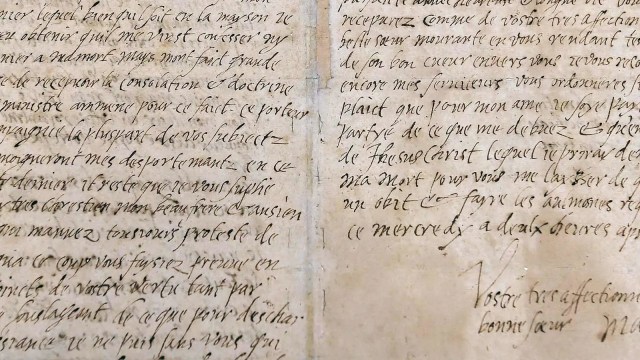
‘My True Final Letter’ was inspired by an article about Mary, Queen of Scots’ actual last letter on display at the National Library of Scotland. Why would her final writing be to her brother-in-law when surely her cousin, Elizabeth, Queen of England, must be first and foremost in her mind?
For over two decades, Elizabeth had kept Mary as an enforced ‘guest’ across the country. Mary reigned as Queen of Scots from 1561 to 1567. However, she was forced to abdicate and flee to England after a rebellion by the protestant Scottish lords. Elizabeth, Queen of England, felt that her cousin threatened her position, yet for years managed to keep her alive in captivity. However, in February 1587, Mary was implicated in a plot to overthrow Elizabeth. Queen Elizabeth’s ministers insisted she sign her cousin’s death warrant.
Note: Photographs from the National Library of Scotland
 Annika Perry
I read many books about these royals. There was little love lost between them, and their families fared no better. Anyone who dared threaten the throne was executed. The letter is interesting. Mary and Elizabeth were always at loggerheads. I believe that if their roles were reversed, Mary would have done the same to Elizabeth.
Caroline, thank you for your interesting and informed comment. My knowledge about the two cousins was very limited so this was very much a fictionalised letter although I was aware their relationship was acrimonious. I agree, I am sure Mary would have made the same decision – maybe even earlier!
A brilliant idea to postulate what Mary would right to Elizabeth, and you navigated the old English and modern English so well, initially I was thinking it was authentic. It is interesting to speculate the torment suffered by Mary imprisoned and Elizabeth perhaps not wanting to make murder another Queen and make her a martyr but being forced to – in the end. Very well done, Annika.
Amanda, thank you so much for your great comment and it is very much appreciated! 🙏😊 As soon a I read about her actual last letter the idea for this piece came to me! What if scenarios are fun to explore … the histories of the two cousins were so intertwined and surely Mary’s thoughts must have been on Elizabeth! While writing this I showed it to a couple of writing friends and they also initially wondered if it was real – the moment I felt it was really working as a letter of fiction! 😀
I think it would be fun and interesting to publish a small collection of such possibilities from history. You would be the person to do that, Annika!
If Mary didn’t write this (or one like it) her Spirit that still lives, wishes she had. So full of emotion and anguish and hatred and yet, also love for what they had as children. Loved this letter so much, Annika!
Pam, wow! Thank you so much for your wonderful thoughts. At such an emotionally heightened time one can imagine the cauldron to feelings and soul searching, allowing love and hate to stand shoulder to shoulder. It means so much that you loved the letter.
And I learned a lot from it. Will you be writing more historical fiction? Like some others said here, I love that genre.
Oh, my favourite “genre” those historical events and letters. Fractures in close familial relationships…fascinating! Enjoyed reading your letter, Annika. xx
Khaya, it’s wonderful that I tapped into your favourite ‘genre’. I think I’m becoming influenced by all the historical fiction I’m reading – hence the letter! Oh, I forget what a superb literary device these are and it was a joy to write. Thank you so much for your lovely comment, Khaya.
You are always welcome Annika. Have a great day ahead 💓💓💓
Brilliant letter and full of emotions Annika.
Kamal, it’s wonderful you enjoyed the letter and can feel the emotions throughout. Thank you for your kind comment.
Well expressed. What betrayal!
Thank you so much, Rosaliene. The era was fraught with intrigue and betrayal! Very rich material for writers!
A very interesting subject and you have conveyed so much with this ‘what if’. After reading the letter I could feel both the anguish and forlorn hope of Mary. Unfortunately she had to pay the ultimate price in a sensitive political and religious period of history. Well done!
Mike
Wow! Mike, thank you so much for your thoughtful comment and it means a lot they you felt so much from my imagined letter. Definitely so many ‘what if’ scenarios although I feel her final end was determined almost as soon as she was arrested, alas. It was a very fraught political time with religion dominating the era and these two giants in history were in the centre of it all.
That was a fascinating letter!
Thank you so much, Jennie! It was fun to imagine this version of her last letter.
And you did it so well! You’re welcome, Annika.
Well, tbh Annika this felt like a quiet exhale. That bit about letting go of pressure and just sitting with the words hit me. It reminded me of the times I’ve forced pieces that clearly weren’t ready to show up.
Ritish, it means a lot that my piece evoked such emotion in you. ‘A quiet exhale.’ – wow, a beautiful phrase. Thank you for your thoughtful comment.
Always my pleasure, Annika.
Wow, Annika, that was a fascinating bit of history your imagination captured in that letter. Well written and well done, historically speaking. Those dark times are made a little lighter by what we are experiencing now.
Curt, it was wonderful to be inspired by the article of Mary’s last letter. The historical era is rich with drama, intrigue and battles for power. It’s great you enjoyed my imagined letter here and I wanted to try and capture the tone and urgency of the time. Yes, sadly, the greed and lust for power amongst some never seems to end and hurts so many people along the way.
Quite creative, Annika.
Pretty cool, Annika, thank you!
I wish it was a real letter. However, if it had been, would it have swayed Elizabeth?
The greed for ultimate power and wealth is ageless, in all directions. I fear only the sun, when it burns out, will end it. ❦🕊
Resa, thank you so much for your thought-provoking comment. Alas, no, I don’t Mary was under any illusion that she had any influence over her cousin’s decision. They were equally headstrong and adamant in their fight for absolute power. As you say, sadly a greed among some that affects much of our lives today – and will do so as long as human beings exist on the planet.
Sigh!
Well, there’s still art! (all the arts) Which is what that letter is, writing art.
Thank you Annika!
That mock final letter sure became angry at the end and it was a clever way to imagine what her final letter to Elizabeth might have been like. Your inspiration from the museum led to a fun post. Years ago, I watched a lot of docs and movies about Queen Elizabeth and the Tudor period. It was interesting at the time!
Thank you so much, Yvette and I enjoyed unleashing Mary’s pent up anger towards the end of the letter – an anger that must be very real, I feel. How interesting to learn so much about Queen Elizabeth and the Tudor era through the visual medium; as young at school it did seem very dry and reams of dates and names. Only when beginning to see history through the eyes of people did I find it truly engaging.
Yes, there are very “dry” ways of exploring history but some of the shows today – wow – they make it all come alive. Also, when I used to grade a lot of student assignments, certain shows played well int he background – and that including history shows. However, the show “alone” never worked because it is a visually heavy show and you have to watch it fully.
Wow, a fascinating letter Annika. I’m addicted to British history, and particularly read and watched lots on the cousin rivals of Mary and Elizabeth. What a creative way to share this rivalry time of British history. Weekend hugs xxx
Debby, it is great that you’re fascinated by British History which is equally enthralling and complex. I’m currently watching Victoria on Netflix which is captivating and even if much is fiction it does give a lovely sense of the era and main events. Reading about Mary’s last letter I thought it much more likely that her thoughts would be upon her cousin Elizabeth who has determined her fate for so many years. It was enjoyable to try this different format for a fiction piece. Wishing you a lovely weekend! Hugs xx
Victoria on Netflix? A new one? I’m puzzled why Netflix hasn’t run it through me if it’s new because I watch such things. I’ll look for it! Thank you Annika. Wishing you too a lovely week! xx
Yes, I wonder.
Absolutely, Mick!
That is some intriguing history and the letter you wrote interpreting her final letter was a pleasure to read. Very interesting.
Thank you, Thomas and it’s great you enjoyed musings on Mary’s last letter! It was a very hectic and dramatic period in British history and I think especially fascinating as the personal and national events were so tightly intertwined.
Yes I agree. It certainly adds a sense of intrigue when personal and national events are tightly intertwined.
Interesting read.
Thank you, Vermavkv!
What a fascinating writing project, Annika. I don’t think I would ever have thought of doing something like this. Kudos. Hugs.
It was interesting and enjoyable to write, Teagan. I think all the historical fiction I’m reading is rubbing off on me – and often letters are featured. Many thanks for your lovely comment. Hugs
Your speaking for Mary in this letter was beautifully done, believable and heartbreaking.
Liz, it’s wonderful you feel I’ve captured Mary’s voice, thoughts and emotions here – thank you so much.
You’re most welcome, Annika! I totally believed it.
oh I love the letter is on display in The National Library of Scotland, Annika. What a great story although it tugs at the heart. What a wonderful story that breaks the heart a little.. xx
Cindy, thank you so much for your wonderful comment. They were heartbreaking times and I couldn’t help but reflect upon her thoughts and missives those last few hours. In today’s world we are nearly overwhelmed with the abundance of instantaneous communication, then one brief letter was everything! Precious.
I love your chosen vehicle for telling the story – a letter. 🙂
Laura, thank you so much and reading about the original last letter was truly inspiring! I started writing this straightaway.
Although being a creative letter, it read brilliantly true. Great job, Annika.
Pat, thank you so much and your comment means a lot to me.
That is a powerful fictional account of a tragic event in history. A sad tale.
Aww … Jan, thank you so much! Yes, very sad indeed and one can just imagine the heartache in the midst of a very tumultuous time for both Queens.
Such a sad time in history. Thanks for the picture of the letter. Neat writing, and historical stuff is very cool. Though your letter may not have been written, perhaps it was thought! 🙂
I agree, the letter is meticulously neat and it was smuggled out and successfully delivered to her BIL. I hoped to replicate the tight handwriting by not including any paragraph breaks which are common nowadays. It was fun trying to imagine her thoughts hours before the execution- and who knows, maybe such a letter was sent and destroyed! 😃
Could very well be!
Well done!
Thank you so much, Neil!
A sad sad story. Thank you for your reimagined telling. Well done.
Libby, I’m so glad you enjoyed this reimagined letter and yes, a very traumatic and sad time.
This was a tumultuous and terrifying time in history. No one was safe. Well done, Annika.
So true, Robbie – it was indeed a precarious existence for the citizens and monarchs! Glad you enjoyed the letter!
This is brilliant, Annika. Although they never met, I liked the doomed Mary imagining they played together as children. How cool that Mary’s actual last letter is on display at the National Library of Scotland. I would love to see it.
Thank you so much, Darlene – it was enjoyable trying to tap into Mary’s thoughts and emotions. Thank you also for pointing out that they never met. I must admit I’m not an expert at all on this era and on doing some quick research read that Queen Mary and Elizabeth I played a lot together. However, checking now, this turns out to have been Queen Mary I, also know as Mary Tudor, who was Elizabeth’s half-sister and actually was 17 years old. Apologies for the error. Maybe I can call it artistic license? 😊 Oh, I love seeing historical letters and such and love visiting old castles / houses etc. You must be enthralled when you’re here in the U.K.
I just took it that she imagined them playing together. I love visiting the UK and the old houses, churches and museums. I plan to visit in March and hope to see Stratford-Upon-Avon. Are you anywhere near there?
How exciting that you’re here in March! Research for a new Amanda book? We’re about three hours drive from Stratford-Upon-Avon but could possibly see about meeting you there. That would be fantastic! 😀
That would be super! I have always wanted to visit Shakespeare’s place and after visiting hubby’s family in York I thought I’d take a train down to Stratford-Upon Avon. It would great to meet you there if it works out. let’s keep in touch. That would be two dreams come true.
😊❤️
There is real drama here!
Anne, I’m so glad that came across – just what I hoped the reader would experience! Thank you so much.
Well done Annika.
Thank you so much, Brad.
As a historian, loved reading your take on the letter. Even though she didn’t actually write to Elizabeth, I’m sure she was on her mind till her last moments.
Pooja, it’s great that you liked this so much. I was trying to get a sense of the era through in my choice of words and phrasing. Do you specialise in a certain area of history? Although I don’t write much historical fiction it is a genre I am increasingly drawn to. Yes, I think Elizabeth, her cousin who had signed her death warrant, would very much be on Mary’s mind.
Yes, I specialise in 60’s and 70’s history. I’ve never written historical fiction but absolutely love reading it. It’s so fascinating.
WOW Annika… You wrote a powerful last letter in the wake of this historical event.. This again showing how those who rule, and control fear losing their positions, so they will go to any lengths to stop others, including their cousins for speaking out against them..
Thank you too for sharing a part of our history xx
Sue, thank you so much for your thoughtful and thought-provoking comment. It is a vicious cycle of the brutality of those in power at times, clinging to their position at nearly any price. Supposedly it was not a decision Elizabeth took lightly, yet one she agreed to all the same. I am drawn to history and increasingly to historical fiction – maybe it will become more of an influence in my writing?!
I used to love reading historical fiction, especially the lady Heroines 🙂 xx
I’m not sure if it was better to be noble or peasant in those days.
I’m not sure either!! Being a peasant was equally fraught depending on the ruler at the time!
Very emotional storytelling in this tale! It is a sad tale in respect to ‘cousins’, a term that surely evokes a tender-hearted relationship. (Like brothers and sisters, cousins are a child’s first friends.)
Absolutely, it is an evocative term for close familial relationship – yes, often first friends and most trusted. Linda, thank you for your thoughtful comment and glad you liked the letter.
Happy New Year Annika! Welcome back. It is great to read your stories again. Best wishes.
A very Happy New Year to you, Ernie and hope you’re having a good start! It’s wonderful you’re enjoying a chance to read my stories – it’s great to post some here again. Wishing you a good rest of the week.
A fantastic post about two women who were living figurehead and in spite of all luxury and power missed out on just being. Except in the touching part when Mary talks about their play and games, especially in the “ manicured gardens”.
it all through you feel the dislike of each other. The ending is grim but your telling makes it come very close. I knew the bare history but now I feel I know the women .
miriam
Miriam, thank you so much for your wonderful in-depth comment. I love how you are touched by the personal relationship between Mary and Elizabeth – I think that was pivotal in both their lives. From childhood friends when young, the cousins became effectively bitter enemies until one doomed the other to death. It means a lot that you felt moved by my piece and I’m glad that it brought the women closer for you.
Well done, Annika. Agreed, I would think her last letter would be to her cousin, the one who could change her fate, relent, even to the very last moment.
One does wonder if she was waiting, expecting a last minute reprieve. Mary’s emotions must have been in a turmoil and I imagine she would want to give a voice to her thoughts of those last years of captivity. It’s great you liked this piece, Lynette.
This is very emotionally compelling and I love the way the letter goes through childhood, her captivity and then to her anger. Brilliant.
Thank you so much, Georgina. When I read a transcript of her actual letter it just felt too cool and collected at such an emotional time, hours from her execution. It was interesting to try and get inside her head to write this.
Ahh, interesting and potentially so much control of emotion but sounds rather like the way our late Queen controlled her emotions because of her position.
I totally agree, Georgina! It must be difficult to live a whole life under such a microscope with emotions tightly reined in. Even in a personal missive as this one imagines it is nigh impossible to give feelings absolute freedom.
Very well imagined and memorable.