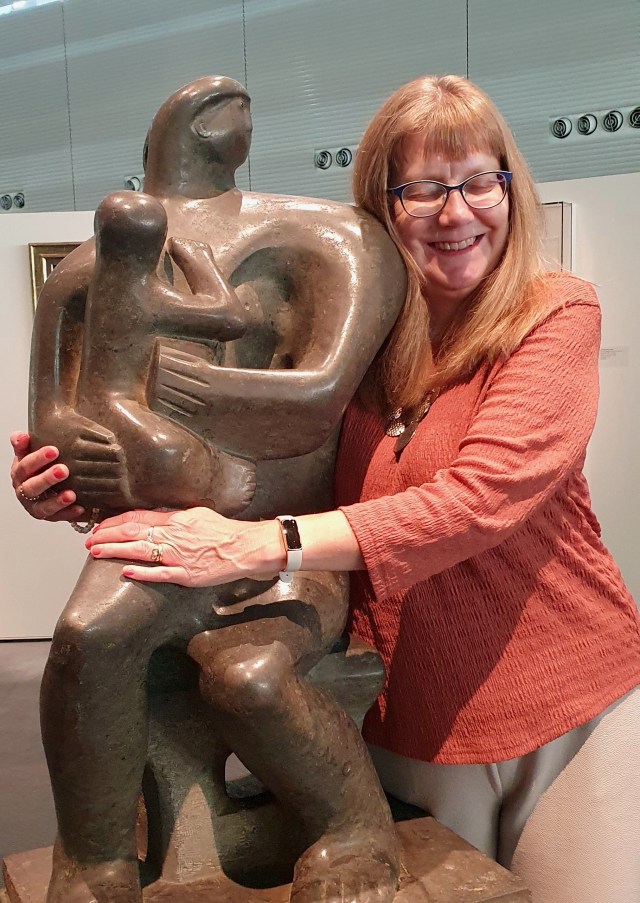
Yesterday I hugged a mother and child The arms unyielding The bodies cold and unrelenting Yet such warmth in expression A soulful tenderness in their closeness
A unique embrace, where the usual Do not touch Replaced with Please hug me
Art is for all Art is not remote To be viewed at a distance Art is life Art is all our lives.
@Annika Perry, October 2024
My poem above was inspired by The Mother and Child sculpture by Henry Moore (1932) which is one of many wonderful, striking and thought-provoking pieces of art at the innovative and eclectic art museum of the Sainsbury Centre in Norwich, East Anglia. Originally a private collection by the Lord and Lady Sainsbury it was later donated to the University of East Anglia in the specially built museum. The collection is part of a desire to allow visitors to emotionally connect with the pieces (I did!) and enhance the belief in the ‘living life-force of art’.
Personal Note
Many thanks to everyone for your lovely comments on my last post and I was looking forward to returning here in September, Alas this became impossible. Tragically there was family bereavement as well as a devastating cancer diagnosis of a close family member. Along with the practical busyness of such news, emotionally I had to hunker down and slowly find my equilibrium. For now, my posts may be rather more erratic, my comments not as timely a I would wish. My heartfelt thoughts are with so many of you going through difficult times.
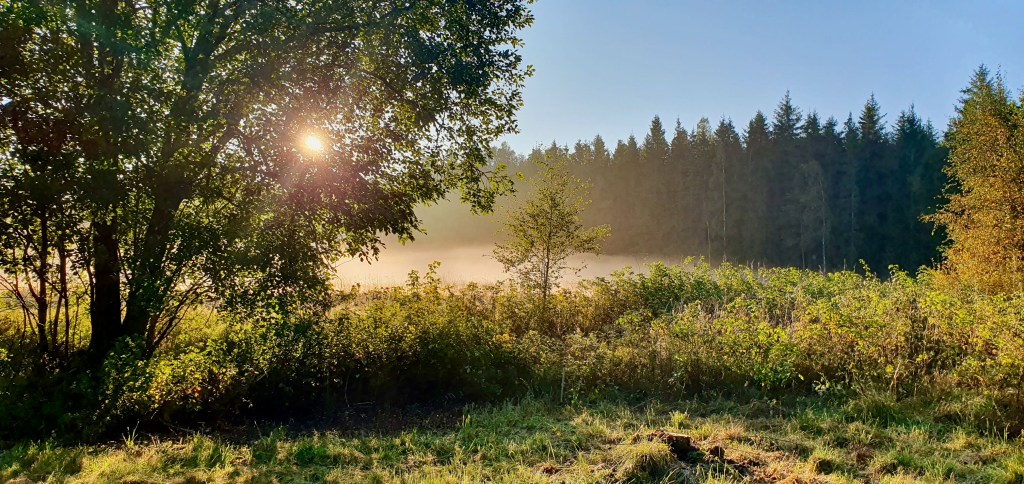
View of sunrise mist in a Swedish forest, August 2024
I’m not one for following rules! Even more so when reading instruction manuals, the very sight of them causes the same reaction in me as physics classes at school – my cognitive skills freeze!
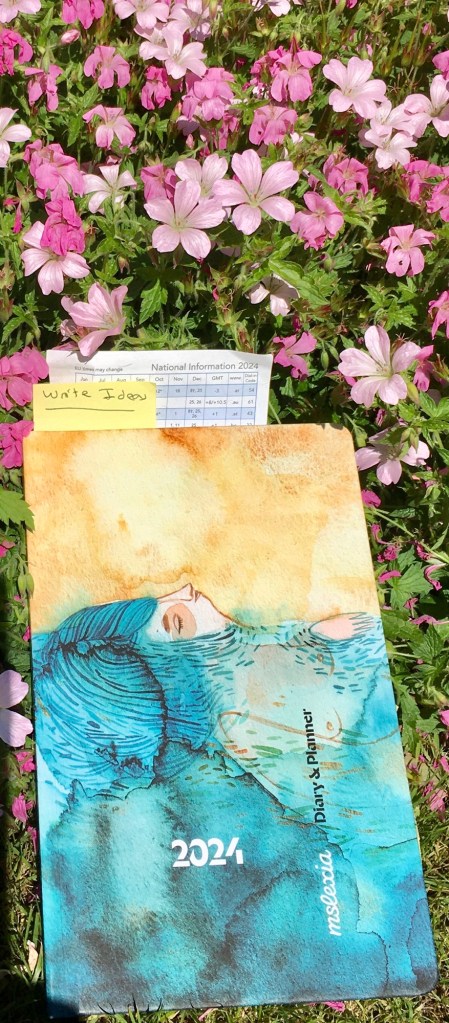
However, I could not fail to be inspired by a creative writing prompt in my beautiful mslexia Diary & Planner.
This is what my mind saw: Take a favourite sentence. I had just the perfect one in mind:
‘Life is really simple, but we insist on making it complicated.’ Confucius
I came across these wise words for the first time earlier in the week while reading Khaya Ronkainen’s heartwarming and inspiring newsletter. (Do take a look at her wonderful poetry and blog here .)
Next, I believed I should place the sentence vertically down a page, a letter per line. Then create a poem or short fiction, starting with each letter on each line!
Creative ideas flowing I scribbled away with a satisfying whirl of energy. It became long; longer than I’d expected. Halfway through I returned to the instructions (quite typical for me!) and realised my piece was unravelling before me!
This was an acrostic writing exercise which involved selecting a sentence and listing the 14 words vertically. (Error #1 Mine was only 11 words) One should then make the first letter of each word into 14 new sentences or lines of poetry. (Error#2 I had made each letter of the sentence a new line – hence 50 line-long poem).
Instructions are great, and helpful at times yet they can be abandoned, as inspirations take us to new directions! Just so! Instead of scrapping my piece, I returned to it reinvigorated, daring!
I hope you enjoy my non-acrostic poem below and I wonder have you ever had any experiences where not following the instructions led to something new?
Listen
Listen! I’m speaking Fine Except I’m not.
Speak to me Relish the moment Experience life Accept it.
Listen Lightly let your heart sing.
Yellow Stains on your shirt Immersed in fantasy My imagination Plays tricks.
Lions, or is it loins, Enwrapped, enraptured, Business, only business, you say. Untruths, lies, fiction Truth, tantalising close Warped, twisted, broken Especially from your mouth.
I sink down onto the chair, Nestling amongst the blankets Snug as a bug, as my mother used to say. Insistent promises; you should become a writer.
Shut up, I whisper Tornado of words whip Over the coffee table, behind the TV.
Neither listen.
Me becomes we Armed with history Knitted over time.
Incorrigible, you really are, my Dad declared. Was I? Am I?
Neither of us speak.
Groundhog Day number 63 or is it 541? I forget.
The Clock Oozes pain. Mine and yours.
Please Listen I’m done Come to me, though As always, worn down.
Dappled sunlight a soft path Fragments of light and shade played catch beneath the lively birch leaves.
A hush hung delicately in the air.
So many goodbyes. To fathers and sons left to fight To a country To one’s language.
For Alina, this was the toughest goodbye. Yet not so at all.
They didn’t understand.
She wasn’t being difficult, as her aunt claimed. She wasn’t a baby, as her sister teased her. She wasn’t like the rest of them.
Her Mama understood that.
These kept her safe. Three grasped tightly in each hand. Knuckles white at times.
She wasn’t a baby.
She knew she was five. A big girl.
But the pacifiers had been her rock. Soothed her as explosions shook their home protected her as Mama forced a way for them through the heaving stations.
These helped her sleep on the trains in the cars from strange beds under unfamiliar blankets.
To home. Her new home.
Alina ran ahead, flitting onto the beach jumped up on a rock arms akimbo feeling free.
Shells, of the sea variety, picked, pocketed Later painted.
Next a left, then a right. She’d arrived at the tree.
The whispers meandered up the path, weaving between the tree trunks carried by the warmest of breezes.
‘She’ll never dare … … it’s too much for her.’
But Alina realised at last. The pacifiers, these pieces of plastic, never were her rock.
Here was her world.
They were her everything. Mama, Sestra and Titka. Her family Her father - her Tato so far away.
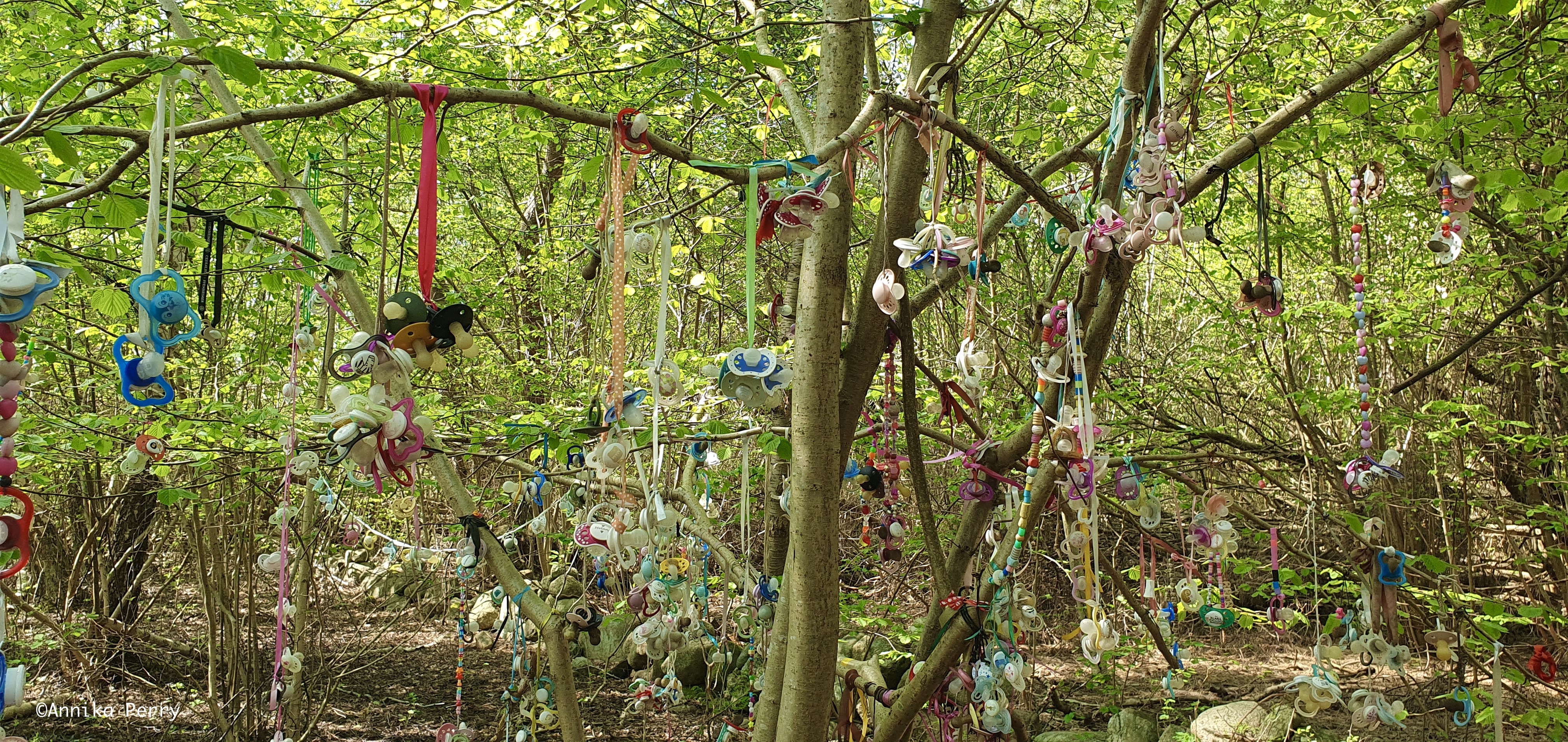
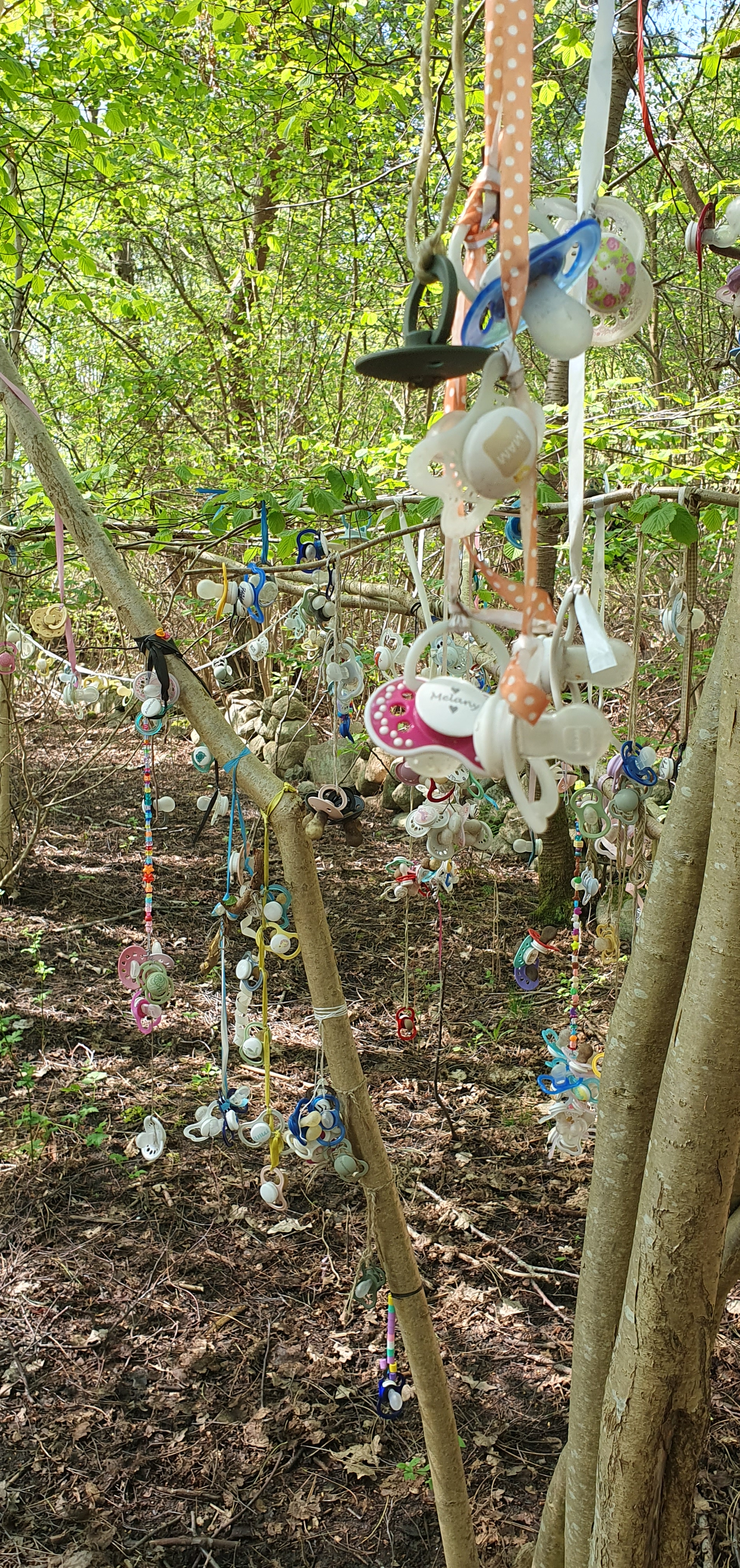
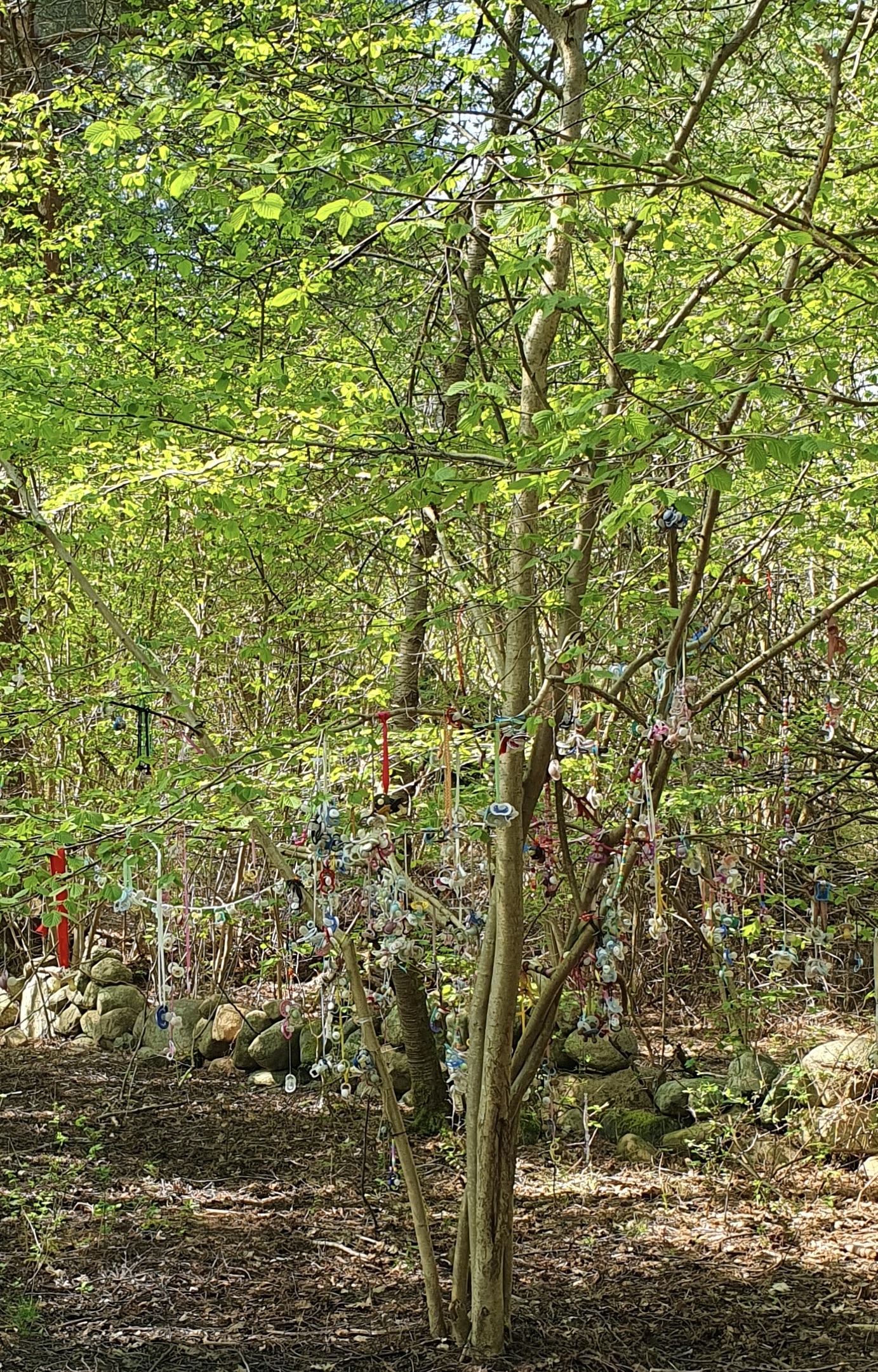
Pinks, blues, yellows, reds Clusters of the rarest decorations hung on ribbons from the birch branches.
One lone pacifier waved hello Ten or more bunched up for safety.
Not a sound.
The air shifted next to Alina. One became four.
Stillness filled her being Sublime peace.
It was time.
‘Up there, please. Lift me up!’
Glancing up they saw it too the perfect branch the sunshine lighting it up.
On a yellow and blue ribbon dangled her six rocks her six pacifiers.
Let them fly here, highest of them all In this nook in this sanctuary.
A worried daughter Woke at night Looked at her phone Waiting for a call
Wondering how her Mamma was faring, under the strains of the dreaded Covid.
She tries to still her mind With counting games Capital cities, memories of Warmth, love and holidays Abroad.
All to no avail.
It seems so long ago.
So now she sits in bed Snuggled up in a star red dressing gown Tapping away To her best friend and Mamma
Hoping the night has gone well for her There is some reprieve in the illness
Hoping she knows her worried daughter Is always there for her.
********
I wrote this little missive early this morning following my mother’s positive test for Covid yesterday. The illness has floored my husband and me earlier in the week although I feel a tinge of improvement.
I feel blessed with my family and my friends. Their love, concern and care keep me strong.
Wishing everyone good health and more luck than us at dodging this latest wave.
Grief Songs is a beautiful and haunting collection of poems that has left an indelible impression on my soul.
The book pays homage to the author’s parents, Elliot and Katherine as well as her brother, George. All deceased. The heart and essence are within the minutiae of the detail of each poem; where the everyday objects or events become increasingly poignant and resonate with vitality, a life lived, a life no longer except within memories of a few. Memories such as the crooked smile of her father, the perfect portrait of the siblings, ‘his (her father’s) precious angels’ who are immortalised in a click but belies the earlier unruly behaviour of the children when:
‘George had cried piteous tears while I railed against my bangs’
A doll during a seaside outing is recalled in the stark awareness that:
‘just Lulubelle and I now detritus of a beach day’
Each poem within Grief Songs is preceded by a photograph and coupled with the poem these become a powerful and emotional combination.
Grief Songs I, II & III consists of one striking poem each. The majority of the poems in the book are tankas within the Poems of Love and Remembrance section. Tankas are a Japanese form of poetry, a type of short song, over five lines with a 5/7/5/7/7 syllable count format.
The hypnotic poems take on a life of their own as familial love, warmth, kindness and care is recalled. Liz’s mother is described with the memorable and striking words of:
‘for a time she stood fearless my protector, my mother’
One of the later poems summarises her mother’s life in:
‘sixty years safe under glass minutes tucked into envelopes decades left in dresser drawers’
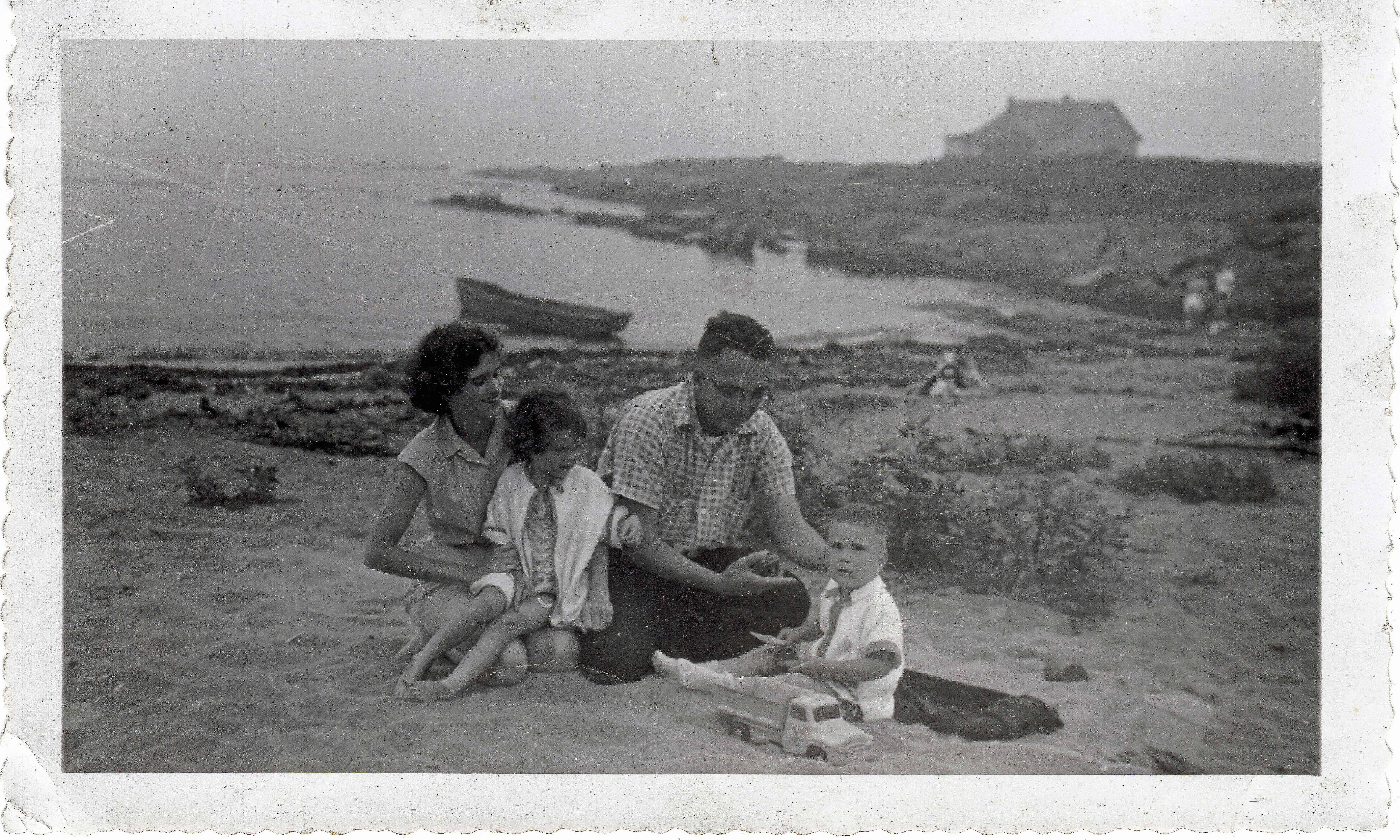
The book is a tribute to her parents, their early life, family trips, love for her brother. An early poem describes how the siblings are enjoying a day on the beach, ‘no diagnosis / his arm around her shoulders’. Another photo and poem describe ‘George Gauffreau enjoys a Coke/classmate, friend, brother deceased’.
Katherine, Elliot, Liz & Geoge Gauffreau at Hannaford Cove Beach in Cape Elizabeth, Maine – photo courtesy of the author, with thanks.
I am deeply moved by the profound inner landscape captured within the ordinary days of family life. Remarkable moments mulled over time. In one poem, entitled ‘Time’, Liz fondly remembers her father’s story-time and her mother’s words of ‘wait till your father gets home / not a threat but a promise’. A father one senses is a hero for young Liz who, as a two-year-old, sits beside him, pen in hand as he writes his sermons. ‘oh the places she will go’. For now, she is happy to be close to her father and recalls on her confirmation day that there is ‘more time with Daddy for me’.
Liz Gauffreau’s book dares to directly approach an emotion that in modern society is often not acknowledged; the universal experience of loss is one of the rawest and most absolute of emotions and one that has become increasingly sidelined in search of ‘happiness’.
Not by Liz Gauffreau who in response to her own close personal losses in life decided to highlight the contradiction of grief. Where dark and light coexist on an existential level, where memories blend with the present, a buffer for living with intense and overwhelming grief. The transient nature of life is explored through these snapshot moments, caught in the black and white of photographs, in the black of the text, through colour images. The memories are retrieved, examined and shared in the most tender and thought-provoking poetry.
Ultimately the book becomes not only a study of Liz Gauffreau’s grief but also of one’s own as well as one’s identity upon losing those closest to us.
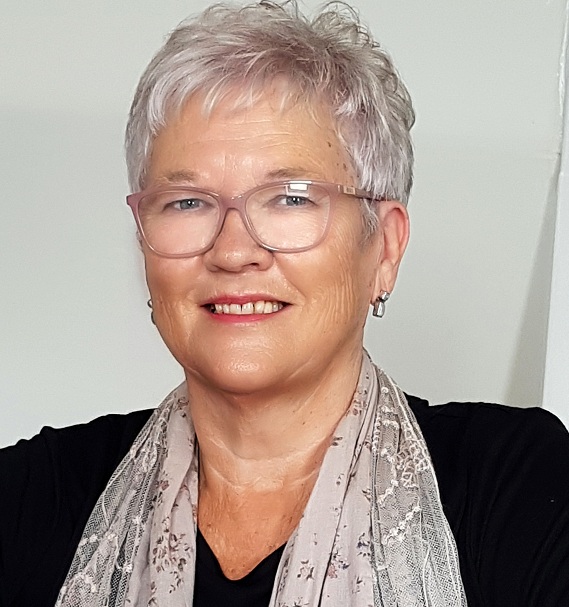
Elizabeth Gauffreau writes fiction and poetry with a strong connection to family and place. She holds a B.A. in English/Writing from Old Dominion University and an M.A. in English/Fiction Writing from the University of New Hampshire. She is currently the Assistant Dean of Curriculum & Assessment for Champlain College Online, where she is an Associate Professor. Her fiction and poetry have been published in literary magazines and several themed anthologies. Her debut novel, TELLING SONNY, was published by Adelaide Books in 2018. Liz lives in Nottingham, New Hampshire with her husband.
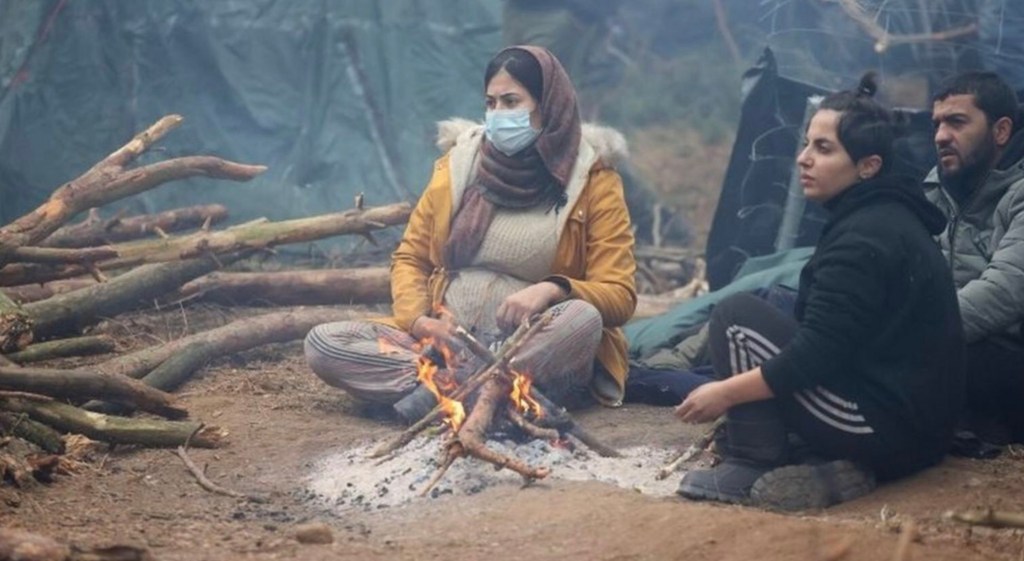
Private people, political pawns Scratching for survival on the barren plains. Tufts of autumn grasses, scraggly skeleton trees A frozen mist of grey descends on them all.
Flickering flames fight for life beneath four large twigs crossed unevenly above the mound of ashes.
Vacant eyes stare despairingly. The route to freedom pushes back Behind them an equally determined force hems them in. No return to civilisation.
Trapped, the human hostages wait. For Life. Or for Death.
As usual the world watches on. Albeit through distorted crackly images sent from the migrants’ phones. The Press refused entry by both sides.
In the glare of publicity, but not. In our sights, but not.
Days become nights. Tens of migrants become hundreds. Hundreds turn to thousands.
In an area bereft of anything There is even less than nothing.
The masses gather at hastily slung up rolls of barbed wire.
The Border.
Words are thrown through the gaping holes of mesh, Stones are hurled across the countries. SNIP SNAP. Shears ineptly attack the coiled boundary.
15,000 official soldiers ahead. Unknown army thugs to the rear. 2,000 imprisoned, homeless, unrepresented. No voice. No advocate.
Humanity at its basest.
As the verbose political volleys are strewn across the air waves, As political threats are met by counter-threats People Die. All hope diminished.
Resolutions are passed in amiable assemblies Discussions continued over replete repasts. Morsels from these luncheon tables But a dream to the Trapped.
Flown in by a malfeasant country on the wings of promises, of easy access to the West, of bright futures.
However much one might question such nativity. The truth remains: No one leaves their home for uncertainty. No one endures such hardship. Without real and absolute cause.
As the hoards gather in the frozen murk Ghostly beings wander the earth Human beings abandoned by the world.
For once, why not take the high ground? For once, why not do what is morally right?
Let governments continue their wrangling, Let world organisations issue their impotent irresolute decrees.
For NOW
At the border, save the people. Allow orderly documented entry From there seek the best way forward.
For NOW
May humanity take a step forward, Through the murk, across the wire.
Thank goodness for the blogging challenges that inspired Sally Cronin’s Life’s Rich Tapestry Woven in Words. An enriching and engaging collection of verse, micro fiction and short stories, her work is mesmerising, always uplifting and often humorous. Throughout humanity and the spirits of humans (and some animals) is a beacon of hope for us all.
Sally’s poetry is enticing, thoughtful and soothing; they are written tightly within the framework of syllables for various formats such as haikus and tankas yet explore a vast range of topics encompassing the wonder of the seasons, recognising human frailties and celebrating the warmth of togetherness. She manages to take us on a journey from cave drawings to digital code across the universe, from the mystical of the ugly troll with his bewitching music in The Moonlight Concerto to the enchantment of Fairies!
As a writer, one poem – an ode to writing – particularly struck a chord with me:
The Freedom to write
The freedom and time to create written words to be read by those open to our thoughts intoxicating.
by Sally Cronin
Sally Cronin is a master storyteller and I was immediately drawn into the lives of the characters in all her short stories. Her writing flows with ease and self-assurance within this diverse selection of short stories. I was moved by the reunion of siblings, impressed how a story told through the point of view of a polar bear both touched me and touched on environmental issues. The reason for a black sheep was raised in one story and had me smiling as did My Mouse, a clever play on words and a predicament experienced by most of us!
The superb stories in The Underdogs section had me in awe of the strength of the individual personalities of the dogs. Later, in For the Love of Lily, I was cheering on as eighty-year-old Millicent found her courage to stand up to her overbearing son with the help of her cat Lily and her kindly neighbour Eric. This was an excellent depiction of what I hope isn’t a scenario that takes place often.
The final longer pieces in the book are under the title of Speculative Fiction and these are all exceptional and shows Sally Cronin’s incredible imagination and ability in writing across all genres.
A moment of alignment is superlative and left me with goosebumps (of the happy variety!) as a child, following her death, manages to cross from the other world for the briefest of times on certain occasions to talk to her mother. Great Aunt Georgina left me tear-eyed and is a wonderful and powerful story partly told through the use of old letters; a deft use of an evocative writing technique. The Enhancement Project combines the tantalising hint of romance between a surgeon and her patient cyborg, all against the backdrop of the end of civilisation. It is a terrific blend of human and futuristic, of dark and light, love and destruction.
I can’t recommend Life’s Rich Tapestry Woven with Words highly enough and look forward to reading more of Sally Cronon’s books.
Sally Cronin is the author of fifteen books including her memoir Size Matters: Especially when you weigh 330lb first published in 2001. This has been followed by another fourteen books both fiction and non-fiction including multi-genre collections of short stories and poetry.
As an author she understands how important it is to have support in marketing books and offers a number of FREE promotional opportunities in the Café and Bookstore on her blog and across her social media.
Her podcast shares book reviews and short stories Soundcloud Sally Cronin
After leading a nomadic existence exploring the world, she now lives with her husband on the coast of Southern Ireland enjoying the seasonal fluctuations in the temperature of the rain.
Sally’s magazine blog for lovers of health, food, books, music, humour and life in general is Smorgasbord Blog Magazine.
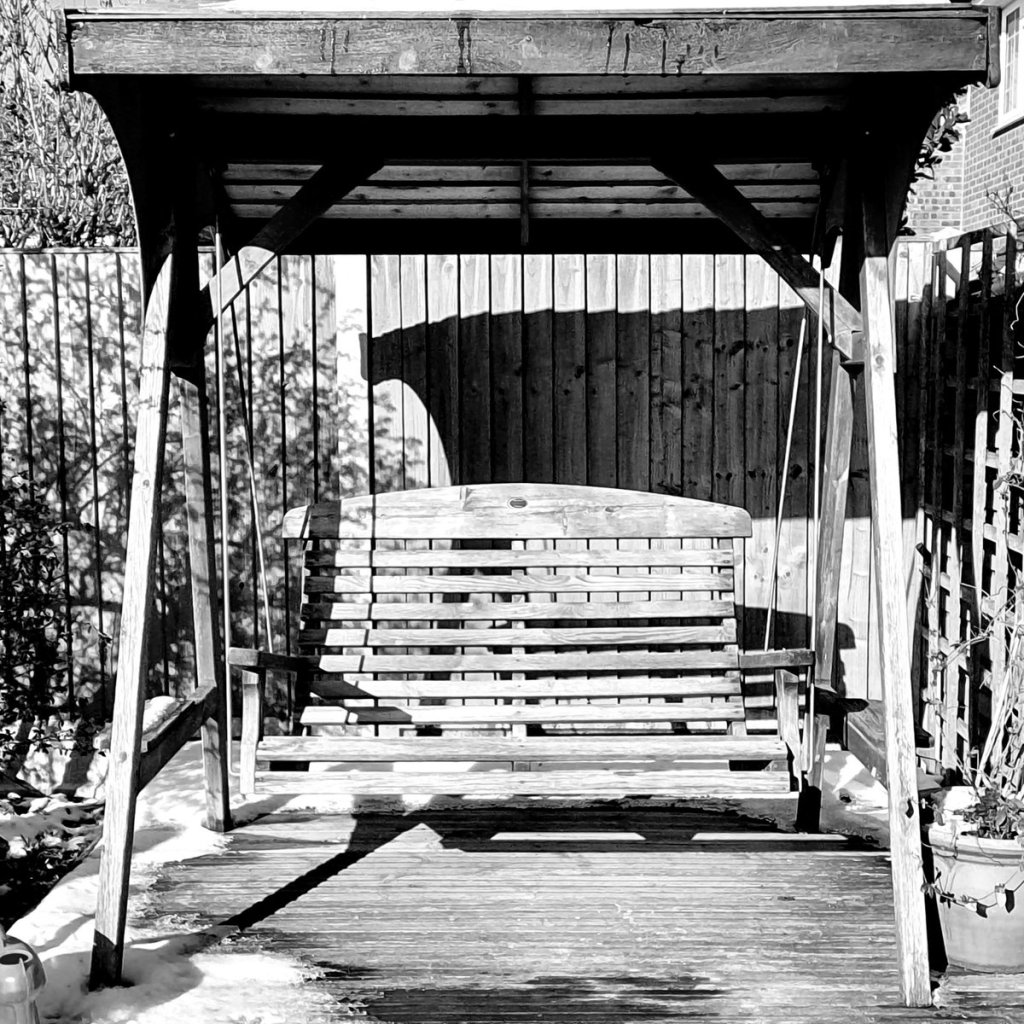
As I headed out into the garden one sunny February afternoon a movement caught my eye; upon the decking the wooden swing seat was gently swaying and for a moment or two endless possibilities swarmed to my mind. A ghostly being seemed to have taken comfort upon the seat, enjoying the wintry sunlight. Alas, the reality is most likely far more mundane and the breeze caught the slats as if a sail.
However, the image would not go away. Luckily I’d taken a video and soon poems came unbidden to me. Here are a couple of them.
The first is in a traditional Haiku format composed of only three lines. The first line of Haiku has 5 syllables, the second line has 7 syllables, and the third has 5 syllables.
ROCKING
Childhood memories Sway with mysterious ease Gentle cosseting.
My second poem is a form called Eyeverse and is a four-line poem based around an image. The name was coined by mslexia, a British magazine for women writers founded in 1999 which releases four editions a year.
MOMENTS
Tea spilled on your torn jeans My curls tousled through your fingers Our first youthful kisses A mere ghostly presence.







 Annika Perry