
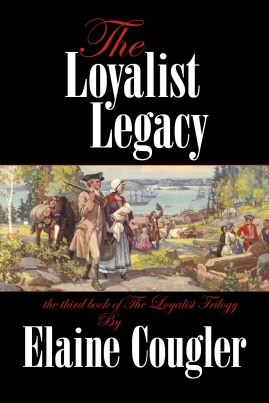
I am very excited to be part of Elaine Cougler’s book tour for her latest historical novel, The Loyalist Legacy.
‘Historical fiction is flourishing as never before,’ declared the head the British Historical Writers’ Association recently and Elaine’s final book in her Loyalist trilogy is testament to the popularity and success of this genre.
Set against the backdrop after the American War of Revolution (American War of Independence) and the War of 1812, The Loyalist Legacy is an intimate, personal and realistic novel centred around William and Catherine Garner seeking to rebuild their lives admist the terrible hardships and ensuing political fallout. Her book can be read as a stand alone but of course would be richer to read in sequence.
With realistic insights into the challenging lives of Ontario’s early settlers, Elaine Cougler once again draws readers into the Loyalists’ struggles to build homes, roads, and relationships, and their growing dissension as they move ever closer to another war. The Loyalist Legacy shows us the trials faced by ordinary people who conquer unbelievable hardships and become extraordinary in the process.
The following encapsulates the essence of the book and I cannot help but want to learn more about the two main characters, their struggle and the change created in both them and their country.
When the War of 1812 is finally over William and Catherine Garner flee the desolation of Niagara and find in the wild heart of Upper Canada their two hundred acres straddling the Thames River. On this valuable land, dense forests, wild beasts, disgruntled Natives, and pesky neighbors daily challenge them. The political atmosphere laced with greed and corruption threatens to undermine all of the new settlers’ hopes and plans. William cannot take his family back to Niagara, but he longs to check on his parents from whom he has heard nothing for two years. Leaving Catherine and the children, he hurries along the Governor’s Road toward the turn-off to Fort Erie, hoping to return in time for spring planting.
The wonderful atmospheric writing of the following excerpt immediately drew me in and transported into the nineteenth century world of William and Catherine.
The tunnel sloped upward and, as the light grew brighter, they left the water behind. First out of the hole, Lucy watched as Robert turned back to help William tug their father, blinking, up into the sunshine. Aaron pulled her to the waiting wagon, and parted the hay to reveal a hiding place. She crawled inside, John came after and then her sons. They were almost blind in the shadowy half-light, brown with the sun filtered through the layered hay.
A bright spot of light opened where they had crawled in and Aaron shoved a jug of water toward them. “Godspeed,” he whispered and was gone. She prayed his part in this would never be known. The wagon lurched and they were off, the three escapees and her, now just as guilty in the eyes of the law as her men, and whoever was driving the wagon….
John dozed beside her, his long legs reaching to Robert and William who sat hunched at their parents’ feet. She had lain down beside John to try to cushion him from the bumpy road and hold his head on her shoulder. How could he sleep? She was acutely aware of each rut in the road and every stone the wheels scraped against as the wagon carried them to what she hoped was freedom. The horses snorted and panted up every hill and she found herself holding her breath hoping they’d make it.
They hardly stopped on the way out of the village, but each time they did everyone held their breath until the squeaky wheels started turning again. But the ride was uneventful. No one followed them; indeed, no one seemed to know they had escaped.
The wagon bed was covered with a thin tick meant to ease their journey and she thanked the planners for their effort even though it didn’t help much. Nevertheless the clip-clop of the horses’ hooves created a kind of rhythm and gradually her thoughts subsided into the sound as she released her fear and her excitement. Her body relaxed against John’s. The last thing she remembered was putting a handkerchief over her nose to keep out the bits of fresh hay floating in the murky air.
Whispering woke her. And a sudden burst of cool air, which wafted into the tight space, now dark. She pulled the cloth away and sat up. John groaned beside her and she felt his fevered forehead.
“Mama? Are you awake?” William’s low voice caught and he cleared his throat. “We’re stopping for the horses.” He crawled through the opening and she followed after him feeling her way in the darkness.
“What about your father? He’s burning with fever.” Picking bits of hay from her clothing she looked around but could see very little. A few distant stars shone weakly and a slip of a moon hung over them like a curved sword. Two men switched the teams but in the dim light she couldn’t see who they were. Only the occasional glint of harness bits and wide eyes—both horses’ and humans’—bore witness to their task. Mr. Beasley had been as good as his word.
Robert went to help the men and Lucy turned to John. William opened up a larger hole in the straw so his father could breathe easier. Very soon the horses were hitched again, the spent team tied to a wheel for a moment, and its driver, spent also after six hours of driving, brought Lucy a package of food from under the wagon seat. They each found a brief moment in the bushes, William helping his father out of the wagon for the purpose, and soon stuffed themselves back into the tight space.
The plan was to drive all night, the new driver had said, but Lucy wondered how much more she and John could take. Her rheumatism pained her at the best of times but bumping along in the back of this wagon was pure agony although she uttered not a word to her family. William had kept the plug of hay out of its hole at the back of the wagon and she was glad of the air. She plunged her hand into the sack to find what their rescuers had packed for them.
Hours later the wagon stopped again. William woke and hastily plugged the hole against the dawn light but soon removed the hay and crawled out, Robert right behind him. John’s eyes were on her and she took his hand.
“Where are we?” he asked.
“Another stop for horses, I expect.” She touched his cheek. “Come. We’ll have a stretch.”
Robert helped his father from the wagon and took him into the bushes.
“Where are we, William?” Lucy asked. “Do you know?”
“We’re going to Burlington Bay. That’s all Aaron told me.”
“Beasley kept his promise.”
William squeezed her rough hand and she winced. “What is it, Mama?”
She forced a smile and took back her hand. “Look. The sun is just clearing the lake.”
“That’s the last we’ll see of it today.” Robert had returned from helping his father. “The driver says we’re still many miles from Beasley’s place.”
 A lifelong reader and high school teacher, Elaine Cougler found her passion for writing once her family was grown. She loves to read history for the stories of real people reacting to their world. Bringing to life the tales of Loyalists in the American Revolutionary War, the War of 1812, and Rebellion of 1837 is very natural as Elaine’s personal roots are in those struggles. She lives today in the heart of Ontario, Canada, and is the descendant of Loyalists who lived through the times of which she writes.
Elaine Cougler can be found on Twitter, Facebook Author Page, LinkedIn and on her blog.
The Loyalist Legacy is out now and available at Amazon UK or Amazon US.

 Annika Perry