COSMIC WONDER

image

Sometimes I just forget our tiny place in the universe. How minuscule an area our atoms occupy, our Earth dwarfed by the enormity of the cosmos. Too large to fathom, to comprehend.

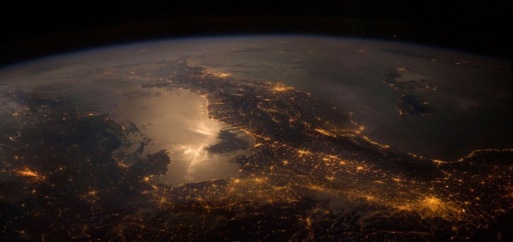
Moonlight reflecting off the Adriatic Sea and highlighting the boot of Italy.

Like the proverbial kick in the solar plexus I ached in awe at the glorious power, space and size of these images and what they represent. My mind started doing gymnastics before conceding defeat and instead stopped to admire the sheer beauty, scope and energy of the images. Enjoy.

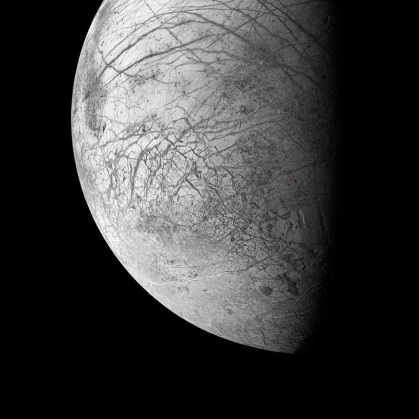
Europa - one of Jupiter's dozens moons - has a an icy surface filled with sprawling faults and deep flowing ridges.
Europa – one of Jupiter’s many moons – has an icy surface filled with sprawling faults and deep flowing ridges.

The pictures form part of a photographic exhibition at the National History Museum, London starting 22nd January 2016.  Called Otherworlds, the exhibition is an exploration of the solar system using some of the hundreds of thousands of images taken by robotic interplanetary probe cameras since the 1960s and recreated by Michael Benson to form the final composite images of the exhibition.

Calm day on Mars overlooking Husband Hill, which was named after Commander Rick Husband. He was the pilot of Colombia Space Shuttle which disintegrated on re-entry in 2003.
A calm day on Mars overlooking Husband Hill, which was named after Commander Rick Husband. He was the pilot of the Columbia Space Shuttle which disintegrated on re-entry in 2003.

 ‘Look up at the stars and not down at your feet. Try to make sense of what you see, and wonder about what makes the universe exist. Be curious.’ Stephen Hawking


A giant dust storm on Mars which can last months at a time.
Fog at the bottom of the 4,000km long & 6.5 km deep canyon on Mars.

‘Music in the soul can be heard by the whole universe.’  Lao Tzu

Ginormous solar flares.

Credit: Nasa/JPL/Michael Benson, Kinetikon Pictures & BBC News.

https://youtu.be/HOQtTgrdljE

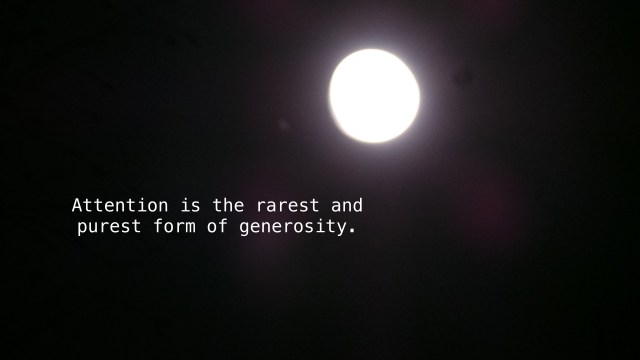
Attention

night2

Time. When did this become such a rare commodity in our modern day life? It is hard to imagine an era when time – time for ourselves, each other – was part of everyday life. Not ‘something’ to be negotiated, scheduled, squeezed into a tiny segment of our 24/7 lives. 

With this in mind the above quote by the French philosopher, Simone Weil (1909 – 1943) struck me as particularly poignant. 

How often do any of us take the time to talk, to really talk to someone? To take the time for conversations that reaches into the depths of the heart, where the spirit lies sad, where secrets are ready for harvesting. To explore moments that warrant more than a cursory glance, that necessitate our full equally mutual attention. 

Norh Pole Sunset (1)

I was motivated to write this blog of quotes by lovely Colleen at http://silverthreading.com/2016/01/06/writers-quote-wednesday-bewow-j-k-rowling/ at her regular Writer’s Quote Wednesday. Always a delight with a feast of imageuplifting, moving quotations and beautiful images. Do pop over and have a look – well worth a moment of quiet reflection in our hectic world. Who knows, you might be inspired to take part!

It took me a year, but better late than never!

The Whiteout Years – Part Two

IMG_1956

Here it is; the second and final installment of my short story, ‘The Whiteout Years’. I hope you enjoy reading it as much as I did writing it. That was a joy – or perhaps that is not the most appropriate word. Considering…

To read Part One, click here. There is an option to read the whole story here,  The Whiteout Years.

Finally, a huge thanks and hugs to you all for reading and for the many warm and positive comments. I’m truly touched by your words and they have given me such a lift. I feel it’s through the comments that a real sense of each other develops and relationships are built; that is the heartfelt core of blogging.

The Whiteout Years – Part Two

Along the road-side Carl spotted the triangle warning sign for elks. For the first time that day he smiled. The signs were far and few between, not through lack of trying. The local highway agency put them out, however they were soon quickly stolen by souvenir hunting tourists and taken home as a memento of their holiday in Sweden. The resilience of the authorities was staggering – hundreds of signs stolen, hundreds more put out. 

Out of the blackness Carl spotted the sign for the village. Two kilometres. His fifth year here and the road felt as familiar as the one he drove every day to work. How could that be? How could he feel so at home in a place he’d visited so infrequently?

He started to in shock, eyes blinded by a kaleidoscopic sheet of colour. Blinking, he saw more rainfalls of brilliant reds, whites, purples high in the sky. Another rocket swerved to the right, evaporating high up in the dark. Firework upon firework followed. Carl was late, the plane had been delayed and it must already be midnight. The start of a new year. As he drew closer to the village Carl saw that it had excelled itself. Now he could hear the distant thunder of the rockets, the odd whoops of delight from the crowd.  

Three years since his last moments with Karin. Three years since days, weeks, months, years ceased to matter. Her parent’s had survived their loss; he never knew how. At their insistence Carl came every year to visit them. Whilst he held himself responsible for  the accident, they had taken it upon themselves to save him. A lost cause, he told them repeatedly. He’d tried to escape their care and concern – to no avail. So, here he was again. Late.

Suddenly a wall of brown appeared in his lights. Large eyes gleamed in the headlights and instinctively Carl slammed on the breaks. The car spun to the side and with a smash it stopped; then suddenly it lifted and twisted up into the air before  landing on its roof with a cushioned thud. Outside Carl heard the sound of an injured animal, the pained barking of an elk.  As the car spun slowly, Carl saw the huge animal steady itself, before sheepishly trekking into the trees.  

He heard her breaths next to him, the harsh rasping and puffs of warm air upon his cheek. Tiny wisps of vapour floated in front of his face, warmth meeting cold. Carl started to shake, then thought of Karin and reached out to her, to protect her. The seat was empty. It was all wrong. Where was she? Wasn’t she driving? Why was he in the driver’s seat? She must have escaped? Gone to get help? He heard her voice in the distance, “Keep safe! Live.” 

“Karin!” Carl shouted her name until his voice was hoarse, quaking with the cold. His hand, blue and black, fought to release the seat-belt buckle. Karin, he had to find her. 

She was driving, laughing, singing away as they took an unknown short cut to her parents. He should have said no. He should have told her to slow down. Be sensible. No, he had told her, she’d shouted back. “Sensible is not living, this is!” and with that she’d turned the wheel first one way and then the other, skidding round and round.  He’d been furious, his temper frayed with fear. Seeing this, Karin had thrown herself around his neck, nestled her face into his neck, kissing him, comforting, all the time muttering, “Sorry, sorry.” After a while the car chilled and conscious of the time and the fireworks display, they set off. “Please, Carl, sensible is okay but remember to live, to live wildly, madly. Promise me.”

“Wildly, madly,” the words echoed in his mind, around him. “Please live…” the silent voice begged of him, 

“Live!” Karin’s voice again. Twisting stiffly in his seat, Carl searched for her. She’d been driving, more carefully after their stop, but he suddenly noticed her seatbelt. She’d forgotten to fasten it again. He told he to stop and do it up. She refused, saying they were soon there. He insisted. She started teasing him, “Calm Carl,” when suddenly he reached over in a huff for the belt. There was no warning, no skid, no shout. Nothing. Just a sharp descent down into the ditch, the car clumsily crashing, round and round down the steep slope. They would have been ok, the police said later. They would have been ok, if it wasn’t for the birch tree. Karin’s side of the car hit it full on, the door crushed on to her side. Unconscious for hours, Carl woke in the hospital with Karin’s father by his side, tears streaming down his face as he held Carl’s questioning look.

“Live wildly…” Karin’s voice again, demanding to be heard and freezing Carl started to, only to find himself dangling upside down in his seat, his head searing with pain, so cold time slowed. With her warm hand on his black fingers, they began to glow red as blood pumped painfully into them. With her guiding force Carl reached for his seatbelt until a sharp click released the buckle and with difficulty he clambered onto the road. 

Ahead lights sparkled from the windows of the houses in the village, colourful tree lights, window lights, candles. The last firework crackled in a cacophony light. “Karin!” Carl spun round, stumbling with dizziness. No one. Nothing. Yet, still something. 

The lights ahead beckoned, the lights of warmth and life and for the first time in three years Carl could see them, feel them. The mantle of oblivion had been lifted and yes, he would listen to her, to live wildly, madly. With tears stinging, freezing into tiny droplets on his cheek Carl staggered off towards the village.

The End

© Annika Perry 2015

The Whiteout Years – Part One

IMG_1958


Following the post about my visit to the Royal Society of Literature thanks to my short story entry to the V. S Pritchett Memorial Prize, many of you kindly asked if I was going to publish the story here on my blog. So I am pleased do just that.

I wrote ‘The Whiteout Years’ in the midst of Spring but it is set in Winter and particularly New Year so I thought this an apt time to post it. The story was also shortlisted for the InkTears Short Story Contest 2015.

As this is quite a long story I have decided to split it into two parts, however if you wish to read it in one go, please click this link.  The Whiteout Years

 As always, I really will appreciate your comments.:)

The Whiteout Year  by  Annika Perry

The music was blaring in the car, some modern Norwegian pop and once again Carl scanned through the radio stations. Lots of grinding static, then a few words, then silence as he hit the off button. Admittedly he was out in the Swedish forest but surely it shouldn’t be impossible to find a decent station, preferably in English.

Outside the snow had started to fall again; thick snowflakes bombarding the windscreen, the white swirls hypnotic. Carl slowed down and rubbing his eyes peered through the windscreen. On full beam he was reduced to the bottom of well vision, so minimal it barely reached the bonnet of the car. There was a slight improvement with normal lights on as the headlights lit a dull streak in front of him.

It was too hot in the car and Carl turned down the heating and opened the windows. The cold blast of air bit into his cheeks. Well, that did the trick and now fully awake he looked out for the sticks. He remembered his first winter here with Karin, her laughter filled the car as she sped along the narrow road at if in a rally, catching the orange snow poles marking the edge of the road with glancing blows. Behind the poles was a metre deep ditch, packed with snow. No poles now, a recession was on, instead birch branches, painted white were impaled into the ground earlier in the Autumn. Clever that, white against the white snow – a genius stroke thought Carl ruefully. Wonder what Karin would have made of that?

Finally Carl reached a crossing for the main road and out of habit he stopped. He knew he didn’t have to; he’d have seen any approaching car from the top of the hill. Nothing. A moment of total silence. With the windows down he sat and listened. He never failed to be overawed by the silence, the odd rustle of snow falling gently to the ground from the over-ladened fir trees. The odd animalistic sound deep in the forest, feral and prehistoric.

That fist time he’d been petrified, as with Karin they took a trek through the woods in the late afternoon. Lunch at her parents had been long and jovial, wine followed by schnapps, then the coffee and cakes. Replete and exhausted they’d made their excuses and headed out for a break. Whilst his body had been warm, his lungs froze in pain, as he inhaled the icy wind. Shocked he’d stopped and gasped and with a warm gloved hand Karin lifted his scarf across his mouth and face, softly stroking his cheek. “Keep safe,” she’d whispered. If only she’d listened to herself.

During their first winter walk, the snow crunched luxuriously under their boots, the frozen twigs snapped against their coat and the moss popped quietly in protest. A world transformed and in awe Carl, gloved hand holding Karin’s, wandered around the magic winter wonderland. He’d laughed suddenly, startling Karin.

“What?” she’d asked.”What’s so funny?”

“Last year we took my nephew to a winter wonderland in Cornwall, it was dreadful, such a disappointment. But look at this. Heaven – there is no way you could recreate this.”

Not far now, he was almost there and yet another year without Karin. Without her blonde air across his chest as he woke in the mornings. Without her grumpy moody mutterings as she woke and then slowly cheered up sitting up in bed, black coffee clasped in her hands, duvet wrapped tightly around her. Carefully he’d snuggle next to her, sipping his tea. Another year without her clothes strewn around the bedroom; a shops collection of tops hogging the dresser drawers, skirts and trousers abandoned as if heading out for a walk. Whilst he folded his clothes with care, hung them on a hanger or over a chair, Karin would blissfully discard her clothes as she headed for a shower, one leg of the jeans in front of the other, as if removed mid-step.

The rejected choices from the previous day lay forlorn on the carpet, chair, wardrobe door. However did they get up there? In a fit of pique? Those early days together Carl had tidied up after her, attempted to mend her ways with hints and then stronger words. Within months he learnt to love the mess; he could gauge her mood by the number of items left out. Just one, a day of confidence and self-assurance. Three or more, Karin needed extra loving, caring. No one else knew, her fear of others, lack of belief in herself. How could they? So self-assured in her work, tall and beautiful. Your poster Swedish woman – god, how had he got so lucky?

The whiteout deepened and claustrophobic Carl glanced down the road. A wall of grey/white murk met his glance. He couldn’t see anything. The silence droned in his ears. Signalling right, he turned, first onto the the left side of the road, then correcting himself onto the right. At least the road was ploughed, snow banked two metres or so high on each side. He was still driving on snow though, icier here and he felt the snow tyres grip the surface with a little skid. That had been his life these past three years, skidding along.

Working, surviving, interspersed with hours, days, nights of whiteout. Oblivious he would just sit in the dark at home. Forgetting to put the lights on, forgetting to eat.

“You’ll slip through the cracks, if you don’t bulk up,” his friends warned him. He didn’t tell them, it was too late, He’d already slipped away.

Meals with Karin had always been spontaneous. His life of routine turned on its head as she entered his life.

“I’m starving,” she’d called out as they returned to his flat after their first date out. It was midnight, dinner was hours ago and the film had been a drag.

“I’ll get some toast and tea,” Carl had suggested. Karin scoffed at the idea, pushed her way into the kitchen and set to work. Within a few minutes most of the contents of his fridge and cupboards were on the counters, with the overspill on the small dining table.

“Let’s make a feast!” Swedish meatballs, rosemary potatoes, salad, dips, bread adorned the newly set table. She’d managed to find his one and only decent table cloth and not satisfied with its brown drabness she’d flamboyantly cast her blue scarf on top. With the harsh electric lights off, his long-forgotten candles were finally lit and in reverential silence they sat and ate. At two in the morning, a grotto of warmth and love. It was not only his kitchen which was transformed that night; Carl was never the same again.

To be continued…

©Annika Perry 2015

HAPPY NEW YEAR!

New Years Eve Is Celebrated In London With A Huge Firework Display

Like so many of you I have celebrated the Christmas holidays with joy and togetherness. 

It also showed me the truth that we all want to give both gifts and smiles. Sharing is essential to the human spirit. 

I could not enter the NEW YEAR of 2016 without wishing all of you around the world a real HAPPY NEW YEAR.

Thank you for being there, for sharing.

So please, join me in the song below and why not in a Merry Dance too.

Auld Lang Syne is Scottish and mean “Times gone by”

A Season Song To Lift Your Heart

Every year at Christmas there will be one song which becomes my favourite for the season and one I will play non-stop. 

One year as young my passion for ‘Pipes of Peace’  by Paul McCartney nearly drove my brother mad. As yet again it spun on my turntable, volume at its loudest, he stormed into my room, lifted the arm from the record and said sweetly, ‘Enough.’ I realised then he might be right.  

‘Mary’s Boy Child’ by Boney M was a hit with us both and one to which  we would bop around the living room. 

Last year, on a Christmas CD of older hits I fell for the warm ‘olde’ tones of ‘I Saw Mommy Kissing Santa Claus’

This year I have returned to my Swedish roots. The song ‘Tänd Ett Ljus’ is sung in acappella and never fails to make my spirits soar it every time I hear it. The sheer clarity of the voices brings tears to my eyes and the words touch my soul. I hope you enjoy it as much as I do. 

Do you have a season favourite tune? Is it the same each year or does it change? 

Here is a translation of the song:

‘Light a candle, let it burn,

never let hope disappear.

It is dark now but light will come.

Light a candle for all Earth’s children.

I saw a Star fall, it was night and all slept.

I think I wished then you were near.

For a minute it burnt, then disappeared.

Was it only me who saw?

On the radio they sang about peace on Earth,

I wanted to believe these worn words.

Light a candle ……

I got a card from Wyndham, didn’t know where it was.

I saw on the map that you are 

on the other side of the planet.

But it is the same sky, the same ocean,

the same star I saw,

Fell for all our dreams, fell so we never forget.

Light a candle…..’

HAPPY LUCIA


lucia2

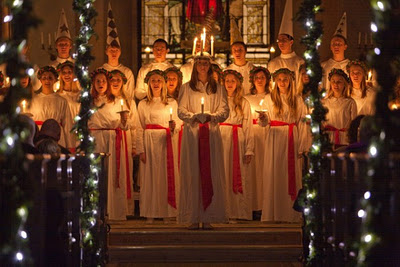
TODAY in Sweden nearly every home, school, hospital, factory, workplace, church, hotel and restaurant is celebrating LUCIA.

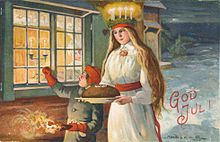
oldluciacardLucia is the Bringer of Light and is celebrated on what, in the old almanac, was the darkest day of the year. The day is one of light, hope and love. The tradition has its roots in St. Lucia of Syracuse who died as a martyr in AD304.

postcardviewWhilst the dark holds its firm grip on night, households across the country waken and quietly prepare. The long white gowns will have been carefully ironed the day before, the red sash belts laid out, candles and matches placed at the ready.
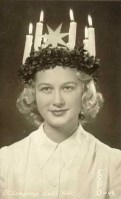
realcandlesLucia herself carries a crown of candles on her head. These are often now battery powered but not too long ago normal wax candles were used. The crown was placed on a damp handkerchief on the head. As the wax melted onto the damp fabric, a sizzling sound could be heard by those closest.
As well as Lucia there are her attendants, tärnor, who are dressed in white gowns with a silver glitter circle on their heads and carrying a lit candle.

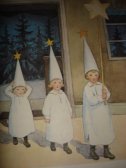
Carl Larsson Style Lucia PicturesIn the later years a place was also made for boys, mainly as Star boys, stjärngossar, wearing a white gown, a pointed conic hat with a star and carrying a silver star stave. Recently younger boys are also dressed as gingerbread men.
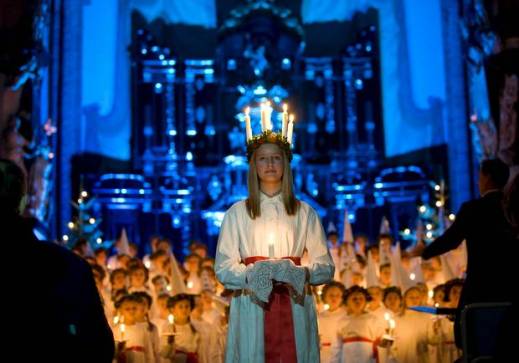
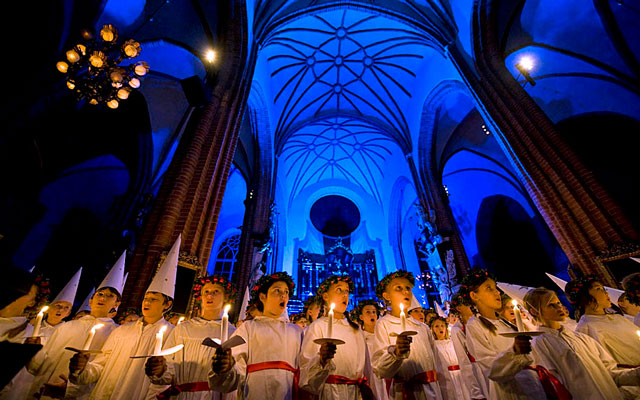
The hushed bustle of the waiting crowd falls to stillness and into the darkness comes Lucia and her train, the glittering light from the candles heralding her visit, traditional songs sending a dusting of heaven across the darkness.

At this point both men and women are tear-eyed.

luciachurch

As the Lucia train approaches the songs ring light and clear. One is ‘Sankta Lucia’, which is the song that epitomises Lucia. Its evocative tones weave their way into my soul. I’m sure I’m not the only one feeling this.

Here is the translation of the first verse:

‘The darkness lies weightily
on fields and cottages
in places forgotten by the sun
the shadows brood.
Into our dark homes She steps
with lighted candles on her head
Santa Lucia, Santa Lucia.’

The spirits continue to soar as Lucia and her attendants come to a halt, either at the front of a larger gathering or if at a home in front of the rest of the family.

church.jg

Now other festive songs lilt their way across the break of morning, the star boys even having their own solo performance. The mystical magical aura shimmers in the candlelight, spreading across the nation.

Being Sweden no festive occasion would be complete without its own traditional fare.

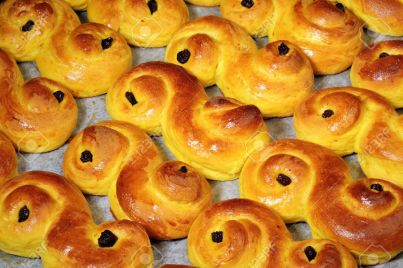
Particular for this day are Lussekatter (Lucia Kitten Buns), which are made with saffron.

lussek

Also on offer are pepparkakor, cinnamon/ginger biscuits. Although many in Sweden now buy theirs, we still make ours and here are some we (my mother, son and I) made yesterday.

Pepperkakkor

Finally on offer for this early morning feast is the special braided Luciabröd (Lucia Bread). To drink there is either coffee, milk or for the more daring a cup of julglögg.

brod

Please, join me today, on this special Lucia day for a cup of coffee or glögg. Help yourself to Pepparkakor. Enjoy the song below whilst you nibble away.

Happy Lucia to you all!

Lucia Morning in Gothenburg Church 2015


TWO DAYS OF PANIC

spinning-beachball-of-death-mac
Sometimes things are just going too well. A few days ago my work was in full flow, Scrivener now an integrated part of my writing life and the proud bearer of my WIP.  

So, there I was happily working away one morning. I took a lunchtime break and since the sun had decided to take a peek at our part of the world I popped out for a walk with a friend. Once home I had a couple of hours before end of school so I happily returned to the computer. I was in such good spirits I might even have been humming a little tune.

With the screen up I double clicked on Scrivener and waited. And waited and waited. Nothing! Just a spinning of the rainbow coloured wheel. 

I didn’t panic  – as yet. Sometimes programmes won’t load the first time and I force quit and tried again. And again and again.

By now I was grinding my teeth and I felt the pressure increase with the onset of a stress headache.

Why is it we will not accept the inevitable?  After two hours of all different attempts I gave up. I was thoroughly dispirited by now. My cheerful songs of before replaced by a melancholic resignation. If I had to look at that ‘scrivener not responding’ comment once more I fear I might scream…or worse. I restrained myself and left my computer for a while.

Calmer, determined I returned and started the Google step – there is always Google involved, don’t you find? I hadn’t realised how vitriolic some people became on the process. There were some quite nasty (and at times personal) attacks as one person blamed computers, others the programme. Deflated I left the sites and went back to the manufacturer and easily found the email address to the tech team.

I  sent them quick note of my problem and operating system and I sat back pleased. Help would soon be on the way!

In my dreams!  An automatic reply said they were experiencing an unprecedented high number of problems and would reply in two days!! 

I closed everything down and turned off the computer.

The next day I of course couldn’t stop myself attempting to open the programme. Again and again. No luck.  

Over 80,000+ words of my WIP now seemed lost. As well as all my other projects and collections of work. To say I was by now feeling low would be an understatement.

At certain stages I had saved my whole draft in pages (Apple word processing programme) and even emailed an extra one to a friend for safe keeping. However all my latest changes were not included not.  More importantly all my ideas on cork board and side-notes on each chapter, plus notes and ideas for book two were inaccessible. 

Furthermore Scrivener had been so perfect for my working method, so automatic and exceptionally useful I couldn’t imagine starting over with a new programme.

By the afternoon my mood had dipped lower than ever. I do what I always do in such circumstances. Placing my documents in a large pile I started to clean. Always therapeutic. The house got cleaner, my mind became more cluttered and stressed.

Then late last night amongst the mass of emails was one unknown entity. I almost trashed it as spam until I spotted  a kind apology for my long wait and then a positive and calm ‘let’s get started’ sentence.

Still miffed I could not help but be reassured by the friendly professional tone of the email, the promise to get this sorted.

Three clear steps were listed for me to attempt first of all. Despite the late hour I just had to try and my Mac sang out as usual upon start. The steps included the magic of finding a ‘package software’ for my file and within that deleting two files. 

Surely it couldn’t be that simple?

The next step said to try to open my project. With little expectation I double clicked. Waited. Yeah!!!! It started to load, then said it was ‘retrieving’ data…at last the project was up – but the pages were blank, my long side bar of chapters empty, nothing down the left column!!

This was even worse, now there was nothing left to rescue. I plunged into darkness but then recalled the strong self-assured email. I could not imagine they would let this happen. With a few more clicks on the side bar, my long list of chapters and the full WIP loaded fully.  

I held my breath. Everything seemed in order. Up to date with all my latest amendments and additions.

Not quite believing it would work, I closed Scrivener and then opened my folder again. A satisfying brr from my computer and up it popped on the screen. Perfect.

With shutdown complete I headed to my family to deliver the good news, dancing downstairs en route and entering the living room with a slight leap of joy.

It has been an emotional two days. I’m relieved everything works now but still bemused what actually happened. I’ve asked scrivener to explain what could have gone wrong and if this could happen again. In the meantime I have finally found out how to set automatic back up from Scrivener although I doubt this would have helped anyway since that whole file was corrupted.

My ease and enjoyment of using the system will in the end override any long term concerns I have and I will continue now to work away on my first draft with renewed confidence.

HAPPY 1st ADVENT

image
However much we moan about it, most of us cherish our routines, need that steady rhythm in our life for peace, stability and joy. An extension to routine is tradition, the bells of the festivities / seasons that cement us to life’s path, that unite families and friends, that bring together our loved ones for celebrations. Traditions at times of life and death. Together being the keyword.

One such tradition is celebrated by many today and I want to wish everyone a very Happy 1st  Advent.

As young we would gather on each Sunday staring at the unlit candles, the four red lights signifying to me an unquantifiable long run until Christmas. The patience needed for those four weeks was not within my grasp as in my excitement I would physically become sick. Older and maybe even a little bit wiser I now treasure the whole peace of December, the calm Sundays, the significance of that first light.

image

Another tradition is the star in the window, a beacon of hope and belief in life itself I feel. A sparkle of joy from our window to passers by walking their dogs in the grey drizzle, to the school children walking through the early frosty morning.

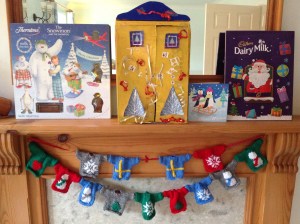
imageFinally, but not least – Advent Calendars! The big kid in me is still as excited by these as when young. My son has his already – it is one we made many years ago together when he was very young. One of those projects you embark upon, thinking this will be easy and quick. Two days later we had ransacked our house for little boxes, the dining room turned into an art studio of paint and glue, I’d explored art shops for gold paint. The advent box is now slightly worn and tired but lives on gloriously, bright with the wonderful memories it shares, solid with tradition, the embellishment of love and family.

‘SURELY THE POETRY IS IN THE PLOTTING.’

RSL_Pritchett


They say you should never arrive too early. We thought fifteen minutes before the start was safe, but apparently not as the photographer seemed to have become welded to his position in front of us with the lens aimed directly at my friend and I. We tried to seem busy. Talked. Scribbled in my notebook a little. I felt as if I’d returned to my university days. Finally I lifted out my phone and took some photos! That seemed to do the trick as the photographer moved and at last I could concentrate on my surroundings watching the rest of the audience gradually enter in twos or threes.

When nearly full with three hundred eager writers and their friends a hush fell on the lecture room as the three ‘stars’ of the evening entered. Three highly distinguished authors with many worldwide successful books between and with an intimate knowledge of the UK and US markets.

As an entrant to the V. S. Pritchett Memorial Prize short story competition  I had been invited to the awards evening at the Royal Society of Literature (RSL). The society was founded nearly 200 years ago by King George IV to ‘reward literary merit and excite literary talent’. New fellows use Byron’s pen or Dickens’s quill to sign in and the sense of history was palpable from the surroundings alone, set near Somerset House at the Royal Institute of Art, London. 

V. S. Pritchett  is regarded by the RSL as one of the country’s finest short story writers and the society set up this prize in 2000 to commemorate his birth. 

The judges for this year’s competition were Philip Hensher, Adam Mars-Jones and Rose Tremain and before the prize -giving there was a discussion between the three of them about the short story. Here are a few snippets of what they had to say. 

As author of 16 books, including award-winning ‘Restoration’  and numerous short stories Rose Tremain has been published in over 27 countries. She believes that writing short stories is the closest a fiction writer is to being a poet. She thinks that short stories can be considered a form of poetry in themselves. Philip Hensher, the chair of the discussion, disagreed strongly with her comment, asking how stories such as the Sherlock Holmes ones could ever be considered poetry? At this Adam Mars-Jones interrupted quietly and said, ‘surely the poetry is in the plotting’. 

Rose Tremain considers it essential on not knowing yourself where the story is going and that this is part of the journey, telling your reader to come along and find out. Endings can vary and some be such as Mark Twain’s ‘snapper’ tales which have with a real bite at the end.

‘The fictional becomes real, the real becomes fictional,’ said Rose Tremain.

Her stories often start with an image or as a result of overheard conversation. Once during a particularly bad  winter storm in America she heard one man say to another that it ‘is really good for roofters’ and from this one sentence she wrote a short story.

As for the fictional becoming real, Rose Tremain read from her short story ‘The Housekeeper’, where the Daphne du Maurier’s fictional Mandeville Hall is recreated as reality with Daphne du Maurier becoming a character in the story who visits the hall one summer.

Adam Mars-Jones, a novelist and also book, film and theatre critic, has just released his memoir ‘Kid Gloves’, admitted he has not written short stories for decades although he considered them a good tool for learning. His co-authored collection of short stories on people living and dying with AIDS was published in 1987.

He mentioned his dilemma of wanting to write one particular story about AIDS but was stuck as he did not want to use the word AIDS – even then, before the world of texting and emailing, he felt it was too shouty, too powerful and would dominate the story. In an epiphany one day he realised he could just substitute that word with another, in this case ‘slim’ and after that he could write the story. It was imbued with a a sense of humour which worked very well.  

Philip Hensher, who has written numerous books including his semi-autobiographical novel ‘The Northern Clemency’, which was shortlisted for the Man Booker prize, has recently edited the two rather large  tomb-like volumes of ‘Penguin Book of the British Short Story’, considers the short story as a ‘witness’ on topical current events surrounding us, such as the World War II short stories. He reiterated the ‘immediate topicality’ of short stories and their ability to address urgent social issues. However he did recognise that the best short stories could also be totally irrelevant to current affairs.

Markets for short stories were discussed at length and I never knew how vibrant and well-paid the short story market was at the beginning of the twentieth century. Between 1890 and WWI there were at least 34 magazines in Britain printing short fiction. One of those mentioned was the ‘Strand’ magazine which had a huge circulation and could as a result pay handsomely for stories. In 1914 when the average  annual salary was £ 400:- a year the ‘Strand’ paid £ 350:- per story. Imagine selling a short story for £ 27,000:-!!  As Philip Hensher says ‘No wonder there was eager competition among writers; no wonder the best writers of the day, including Rudyard Kipling, DH Lawrence, Bennett, Joseph Conrad and HG Wells, placed the form at the very centre of their creative practice’.

There was disagreement about the expose these magazines offered to ‘experimental short fiction’ with Adam Mars-Jones believing the magazines did not afford many opportunities early on for this kind of fiction whereas Philip Hensher felt strongly that they did, although they would lead with a ‘safe story’ and often put the unusual experimental ones on the back pages of the magazine.

Although the short story market in the UK is languishing it is still vibrant in the US, the ‘New Yorker’ being a prime example of excellent literary short fiction, the writers agreed.

Another issue quickly discussed by the judges is the seeming unpopularity of the short story by the general public. Rose Tremain feels that the short story requires more effort from the reader as it is often full of original thinking and written in a tight structure which results in the reader having to peruse the work critically. This can be considered exhausting and as a result puts off potential readers. Novels by contrast she says resembles ‘a bouquet’, far easier to read with less expectation on the reader. 

After an evening of interesting discussion and readings the winner and runner-up to the £1,000 Royal Society of Literature V.S.Pritchett Memorial Prize 2015 was announced. Following on Philip Hensher’s earlier point about topicality both stories were strong on current issues, one based in China, the other in Ukraine. 

The sponsor’s of the prize, Christopher and Jennie Bland, announced the winner– Jonathan Tel with ‘The Seduction of a Provincial Accountant’. Unfortunately he was in San Fransisco writing a story about the current crisis in Syria so his agent picked up the £ 1000:- award. The runner-up was Nick Sweeney with ‘Traffic’. 

All in all, my friend and I had an exciting inspirational and enlightening  evening surrounded by so many like-minded people and listening to ideas from successful writers about the short story. Wine and refreshment afterwards were most welcome! 

RSL_logo