A Coastal Town’s Mystique

The old and the new sit easily side by side in this beautiful town on the east coast of England. Established as a borough in 1529, Aldeburgh was formerly a Roman settlement, then a small fishing village before prospering when the coastline opened up and brought trade and shipbuilding to the town. The North Sea connects across time, lapping now, as then, along the undulating shingle shoreline. 

Nature’s Art – Large piece of driftwood upon the beach.

I was here with my family for a quick break during school half-term and we were blessed with unexpectedly warm sunny days. It was heavenly and rejuvenating to enjoy this blissful weather, to feel so alive. 

Aldeburgh is famed for its music, literature and arts and it is the birthplace of the composer Benjamin Britten. He founded the famous Snape Maltings, ‘- a place of energy and inspiration, one of the world’s leading centres of music’ –  which is located nearby but we couldn’t seem to tear ourselves away from the sea views! 
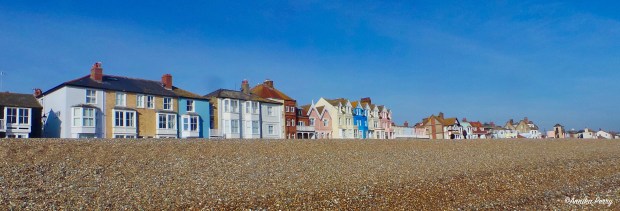
No fears, there was more than enough to enjoy along this unique coastline. The hotel was a few steps from the beach, and it was fun to slip-slide along the shingles as we explored the area! From the waters edge we had a tantalising view of  the picturesque houses in all their various colours. Two-thirds are now holiday homes for private or rental use which must have an impact on the town as a whole.
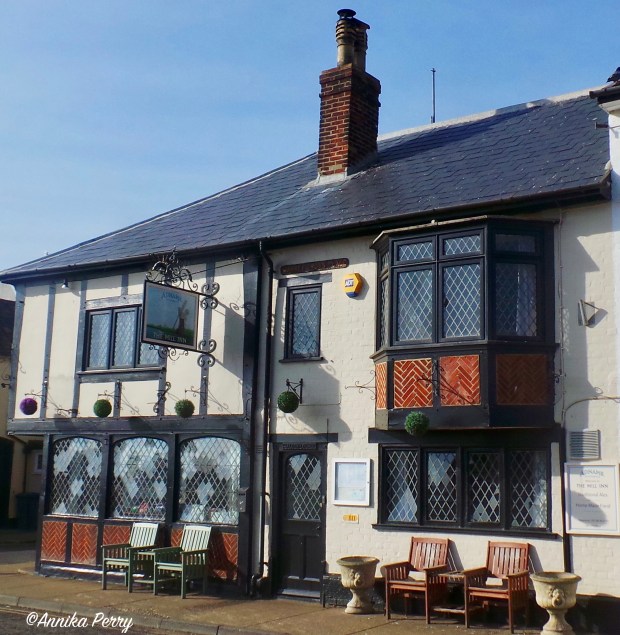
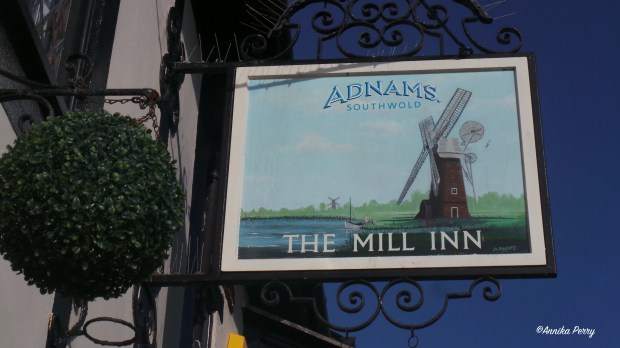
The Mill Inn

‘The Mill Inn’ is a local pub dating back centuries and its dark beams and low ceiling provided an atmospheric setting for lunch. I sat back and imagined the shenanigans of the smugglers who frequented this establishment!
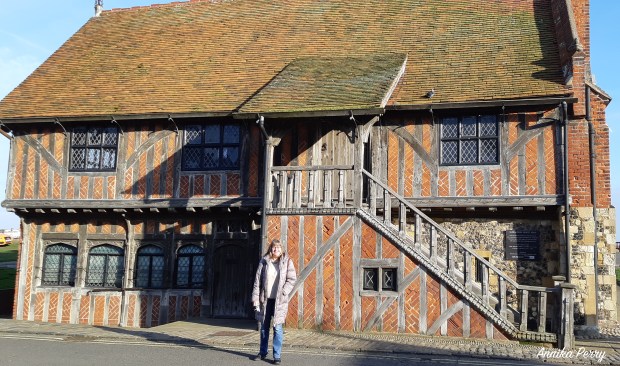
The Front of the historic Moot Hall

Opposite the pub is the striking and historic Moot Hall, which now stands proudly near the beach but at the time of being built would have been a mile from the coast. This wonderfully striking 16th-century building was the town hall and amazingly this is still its main purpose, as well as housing the town’s museum.

Set to one side is a stone seat, perfect for reclining and enjoying the view. My husband noticed the rusty sign above; the alcove was a place for people in the stocks to take a break before activities resumed! Luckily I could enjoy the long distance views in the knowledge that a calm and peaceful day lay ahead of me! 
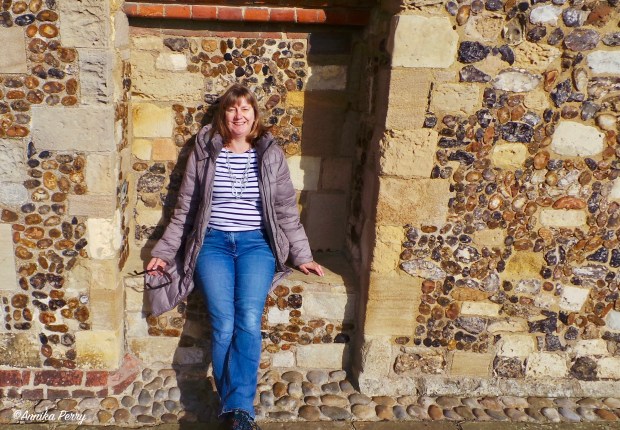
Me enjoying a break in the sun on the stock stone seat.

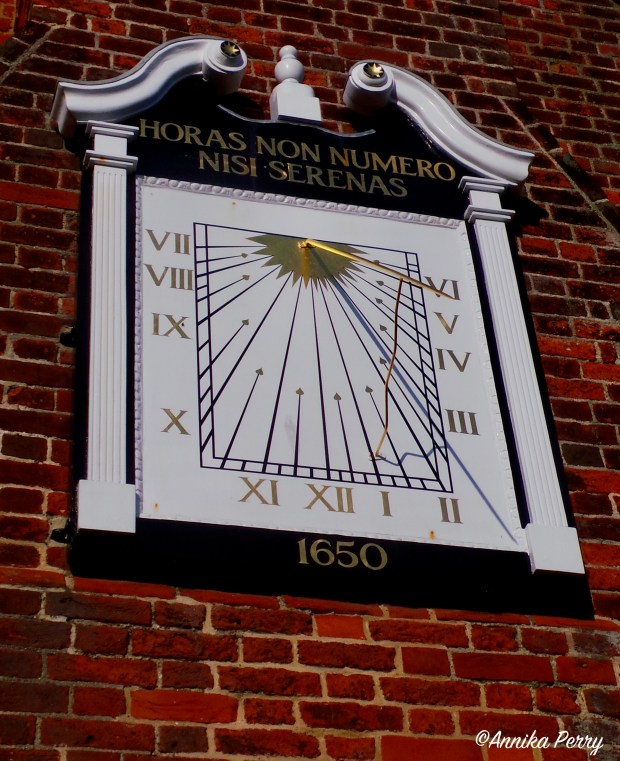
The unusual clock on the building is actually a sundial and the motto translates as ‘I count only the sunny hours.’ Sounds ideal to me! 
Two incredible landmarks flag the most northerly and southerly points of Aldeburgh; one a magnificent historic relic from the Napoleonic era (1799-1815), the other very much of the modern world.

The Martello Tower marks the southern point of Aldeburgh beach and is one of 18 towers built along the Suffolk and Essex coastline to keep Napoleon out. This is not the first such tower I’ve encountered from visits to the coast and they are always an awesome sight, sitting by themselves, standing forty feet high with thick walls and wide roofs. I am sure they would have been an impressive sight to any potential invader.
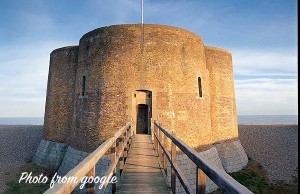
The Martello Tower

In sharp contrast is the gleaming white dome just north of Aldeburgh.  The dome is a nuclear reactor – named Sizewell after the village nearby – and is one of 15 nuclear reactors in the UK.  I am in equal measure awed and unnerved whilst looking at the power station!

In between are the coastline and its treacherous waters. Here the sea harbours miles of sandbanks which are often swept by fierce gales which present a real danger to shipping and particularly so during the town’s heyday of its busy seaways in the 19th and 20th-centuries.
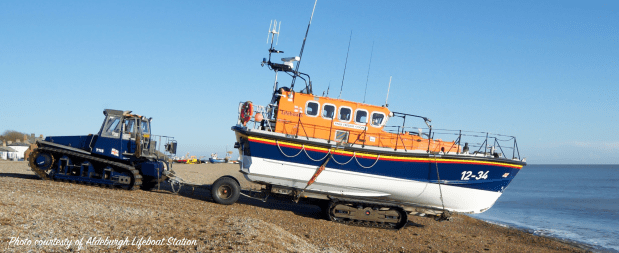
 Therefore it’s no surprise a lifeboat station has existed on the shore for over 150 years and its existence still plays a major part in the lives of the inhabitants. It was awe-inspiring to learn about the brave deeds of the men and women (all volunteers) of the Royal National Lifeboat Institution (RNLI). In the early years the wooden boats were powered by sail and oars and in 1899 one such rescue ship was overturned by a giant wave soon after being pushed out to sea. Tragically seven out of the eighteen crew died as they were fatally trapped beneath the hull. 
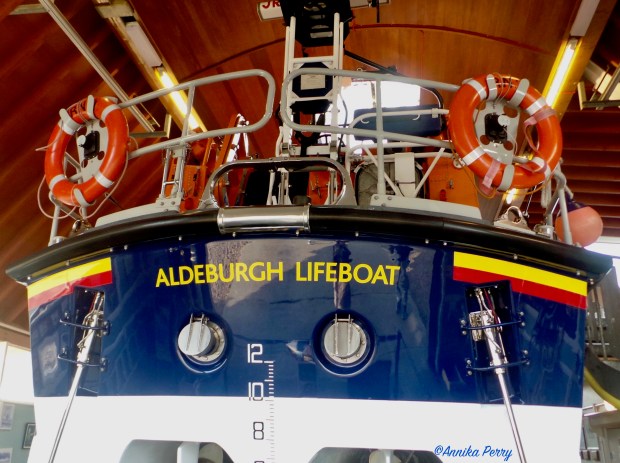
The aft of Aldeburgh’s Lifeboat ‘Freddie Cooper’

The modern-day lifeboat is an All-Weather Lifeboat (ALB) named  ‘Freddie Cooper’. This remarkable boat has been launched out to emergency situations seventeen times in the past two years whilst the inflatable lifeboat has been on thirteen missions. The courage required cannot be underestimated as the weather is often appalling and the crew face massive waves, reaching an incredible and daunting ten metres (thirty foot). Since its inception the lifeboat crews have saved the lives of nearly 700 people!
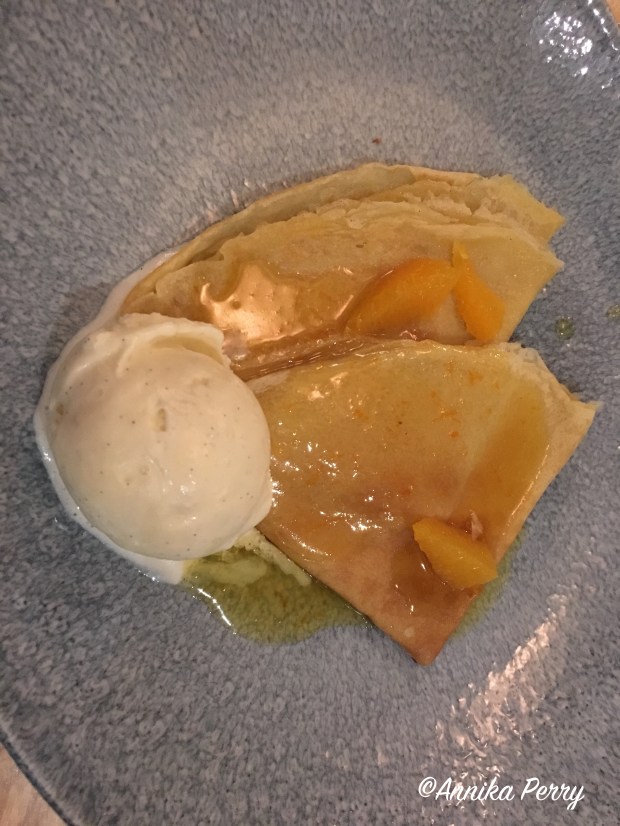
No travel post would be complete without a mention of the replenishments along the way and we treated ourselves to several  culinary delights throughout our break. As well as the pub, we enjoyed the first ice-cream of the year outside. Resting against the edge of a small wooden boat we enjoyed the delicious and rather large small scoop of maple and walnut ice-cream. The evening meal at the hotel was sublime; a delectable feast and we savoured every morsel. For dessert I could not resist the Crêpes suzettes with Grand Marnier, oranges and vanilla ice-cream

There are of course always gulls by the seaside and Aldeburgh was no exception; their evocative call creating a rush of happiness within me. I felt at home! At exactly the place I was meant to be!

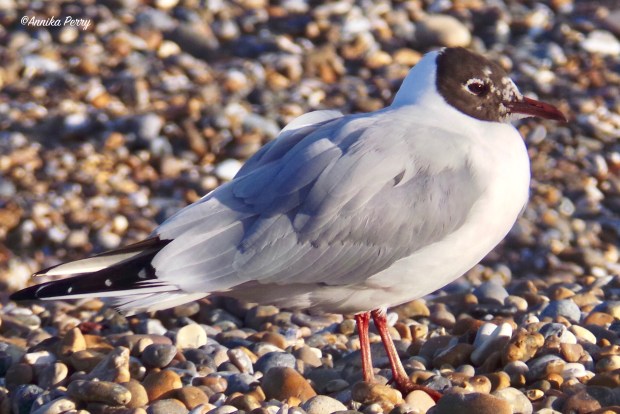
Black-headed Gull – winter plumage
Black-headed Gull – Summer Plumage

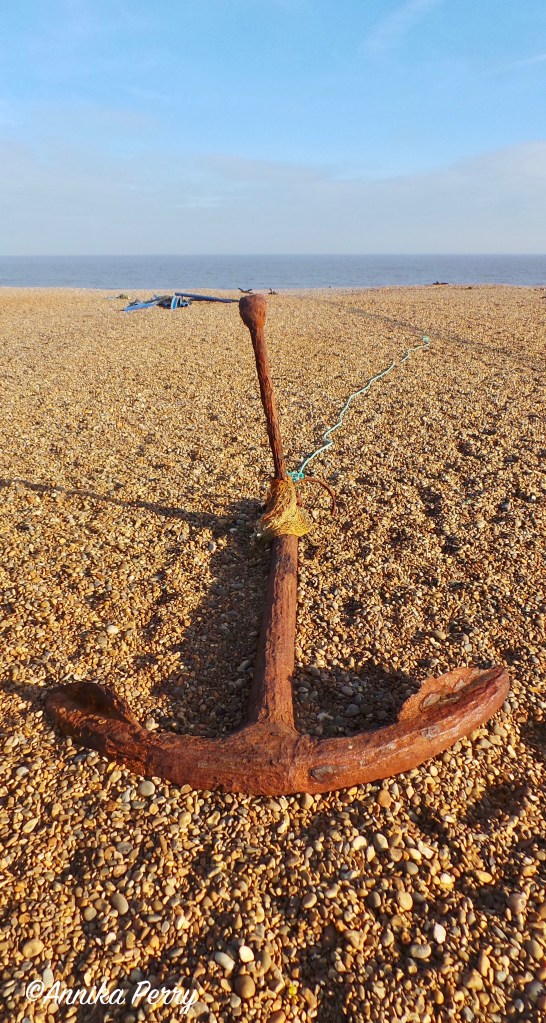
Beaches are a haven of discarded objects, and the nautical theme from the array of boats around us continued as we came across this huge anchor resting on the shingle; the red and golden hues of its rusty exterior blended in perfectly with the coloured pebbles.
Thank you very much for joining me on this brief tour of my visit to Aldeburgh and I hope you found it enticing and enthralling; as you can tell I was, and am, thoroughly smitten with the town and outstanding coast! I will be back!  
I Remember

I remember the splash of the waves against the side of my grandfather’s wooden boat, my brother standing proudly by the mast.

I remember sitting in the back, snuggled like a chick under my mother’s arms, the sea salt and my long blond ponytail lashing my cheeks.

I remember being passed to land like a bag of sugar, an exulted terrified scream then the freedom of the warm rocks beneath my feet. Away I sped, an uninhabited island awaiting exploration by five-year-old me. 

I remember our trusted blue Opel Kadett swaying in the sling, over land, over the ship; a pendulum of our future. To stay, to go. Awed, fearful, I awaited its plunge to earth. 

I remember the car’s thudding descent to deck, the rousing cheer from family on shore, a cheer that turned to tears as the giant ship eased from the dock. 

I remember the confusion. Why cry at this adventure?

I remember my guilt. Should I cry too? A guilt often repeated. 

I remember the hastily arranged assembly. The morning’s floor wax still potent and sickening. A keening nausea as we heard the news. Mr Kewley died last night; the incomprehensible words sought comprehension in my nine-year-old heart and mind. 

I remember the poke in the chest, the verbal jibes, and the scornful faces. ‘Why aren’t you crying?’ they taunted. ‘He was your favourite teacher after all. Taught you all that creative writing rubbish.’

I remember the searing slurs.

I remember my silence. Shaking my head as I walked away, not shedding a tear. 

I remember once home just sitting on the sofa, stroking patterns of light and dark gold, the softness reassuring, safe. Not the usual TV or books. Just space. To think. Here the disbelief turned to truth. 

I remember my mother’s concerned questions. Then we rocked, me as a baby in her arms. We both wept at the loss. This was my first death; I had been lucky. 

I remember my first kiss, stolen across a lilo, the warm Mediterranean Sea lapping my body as I paddled languidly to land. My first kiss! A moment I will always remember, bubbling with excitement, with unadulterated joy of being so grown-up. 

I remember splashing along the shore, the air mattress dangling loosely in my grasp, ripples of emotions echoing into eternity.

I remember my feigned indignant recount of THE kiss to my mother. A secret I’d pressed like a diamond to my heart to treasure forever. A secret bursting to be shared. 

I remember her brief questions, her sweet smile. ‘We are meeting later,’ I declared. And so we did!

I remember the strums of the bouzouki, the warm light and night, seeing people on the dance floor, chatting at the tables. There he was! Heading over to me. Almost swooning, a maelstrom of emotions rushed through my body. We had a quick chat. He asked my age. ‘Fourteen,’ I replied nonchalantly. A surprised look flittered across his face then quickly vanished as he invited me and my family to meet his family. I was stricken!

I remember rueing my young age. 

I remember longing for its return. 

I remember a normal spring day, the German lesson in the Portakabin going as usual. My five friends and I. Unflappable Mrs Stockums at the front. As normal in the sixth form we discussed topics with ease and determination. 

I remember the quiet giggles. Who was it? Katy? Sally? Chris? As a fast moving contagion the laughter skipped from student to student. Side-bursting laughter. We tried to rein it in. Honestly. Amidst the uproarious chuckles, we cast furtive nervous glances to our teacher. Was she laughing too? Impossible!

I remember the cacophony of pure happiness. At life itself. Such a jubilant sound of innocence and delight at being. We barely dared look at one another, such was the danger of setting off another cascade of stomach-churning laughter. 

I remember the ache of my side, the slam on the teacher’s desk. ‘Go outside,’ she mumbled, pointing at the door. ‘Ten minutes then come back silently. And sit apart.’ The biting breeze startled us as we marched up and down, calming the inexplicable immersive laughter. It hadn’t quite disappeared but already I was mourning its departure. 

I remember those summers of sizzling sun, drifting in dinghies along thirsty riverbeds. 

I remember those school days, whether good or bad, always coddled at home.

I remember too much. 

I remember too little. 

© Annika Perry, February 2019

Elisabeth’s Lists: A Book Review

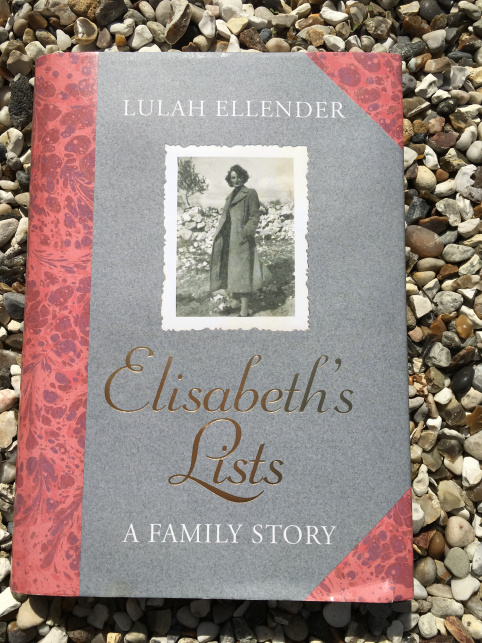
My signed copy of Elisabeth’s Lists: A Family Story by Lulah Ellender

There is a word in Japan for unread books left to pile up around one – tsundoku! I’m guilty of a few tsundoku collections of books; ones bought with well-meaning and tingling anticipation. Somehow they become unintentionally forgotten and lay precariously balanced with other books, dangling over the edge of shelves.

Often treasures of literature are hidden among these and this is the case for one such book which I recently extricated from a listing pile and eagerly I started to read the book.

‘Elisabeth’s Lists’ by Lulah Ellender is a gem! I was hooked from the very beginning and it is incredibly moving and thought-provoking.

The beautifully crafted book is an eloquent memoir based on the life of Lulah’s grandmother. A life recorded in meticulous detailed lists; lists which were entrusted to Lulah by her own mother. 

Elisabeth

The lists started during Elisabeth’s childhood whilst growing up in 1930s China. Just as her father was a diplomat, so was her husband, Gerry and her world travels continued into adulthood. The lists, many innocuous and of everyday items, included information about  packing, dinner parties, price of food and even the names of hens and number of eggs laid.  The lists are endless. A touching heirloom in their own right, they have been transformed into a moving and heartfelt book by Lulah. Her research and dedication are superlative and the end result is a sweeping and engrossing story of Elisabeth’s life.

Postings abroad included Madrid under Franco’s  regime, post-war Beirut and Rio. In sharp contrast Elisabeth endured the hardship and deprivation of bombings and food rationing in England during World War Two, whilst at the same time finding a certain peace and harmony as a normal suburban housewife, away from the hectic duties of a diplomat’s wife. Throughout the book the various eras are exquisitely captured and provide a vivid impression of the times.

It was not all a joyous time however, as occasional bouts of depression, some post-natal,  forced Elisabeth to seek medical care and time away from the family. Furthermore, a family tragedy darkened her life.

The author, Lulah Ellender

The book develops into a deeply profound study as Lulah weaves the threads of her own life and that of her mother into the memoir. The three generations of women effectively become the focus of this family story; their lives remarkably intertwined and the memoir gives not only insight and comfort about motherhood, family, and loss to Lulah but also to the reader. 

Even more heartbreaking and poignant is that the book is written whilst Lulah’s mother is terminally ill with the cancer; the very disease which killed Elisabeth when her daughter was only nine-years-old. As Lulah delves deeper into Elisabeth’s life she finds some solace and acceptance in her own life; a process which she describes with exceptional clarity and feeling.

As she must feel, I believe that without our past, our present is unclear, our future unnavigable.

To conclude, ’Elisabeth’s Lists’ is an enriching, gifted and rewarding book and one I highly recommend. 

I just want to add that I had the privilege of briefly meeting the author following a talk in March 2018 as part of Essex Book Festival. Her intelligence, warm and kind nature sparkled and she spoke with ease and confidence at great length without any notes whatsoever! 

RATING: 5 out of 5 stars.

AVAILABLE: From bookshops, libraries, online such as Amazon UK and Amazon US

Finally, if this book seems slightly familiar to you from my blog, I mentioned it briefly in May 2018 in my post Books in the Shingle.

The title page of ‘Elisabeth’s Lists’ with inscription to myself and signed by the author.

A LITERARY ROLL CALL

I thoroughly enjoyed the recent book discussion following my post ‘Reading Across Time’. Thank you for all your wonderful and fascinating suggestions of books to read for the various eras, particularly coming to my aid for pre 1300. 

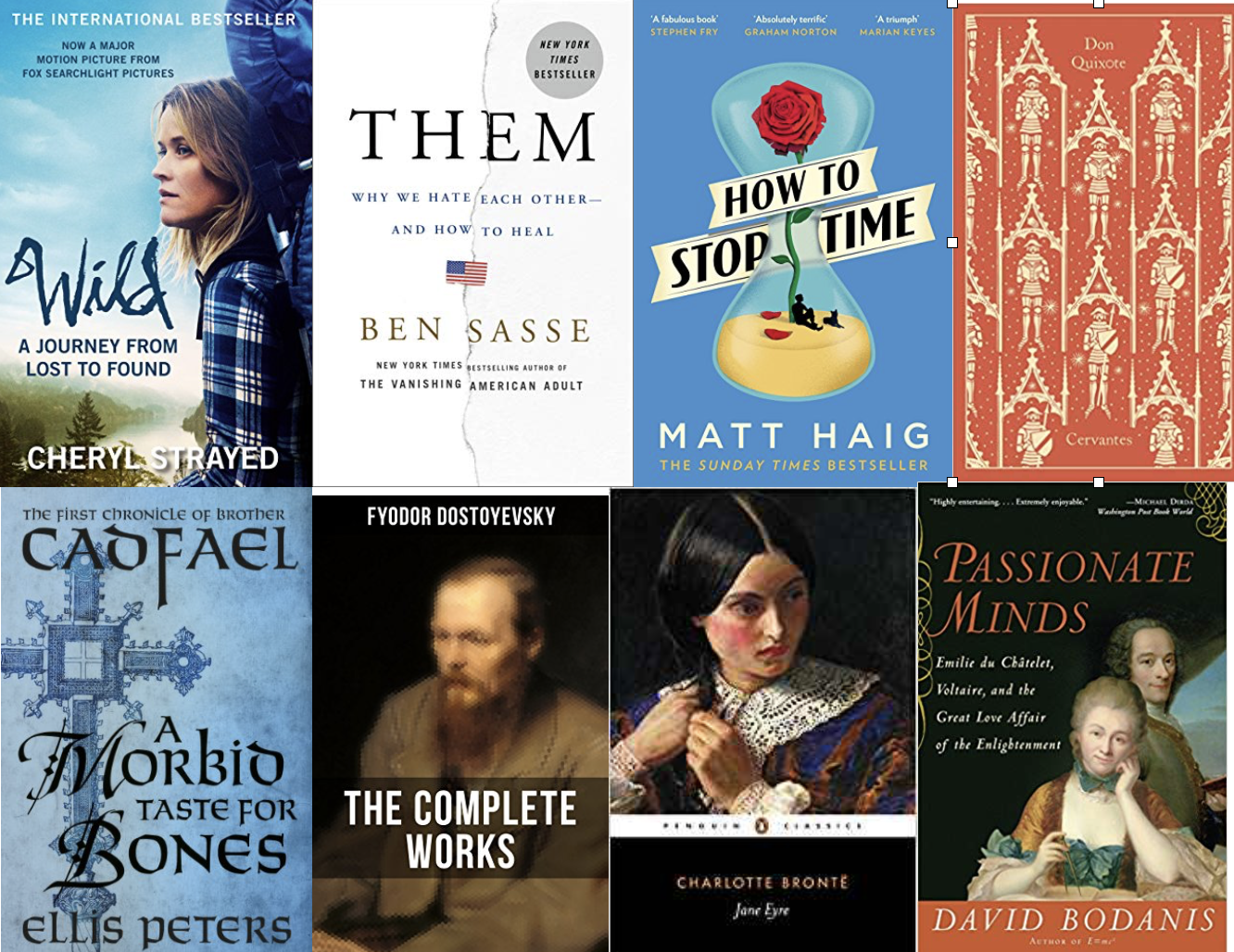
As a list nerd, I’ve collated all the mentioned books as below for your enjoyment and perusal. I’ve also included who suggested the books and, when applicable, added links to their blogs. I feel lucky to have made so many warm and kind friends here on WordPress, happy to share their time and knowledge for an in-depth discourse. 

Please note that since this is a follow-up post comments have been turned off.

Pre 1300

Beowulf by Anonymous. Recommended by Dorothea & Julie Holmes

The Illiad by Homer. Recommended by Sharon Bonin-Pratt

The Odyssey by Homer. Sharon Bonin-Pratt

The Aeneid by Homer. Recommended by Sharon Bonin-Pratt

Edda by anonymous. Recommended by Miriam

The Emigrants by Vilhelm Moberg. Recommended by Miriam

Labyrinth by Kate Moss. Recommended by Andrea Stephenson

Hilary Mantel books. Recommended by Andrea Stephenson

Cadfael Novels by Ellis Peters. Recommended by Clive

The Last Kingdom by Bernard Cornwell. Recommended by Mike

The Valley of Horses by Jean M Auel. Recommended by Jennifer Kelland Perry

The Greenest Branch: A Novel of Germany’s First Female Physician

by P K Adams. Recommended by Jena C. Henry

Born in a Treacherous Time by Jacqui. Recommended by Pamela Wight & Julie Holmes 

1300 – 1499

Decamaeron by Boccaccio. Recommended by Laura Bruno Lilly

1500 – 1699

The Bones of Avalon by Phil Rickman. Recommended by Andrea Stephenson

The Heresy of Dr Dee by Phil Rickman. Recommended by Andrea Stephenson

A Journal of the Plague Year by Daniel Defoe. Recommended by Neil Scheinin

Passionate Minds by David Bodanis. Recommended by Rebecca

Don Quixote by Miguel De Cervantes. Recommended by Nicki Chen

1700 – 1799

Dream of the Red Chamber by Cao XueQin. Recommended by Nicki Chen

1800 – 1899

Sharpe novels by Bernard Cornwel. Recommended by Mike

Dostoyevsky novels by Dostoyevsky. Recommended by Jennifer Kelland Perry

Victorian Secrets 

read by Stephen Fry written by Oscar Wilde. Recommended by Rebecca

Jane Eyre by Charlotte Bronte. Recommended by Khaya Ronkainen

My Heart is Boundless: Writings of Abigail May Alcott, Louisa’s Mother

by Eve LaPlante. Recommended by Bonnie A. McKeegan

1900 – 1919

The Romanov Sisters by Helen Rappaport. Recommended by Rebecca

1920 – 1939

The Devil Aspect by Craig Russell. Reading

1940 – 1959

Youngblood Hawke by Herman Wouk. READ (Barbara & Jennifer)

Auntie Mame by Patrick Dennis. Recommended by Rebecca

Elisabeth’s Lists by Lulah Ellender. READ

A Killer in King’s Cove by Iona Whishaw. Recommended by Debra Purdy Kong

1960 – 1979

1980 – 1999

Little Fires Everywhere  by Celeste Ng. READ (& Jennifer)

Becoming by Michelle Obama. Recommended by Nicki Chen

2000 – Present

This is Going to Hurt by Adam Kay.  READ (& Mary Smith)

The Sleepwalker by Chris Bohjalian. Recommended by Nicki Chen

The Waiting Room by Emily Bleeker. Recommended by Glynis Jolly

Whispers by Dean Koontz. Recommended by Glynis Jolly

Bad Blood: Secrets and Lies in a Silicon Valley Startup

by John Carreyrou. Recommended by Mary Ann Niemczura

Them by Ben Sasse. Recommended by Mary Ann Niemczura

Marlie by Anneli Purchase. Recommended by Lori Virelli

Watching the Daisies: Life Lessons on the Importance of Slow

by Brigid P Gallagher. Recommended by Bonnie A. McKeegan

Wild: A Journey from Lost to Found by Cheryl Strayed. Recommended by Bonnie A.McKeegan

The Future

Fantasy / Other Worlds (an excellent additional era suggestion from Pamela Wight)

Books by D. Wallace Peach. Recommended by Pamela Wight

Finally:

A couple suggested How to Stop Time by Matt Haig – which covers many of these eras. Recommended by Josie Dom & Mackay