
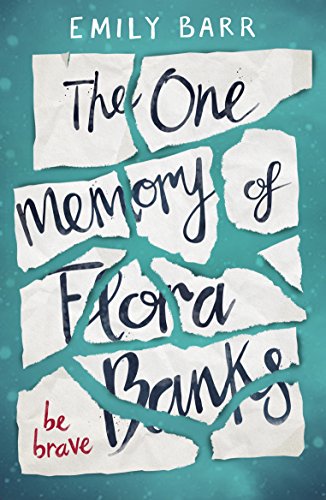
This is a book that shouldn’t work. But it does so brilliantly. The One Memory of Flora Banks tells the story of Flora, a girl with no recent memory and who astonishingly is the sole narrator. As she faces the world and herself anew every few hours the reader quickly becomes as one with Flora and her confusion, despair and growth.
As a result of treatment for a brain tumour at the age of ten Flora Banks has anterograde amnesia. The seven years following the operation are a void to her although she remembers much of the first decade of her life, especially her parents, her best friend, Paige and her brother Jacob. However each day she’s startled by her older self, family and friends as she wakes to fear what is happening, what has happened. No wonder she has ‘Flora, be brave’ written on one of her hands.
Writing is one form of survival for Flora as she seeks to navigate her disjointed life and for her aid, she covers her hands and arms with words to remind her of her life, events, people. She also keeps a detailed notebook throughout the days which becomes vital for her sanity and further notes direct her to the book.
 This is Flora’s life until one day something amazing occurs – she kisses a boy on the beach and remembers it! The boy is called Drake and also Paige’s boyfriend. This pivotal event transforms Flora’s life and she will do anything to chase her memory of Drake – even to the extent of travelling to the Artic alone in search of him. Her one and only memory in seven years. She’s sure he holds the key to her future self.
Memory forms not only ourselves and our lives but is also critical in storytelling with a beginning, a middle and an end. The One Memory of Flora Banks is unique in that the past, present and future become the now and along with Flora we face each new moment with a tangible sense of fear and anticipation. Her bewilderment and turmoil are brilliantly conveyed and the reader immediately mirrors the unpleasant surreal sensation of her existence. Life becomes akin to a waking dream, at times nightmarish, at times exquisitely beautiful. Whilst Flora’s life in Penzance is written with a more concrete grounding in reality, her time in Spitsbergen gains a stunning dreamlike quality whilst her new-found friends remind her about themselves and herself, helping her, losing her as she chases Drake further.
 Unlike Flora, the reader has one major advantage – memory! With this ability, the brave, tenacious and surprisingly whimsical nature of Flora shines through and the remote location in the frozen depths of the Artic takes prominence, the bleak white landscape a metaphor of Flora’s blank spaces where her memories should reside. Gradually a more complete picture of her life is created, how her parents dealt with her illness, how her brother wanted her to have a more free, less protected life. His belief in her strength and ability to do anything is the driving force that carries her closer to Drake. But will she ever find him? Will it help her recover her memory?
This is a book that lived with me through the days even when not reading and to which I couldn’t wait to return to every evening. Its magical enchanted feel fluttered like lilting music over me, the absolute unknown a welcome break from formulaic writing.
Why on earth it is marketed under the YA (Young Adult) category beggars belief. This is truly a disservice to a superb book which would be loved by readers of all ages, so please don’t be put off by this pigeonholing.
This is a wonderful unexpected unusual book which will delight you with its story, its originality and its deft and clever execution; I really can’t recommend this highly enough.
 I received a free copy of this book from NetGalley in exchange for an honest and impartial review.
Rating: 5 out of 5 stars.
Publisher: Penguin
Price: £ 3.99 Kindle UK
$ 4.39 Paperback US







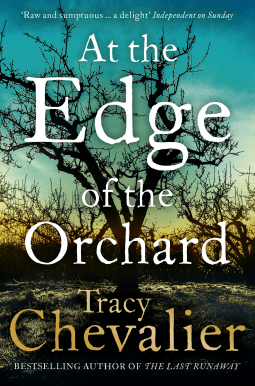
 As a huge fan of her earlier books, particularly Girl with a Blue Earring and The Last Runaway, I was positively giddy to be approved by HarperCollins to review her latest creation, At the Edge of the Orchard. I started reading with a great sense of anticipation.
 Constant war reigns between James and Sadie Goodenough in Ohio in 1838 and onwards as they struggle to turn the inhospitable and aptly named Black Swamp into a successful apple orchard. To James, son of an eminent apple farmer in Connecticut, apples and their trees are an obsession and are treated with reverential care and none more so than his beloved Golden Pippen, a sweet-tasting ‘eater’.
  Meanwhile, his wife Sadie seeks solace from the misery of her life, her losses, in the applejack cider which is made from fresh ‘spitters’ apples.
 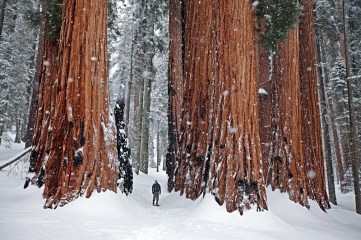 Whilst the first section of the book deals deftly with details of apple grafting, growth, picking, the second section centres around the grand sequoia of California and of Robert’s life with them. The description of the sequoia that Robert first encounters is awe-inspiring and I can visualise the whole scene exactly.
 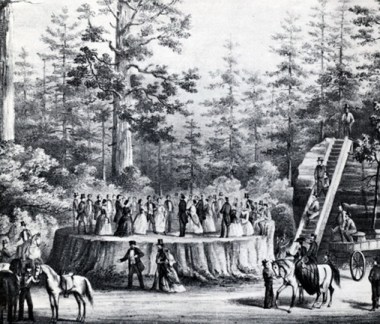 Throughout the book, Tracy Chevalier expertly weaves fact with fiction, including the then recently discovered Calaveras Grove in California. Billie Latham built the infamous stage on the stump of first giant sequoia, named The Discovery Tree, to be cut down at the Grove. As a tree agent, Robert becomes responsible under William Lobb to collect seeds and saplings to send to James Veitch, an English nurseryman for the stately homes in the UK.
 Annika Perry